Your speed test is lying to you, and here is the chart that proves it
30 August 2026
We've been collecting customer reviews of Australian broadband providers since 2004. Every review comes from a real person who has used the service, not a paid reviewer. The database currently holds 1,319 reviews across Australian NBN, wireless and satellite providers. The top rated provider right now is Aussie Broadband, scoring 4.5 out of 5 from 40 ratings in the last 36 months. The site is independent and earns its keep through affiliate links to a handful of partners, marked with a "Partner" badge wherever they appear. We only partner with providers we'd recommend to a mate.
| 1 |
 Partner |
Speedy Max
500 Mb/s
Unlimited data
|
$59.90/mth
$92.90 after 6 months |
Get this plan |
| 2 |
 Partner |
Extra Value
50 Mb/s
Unlimited data
|
$69/mth
$89 after 6 months |
Get this plan |
| 3 |
 Partner |
Fast Fibre - nbn 500/50
500 Mb/s
Unlimited data
|
$79/mth
$99 after 6 months code SPRING20 |
Get this plan |
| 4 |
 Partner |
One Plan
500 Mb/s
Unlimited data
|
$80/mth | Get this plan |
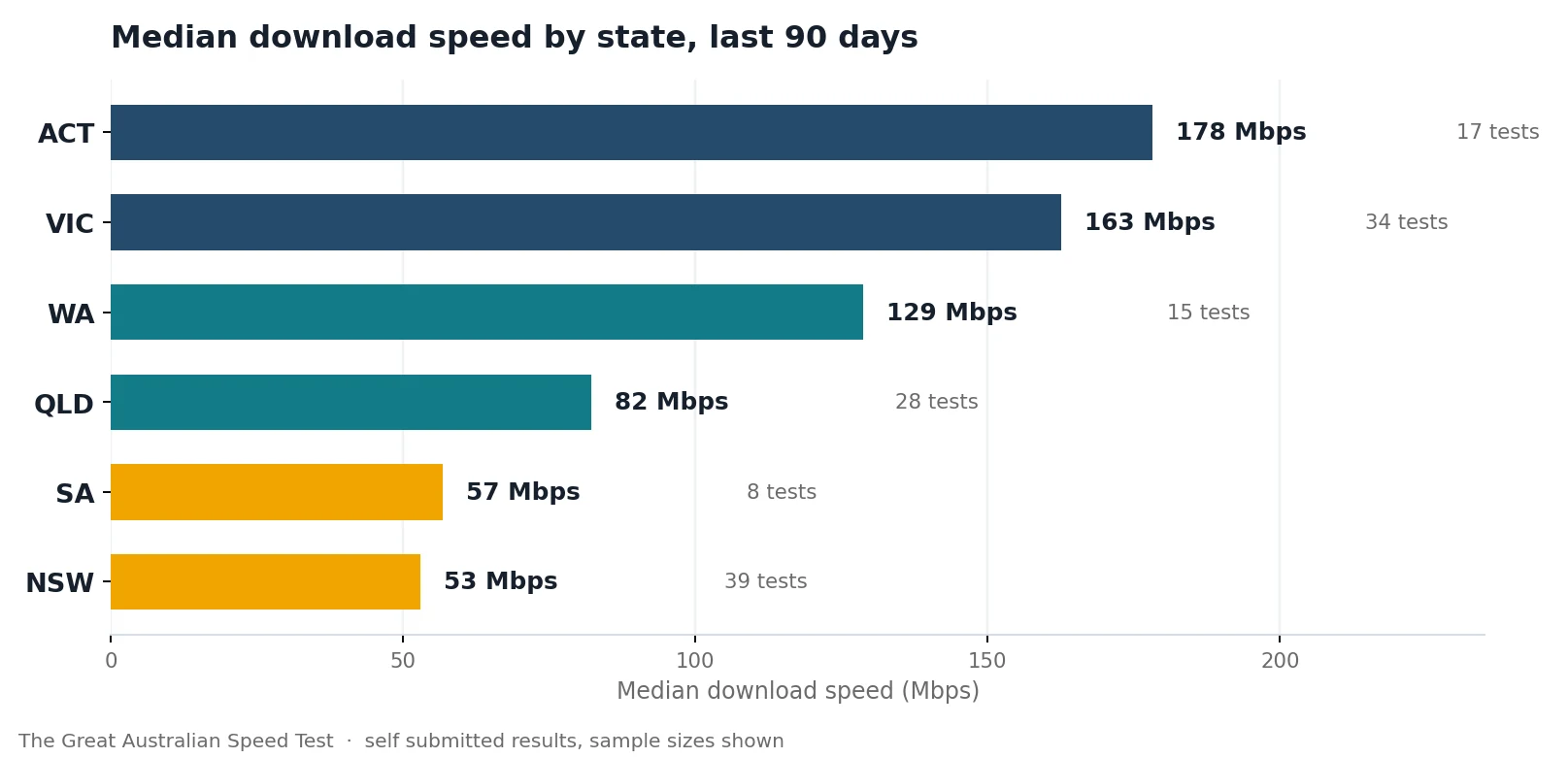
The Great Australian Speed Test
How does your internet rank?
Test your connection and see how it stacks up against other Australians on the same plan and the same technology, from 128 results. Twenty five seconds, no signup.
Enter the details of your current broadband or NBN plan and we will show you how much money you can save.
The cheapest, dearest and average monthly price we can find for every NBN fixed line speed tier. Same scale on every row, so you can see how much you really pay to move up a tier, and how wide the gap is between providers selling the identical connection.
Residential NBN fixed line plans only, so fixed wireless, Sky Muster and private fibre are left out. Prices are the ongoing monthly cost, not an introductory rate. Speeds are the typical evening speed providers publish under ACCC guidelines, which is why a few plans sit in a lower band than their marketing name suggests. Compare every NBN plan →
The NBN has six main speed tiers, named after their typical evening download speed in Mbps. NBN12 (basic, mostly used for VOIP phone lines only), NBN25 (light browsing and HD streaming), NBN50 (the most popular tier, fine for a family of three or four), NBN100 (multiple devices streaming and gaming at once), NBN250 (heavy users and 4K households), and NBN1000 (gigabit, for power users with fibre to the premises). Each tier has a typical evening speed that providers must publish under ACCC guidelines, so the numbers you see should reflect real busy hour performance.
The technology at your address depends on where you live. The main types are: FTTP (fibre to the premises, the gold standard, around 17% of connections), HFC (cable, mostly in metro Sydney, Melbourne and Brisbane, around 19%), FTTC (fibre to the curb, around 7%), FTTN (fibre to the node, the most common at around 31%), Fixed Wireless (for outer suburbs and regional towns, around 5%), and Sky Muster (satellite, for very remote areas). The fastest way to check yours is the NBN Co address checker at nbnco.com.au.
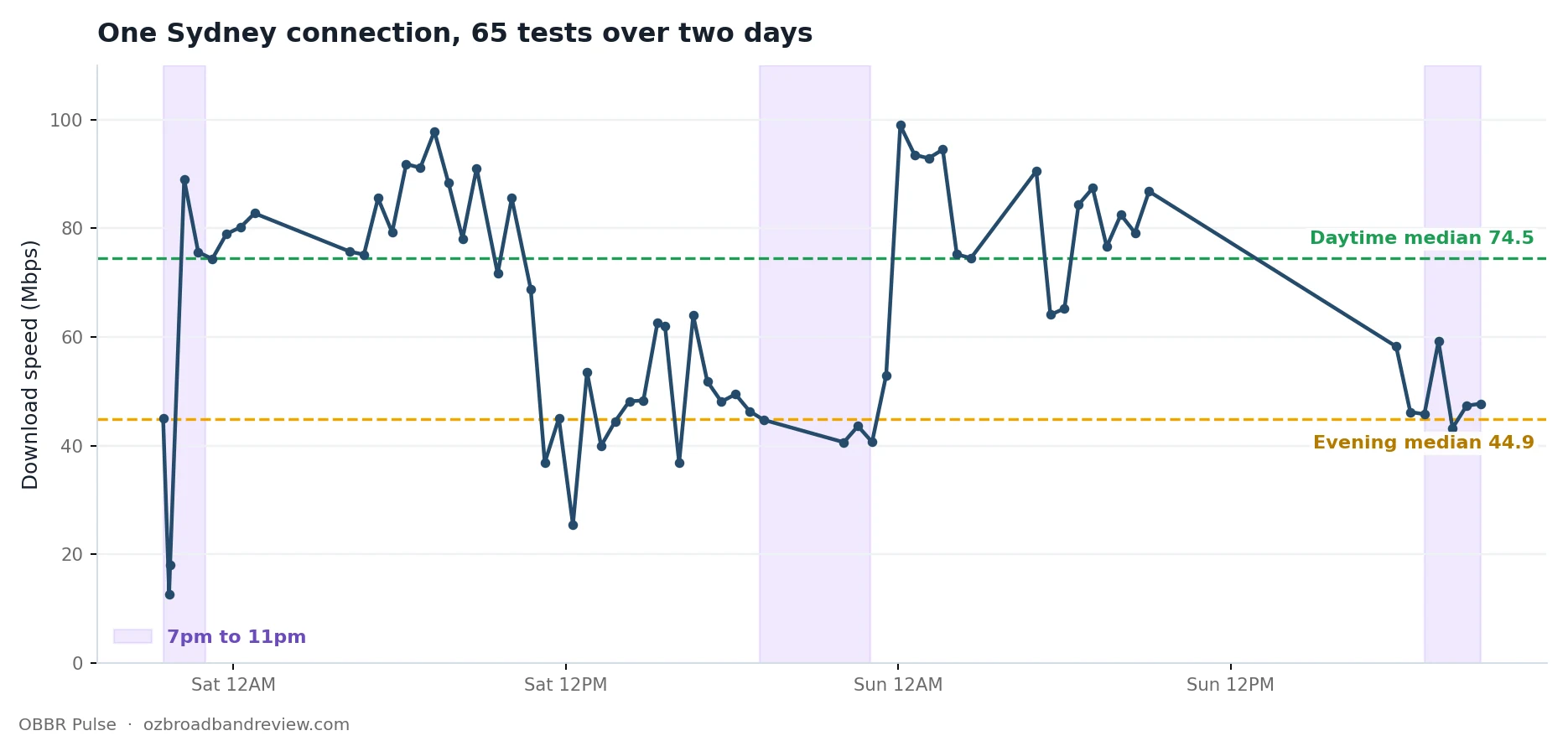
Evenings between roughly 7pm and 11pm are the busiest time on the NBN, when most households are streaming, gaming and video calling at once. Your provider buys a fixed amount of network capacity from NBN Co (called CVC), and at peak times that capacity gets shared more aggressively across customers. Smaller, well managed providers like Aussie Broadband and Superloop tend to buy generous CVC and slow down less than budget brands at peak. If your evening speed is way below your daytime speed, the provider's CVC capacity is usually the bottleneck.
5G home internet is fast, often genuinely faster than NBN50 or NBN100 in good coverage areas. Telstra, Optus and TPG all offer plans. The catch: 5G speeds depend heavily on how close you are to the tower and how many other people are using it. NBN speeds are more predictable because the connection comes via a wire to your house. If you're in a 5G coverage area and your NBN is on FTTN (the slower copper based variant), 5G can be the better choice. If you're on FTTP NBN, NBN is hard to beat.
Yes, but the technology has changed. Your old landline runs over copper or fibre to your NBN modem rather than the historical phone network (the PSTN was switched off in most areas by 2020). Most NBN providers either bundle a "home phone" VOIP service or let you plug your existing handset into the modem's phone port. The main difference for you: if the power goes out, your phone goes out too, because the modem needs power. Worth keeping a charged mobile phone for emergencies.
For the speeds we get, Australian NBN is more expensive than most developed countries. ACCC data shows the average Australian household pays around $75 to $90 a month for NBN50. South Korea and Japan offer gigabit speeds for the equivalent of around $30 a month. France, Spain and Singapore have full fibre to most premises and cheaper plans. The reasons are a mix of geography (we're a big country with low population density), the political decision to build a mixed technology NBN rather than full fibre, and the wholesale pricing structure NBN Co charges providers.


Write a review of your broadband company to go in our draw to win a $100 Amazon Gift Card!
Read the competition details and terms.
Add a review