Last updated: 21 August 2026
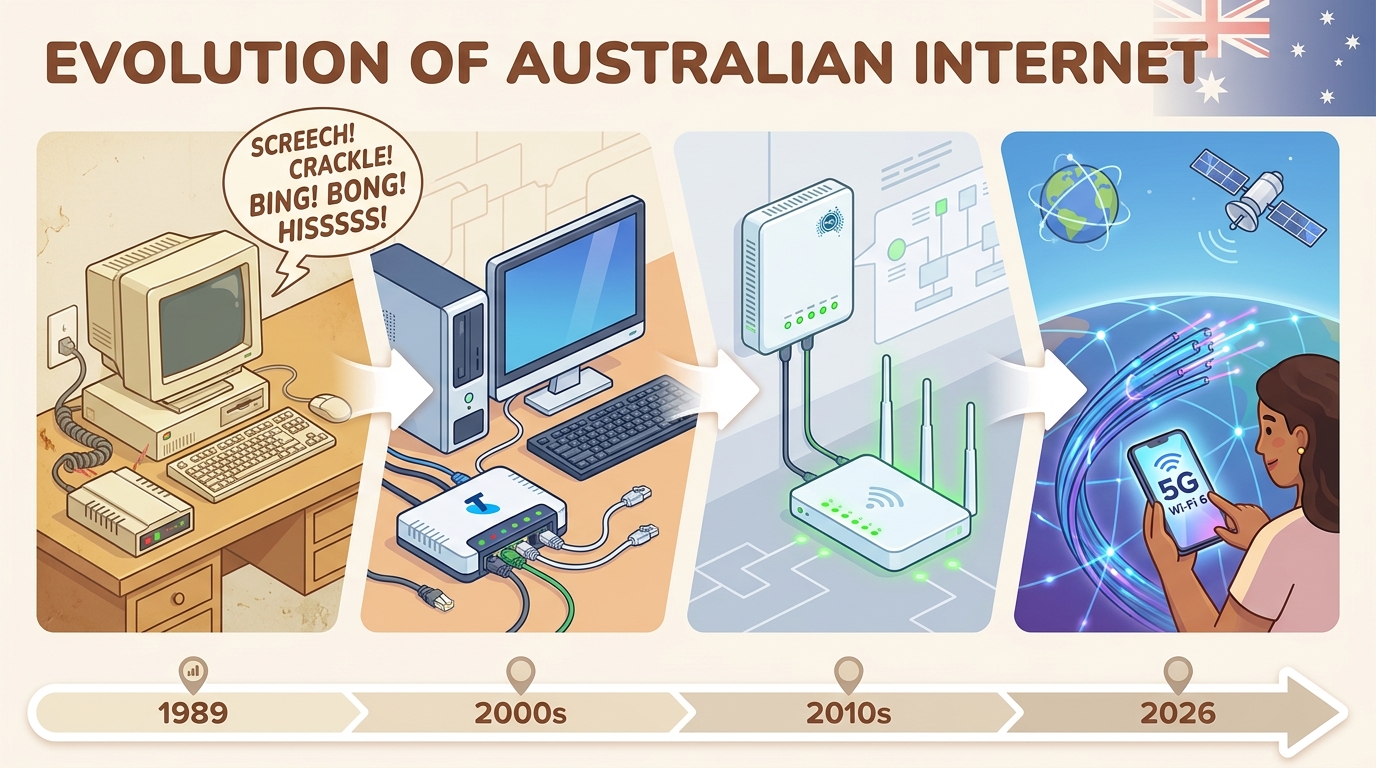
In 1989, Australia was first connected to the internet through the University of Melbourne. At that time, the internet mostly consisted of computer scientists communicating between major universities. Even the fastest connections between major cities in Australia were limited to less than 50kbps. With 128kbps considered the absolute lowest acceptable bitrate for music files today, Australia didn’t have the capacity to stream a single music file over its national backbone network links.
Today the NBN offers gigabit connections, and from 2024, a 2 Gbps (NBN 2000) tier, directly to homes and businesses. The average Australian household now downloads over 540 GB of data per month, with 5G home wireless and Starlink satellite filling the gaps in places NBN fibre doesn’t reach. This is a timeline of Australia’s journey with the internet, from its 1989 inception through to 2026.
Wi-Fi 7 and NBN 2000 go mainstream
Wi-Fi 7 routers become widely available in Australia and NBN 2000 (2 Gbps) reaches more FTTP-served suburbs. Starlink has over 7,000 satellites in orbit globally with strong Australian coverage including the Mini home unit.
Free FTTP upgrade hits 2 million Australian homes
NBN Co's free FTTP upgrade program (running since 2020) crosses 2 million upgraded homes. FTTN copper is gradually phased out in favour of fibre across most metropolitan and regional areas.
NBN 2000 launches and Starlink crosses 200,000 Australian customers
NBN Co releases its 2 Gbps speed tier (NBN 2000) for FTTP customers, the fastest residential plan available in Australia. Starlink satellite internet passes 200,000 Australian subscribers, providing high-speed alternatives to NBN Sky Muster for rural Australians.
5G home wireless becomes a real NBN alternative
Telstra, Optus, TPG and Vodafone all sell 5G home wireless plans by 2023. Adoption crosses 500,000 households as 5G coverage expands to most major Australian regional centres.
NBN Co launches free FTTP upgrade program
NBN Co announces that millions of homes on FTTN and FTTC connections become eligible for free upgrades to full fibre when they order a higher speed plan. The biggest single broadband infrastructure boost since the NBN rollout began.
NBN 90% complete
Stephen Rue (CEO of NBN Co.) announcd the NBN rollout is 90% complete in February 2022.
Australia’s first 5G network
Telstra launched Australia’s first 5G network. 5G has a theoretical maximum speed of 10Gbps, but Australia’s 5G network still struggles to reach 1Gbps even in our biggest cities.
FTTC added to NBN rollout
Fibre To The Curb (FTTC) is added to the mix of technologies in the NBN rollout.
Netflix reaches Australia
By the end of 2015, Australia was still one of only 50 countries with Netflix access. In 2017, this would grow to 190 countries.
NBN Rollout changed to multi-technology mix
The Liberal/National Coalition replaced the Labor government in the 2013 federal election. They changed the planned FTTP NBN rollout to make use of a mix of technologies.
Australia’s first 4G smartphone
Telstra launched Australia’s first 4G-compatible smartphone, the HTC velocity 4G. 4G offers download speeds of up to 150Mbps.
Telstra privatisation complete
The federal government sold the last of its remaining Telstra shares, ending it’s three stage privatisation plan.
NBN Co. Established
Initially, the NBN rollout was expected to be reach completion by 2021 with 93% of homes connected through an FTTP connection.
First Android phone released in Australia – HTC Dream
Android phones are generally more affordable than iPhones and helped bring the internet to the pockets of many Australians.
Google Chrome Web Browser released
Today, Chrome has a 65.5% market share making it the most popular web browser by far.
iPhone launched in Australia
The iphone bought the internet to the mobile phone and gave Australians one of the first usable handheld devices to browse the web on.
Labor party wins federal election
The election platform of the labor party in 2007 included the rollout of a National Broadband Network (NBN) expected to begin before the end of 2008.
AARNet begins work on its second backbone network
The second AARNet national backbone network (AARNet2) was built in collaboration with Optus.
Firefox launched
Mozilla launches the Firefox Web Browser, achieving more than 100 million downloads in the first year
Gmail Launched
Today, Gmail has a market share of 28%, making it the second most popular email client behind Apple Mail.
Australia’s first 3G network
Hutchison launched Australia’s first 3G network, covering 96% of the population. 3G has a maximum download speed of 42Mbps
ADSL2 Introduced
ADSL2 allowed for download speeds of up to 24Mbps, compared to the 2Mbps of ADSL1.
Stage 2 of Telstra’s privitisation plan
The commonwealth government sold another 16% of Telstra’s shares in the second stage of its transition to full private ownership.
Telstra launches first retail ADSL service
Telstra’s initial rollout of ADSL was limited to 1.5Mbps. However, speeds of up to 6Mbps through ADSL had already been demonstrated in Australia by Telecom Research Labs.
Google launched
Google search engine officially launched by Stanford Students Larry Page and Sergey Brin
IRC Created
Jakko Oikarinen created IRC (Internet Relay Chat) to be part of a BBS for the University of Oulu. It grew rapidly, and by 1989 there were already 40 IRC servers worldwide.
Telstra begins selling shares
The Commonwealth sold 33% of its Telstra shares, the first of three stages in a transition to full private ownership.
Bigpond launched
Telstra launched Bigpond and used it to distribute wholesale cable internet access.
AARNet1 sold to Telstra
Telstra took on responsibility for managing the existing AARNet network and operated it as Telstra Internet. AARNet1 was Australia’s first national backbone network and permanent connection to the global internet.
Yahoo! launched
Jerry Yang and David Filo launch Yahoo!, offering various services including e-mail and a search engine
Netscape Navigator Launched
Known as Mosaic at the time, the browser was released by Mosaic Communications Coorporation (now known as Netscape Communications Coorporation)
Mosaic web browser released
Tim Berners-Lee created the Mosaic web browser, the first truly user-friendly, graphical web browser. It introduced many of the layout standards which continue today and was the first web browser to display images alongside text in a web page.
First cable-modems
Rouzbeh Yassini founded LANCity, creating the first cable-modems capable of high-speed data transfer over coaxial cables. Today, cable interent provides speeds of up to 500Mbps.
AARNet National backbone established
the AARNet national backbone connected Universities across the country to a central hub at the University of Melbourne. Each link supported speeds of up to 48kbps.
First Australian ISP
Pegasus begun offering dial-up internet (56Kbps) as a commercial service in major cities, becoming Australia’s first ISP.
World Wide Web Established
Though mostly unimportant at the time, Tim Berners-Lee created the World Wide Web. This is the set of protocols used today for exchanging documents and other web resources over the internet.
AARNet Established
The Australian Academic and Research Network (AARNet) was launched by the Australian Vice-Chancellor’s Committee (now Universities Australia). It established Australia’s first long-term connection to the global internet.
ARPANET adopts TCP/IP
ARPANET Adopts a new internet protocol suite based on the specification published in 1974. It was called TCP/IP (Transfer Control Protocol / Internet Protocol), and set a standard which continues today.
ACSNet Launched
The Australian Computer Science network connected Australian universities to each other and to ARPANET using a store-and-forward message handling system.
First BBS Created
Ward Christensen and Randy Suess launch CBBS (Computerised Bulletin Board Systems), making it the first public dial-up BBS.
First fibre-optic network
Fibre-optic cables used to link a network of computers together in the NORAD (North American Aerospace Defense Command) headquaters in Colorada, USA.
TCP/IP precursor published
DARPA scientists Vint Cerf and Bob Kahn publish ‘Specification or Internet Control Protocol’, a formal specification of a protocol for internetwork communication using packet switching.
ARPANET Established
The Advanced Research Projects Agency Network (ARPANET) was established by the United States Department of Defence and introduced many of the internet standards we continue to use today. It is an early example of a large scale packet-switched networks.
CSIRONET established
The CSIRO division of computing research established a national network of dial-up and low-speed leased line connections called CSIRONET.
Reading back through three decades of dial up, ADSL and the NBN rollout, the obvious question is what decent internet costs now. Here is the current crop of cheap unlimited NBN plans.
Frequently asked questions about Australian internet history
When did internet first come to Australia?
1989. Australia’s first internet connection was made through the University of Melbourne, linking to ARPANET via the United States. At that time the network was limited to academics and computer scientists, with backbone speeds under 50 kbps. Slower than a single MP3 stream today.
Did Australia invent Wi-Fi?
The key patent for the technology that became modern Wi-Fi (the wireless LAN standard) was developed by Australia’s CSIRO in the early 1990s. The CSIRO team led by Dr John O’Sullivan solved the multipath interference problem that made indoor wireless networks unreliable. CSIRO went on to win major patent settlements against Wi-Fi chipmakers, with the technology now used in every Wi-Fi device on the planet. So yes. The foundational Wi-Fi technology was invented in Australia.
Did Australia invent the internet?
No. The internet as a packet-switched network grew out of ARPANET in the United States (started 1969). Australia connected to ARPANET in 1989 via the University of Melbourne. But Australia did invent Wi-Fi, the wireless networking technology used in billions of devices today.
When did dial-up internet end in Australia?
Dial-up internet faded through the mid-2000s as ADSL broadband replaced it. By 2010 dial-up was effectively dead for households. Telstra continued offering dial-up as a back-up service for rural customers into the 2010s, but by 2020 it had been retired in favour of mobile broadband and NBN Sky Muster satellite.
What is the fastest internet in Australia today?
The fastest residential plan available in Australia in 2026 is NBN 2000. A 2 gigabit per second tier, only available on FTTP connections. The cheapest gigabit (NBN 1000) plan is Tangerine’s Speedy Max at $88.90/month. See our fastest NBN plan guide for the full picture.
What was the first broadband internet in Australia?
Cable internet (Optus@Home and Telstra BigPond Cable) launched in 1996, followed by the first widespread broadband, ADSL, rolled out by Telstra in 2001. ADSL replaced dial-up for most Australians through the mid-2000s.
When did NBN start in Australia?
The NBN project was announced in 2009 by the Rudd Labor government. Construction started in 2011, the rollout was substantially completed by 2020, and the network continues to be upgraded. Most recently with the NBN 2000 tier (2024) and the free FTTP upgrade program (running since 2020, reached 2 million homes by 2025).
Who were the first internet providers in Australia?
Australia’s first commercial internet providers in the early 1990s included Connect.com.au (1992), OzEmail (1992), and Pegasus Networks. Telstra entered the consumer ISP market in 1995 with its BigPond service. iiNet (founded 1993) and Internode (founded 1991) became major early competitors that eventually merged into the TPG Telecom group decades later.
Related guides
From dial-up prices to today’s plans
Reading a 37 year timeline is one thing; paying for internet in 2026 is another. If the history has you wondering whether your current plan is still good value, our best NBN plans page shows the current picks at every speed tier and the affordable NBN plans list tracks the cheapest unlimited options, both updated daily from our database.