Last updated: 22 August 2026
Internet terminology can feel like a foreign language. Speed, bandwidth, quota, latency, congestion. What do they all actually mean? The easiest way to understand most of it is to think about water flowing through a pipe. Here’s the analogy that explains the main concepts in plain English.
Connection speed = water flow rate
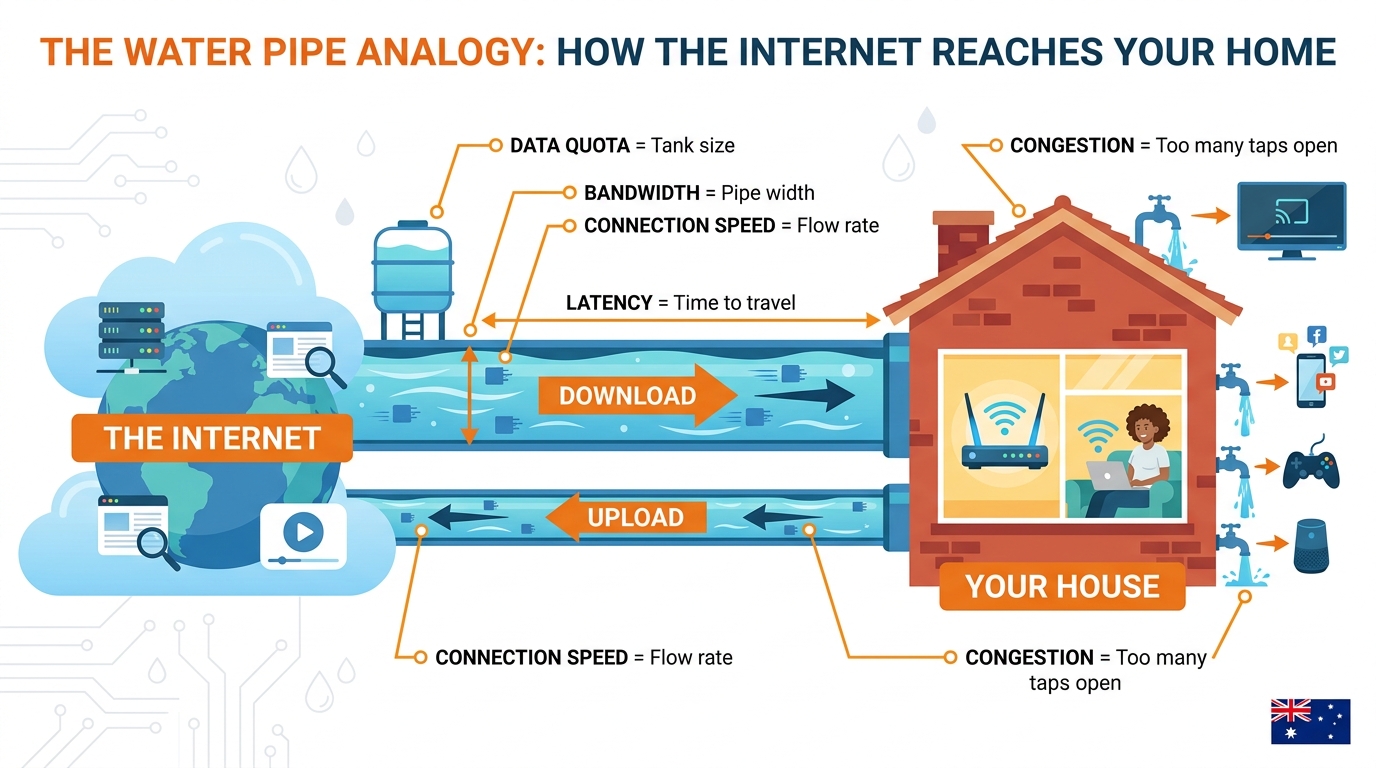
Connection speed is how fast data moves through your internet connection, measured in megabits per second (Mbps). In the pipe analogy, this is the flow rate of the water. How much water comes out of the tap per second. A faster connection (higher Mbps) means more data moves through in the same amount of time, the same way a stronger flow rate fills a glass quicker.
Bandwidth = pipe diameter
Bandwidth is the maximum amount of data your connection can carry at one time. In the analogy, it’s the diameter of the pipe. A wider pipe lets more water flow through at once; a higher-bandwidth connection lets more data through simultaneously. That’s why a 50 Mbps connection can handle multiple people streaming and gaming at once where a 5 Mbps line cannot. The pipe is bigger.
Speed and bandwidth get used interchangeably in marketing, but technically: bandwidth is the maximum, speed is what you actually achieve at any given moment.
Data quota = the size of your water tank
Some internet plans cap how much data you can use per month. That’s the quota. In the analogy, it’s the size of the water tank feeding the pipe. Even if your pipe is huge, you can only use as much water as your tank holds. Run out before the month is up and you might be cut off, or have your speed throttled, depending on your plan.
The good news: in 2026 almost every NBN and 5G home wireless plan in Australia is unlimited as standard. Capped plans still exist on mobile broadband but they’re rare on home internet.
Latency (ping) = how long the water takes to travel
Latency is the time it takes a packet of data to travel from your device to a server and back, measured in milliseconds (ms). In the analogy, it’s the time it takes for water to travel from one end of the pipe to the other. A short pipe (server close to you) has low latency. A long pipe (server on the other side of the world) has high latency.
For everyday browsing it barely matters. For online gaming and video calls it matters a lot. A high-ping connection feels laggy even if the speed is fast. NBN on fibre typically gets 5-15 ms; 5G home wireless sits around 15-30 ms; satellite is much higher.
Network congestion = too much water trying to flow through one pipe
Network congestion is when too many users try to use the same connection at the same time. In the analogy, it’s everyone in your house turning on the tap at once. Each tap gets weaker even though the main pipe didn’t change.
The classic example is the evening peak (8-11pm) when most Australian households are streaming and gaming. Even a fast NBN plan can feel slow if your provider’s network is congested, because you’re sharing the same upstream pipe with everyone else. Switching to a provider with more spare capacity (Aussie Broadband, Superloop, Swoop top the ACCC’s evening speed report) often fixes the problem instantly.
The whole analogy at a glance
| Internet term | Water analogy |
|---|---|
| Connection speed (Mbps) | Flow rate of water out of the tap |
| Bandwidth | Diameter of the pipe |
| Data quota | Size of the water tank |
| Latency / ping | How long water takes to travel through the pipe |
| Network congestion | Too many taps open at once |
| Upload speed | Water flowing back up the pipe (smaller pipe in most homes) |
Frequently asked questions
What’s the difference between bandwidth and speed?
Bandwidth is the maximum amount of data your connection can carry. The diameter of the pipe. Speed is how much data you’re actually moving at any given moment. You can have a wide pipe (high bandwidth) but only a trickle of water through it (slow current speed) if the connection is congested or the source is far away.
What is latency and why does it matter?
Latency (also called ping) is the time it takes for a small packet of data to travel from your device to a server and back, measured in milliseconds. It barely affects everyday browsing or video streaming but matters a lot for online gaming and video calls. High latency feels laggy even on a fast connection. Lower is better. For Australian gaming you ideally want under 30 ms.
Why does my internet slow down in the evening?
Network congestion. Most Australians use the internet between 8-11pm to stream and game, which means everyone on your provider’s network is fighting for the same upstream capacity. Even a fast NBN plan can feel slow during peak hours if your provider hasn’t bought enough wholesale bandwidth. Switching to a provider with better evening speeds (Aussie Broadband, Superloop, Swoop top the ACCC’s quarterly report) usually fixes it.
What’s a good internet speed for my home?
For most Australian households (2-4 people), NBN 50 with unlimited data is the sweet spot. Handles HD streaming, video calls and normal browsing comfortably. Step up to NBN 100 if you have heavier 4K streaming or multiple people working from home simultaneously. See our what speed do you really need guide for the detailed breakdown, or run a free speed test to see what you’re actually getting right now.
Are all internet connections unlimited now?
Pretty much, for home internet. Almost every NBN and 5G home wireless plan in Australia is unlimited data as standard in 2026. The exception is mobile broadband (a 4G/5G SIM in a small modem) where capped plans are still common. A heavy household can blow through a 500 GB monthly cap quickly.
Why is upload speed slower than download?
Australian home internet plans are usually asymmetric. The download “pipe” is bigger than the upload “pipe”. For example, NBN 100 typically gives 20-40 Mbps upload (vs the 100 Mbps download). Cable, FTTP and 5G plans tend to be more upload generous. If you regularly upload large files (video editing, cloud backup, livestreaming) it’s worth checking the upload number on the plan before signing up.