Last updated: 21 August 2026
Here are 30 questions about the internet and broadband for the nerds among us. Use them at the next pub trivia night, run them at the office Christmas party, or just sit down with a cuppa and see how badly you do. There are three themed rounds — internet history, Australia and the NBN, and the weird back-end of how it all actually works. Answers and sources sit at the bottom of the post. No peeking.
Every fact has been checked against a primary source (Wikipedia, CERN, NBN Co, ICANN, you get the idea) and the source URLs are listed with each answer. If you spot a mistake, we owe you a beer.
Before you start: scoring

One point per question. No half marks. If you have to phone a friend you score zero for that one. If you’re using this at a real trivia night, give each team a sheet of paper and 60 seconds per question.
Round 1 — The history of the internet
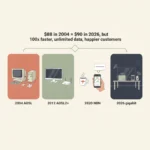
The cheating timeline below covers most of what’s in this round. Don’t look at it while you’re taking the quiz, you absolute legend.

- What year was the first message sent over ARPANET, the precursor to the internet?
- The first ARPANET message was supposed to spell out a word, but the system crashed after two letters. What were those two letters?
- Sir Tim Berners-Lee invented the World Wide Web in 1989 while working at which European research organisation?
- What was the very first webcam on the internet pointed at, in 1991 at the University of Cambridge?
- What does HTTP stand for?
- Larry Page and Sergey Brin launched Google in which year, while both were PhD students at Stanford?
- What was the title of the very first video uploaded to YouTube, on 23 April 2005?
- The first commercial email spam in history was sent on ARPANET in 1978. It was sent by a marketing manager at which computer company?
- What does HTML, the basic language of every webpage, stand for?
- The very first website, still online today, hosted what kind of content?
Round 2 — Australia and the NBN
- Australia connected to the global internet for the first time in June 1989, via a satellite link to which American university?
- What does the acronym NBN stand for?
- Which Australian Prime Minister announced the NBN in April 2009?
- Which three small Tasmanian towns were the first communities to get a live NBN connection in August 2010?
- The NBN was originally promised to be 100% fibre to the home. The Coalition Government later switched it to a “multi technology mix”. How many different NBN technologies are in that mix today (counting Sky Muster satellite)?
- What does the acronym FTTP mean in the context of NBN connections?
- Roughly what percentage of Australian premises can today connect to the NBN?
- What’s the name of the government owned wholesale operator that runs the NBN?
- As of 2026, what is the fastest residential NBN speed tier you can order from a retail provider?
- The NBN’s fixed wireless network exists for premises that can’t get fibre. Roughly how many Australian premises does fixed wireless currently serve?
Round 3 — Speeds, specs and other weird stuff
- What does Wi-Fi actually stand for?
- The theoretical maximum speed of the Wi-Fi 7 standard, with all the antennas turned on, is how many gigabits per second?
- Roughly how many Starlink satellites are in orbit as of May 2026?
- What special IP address always means “this computer” (the loopback address)?
- What does the “S” in HTTPS stand for?
- Light travels through fibre optic cable at roughly what percentage of the speed of light in a vacuum?
- “Ping” in networking measures what?
- The smallest unit of data is the bit. Eight of them make one of these. What’s it called?
- What’s the official scientific term for the @ symbol that you tap when you type an email address?
- What does the C in CVC stand for, in the context of NBN wholesale capacity that retailers buy from NBN Co?
If you’re running this at a real trivia night
A few notes for the trivia host. The 30 questions split cleanly into three 10 minute rounds. Throw in a 5 minute break between each round to argue about answers and rebuild the round 1 dynasty that one team is building. Project the scoring rubric and timeline on the screen at the start of each round — they double as a warm up and a soft cheat sheet. Make round 3 a tiebreaker if you need one; questions 27 to 30 reward the engineers and the showoffs.
Answers (with sources)
Stop scrolling if you haven’t finished the quiz. Last chance.
Round 1 — The history of the internet
- 1. 1969. The first ARPANET message was sent on 29 October 1969 at 10:30 PM from a computer at UCLA to one at Stanford Research Institute. Source: Wikipedia — ARPANET.
- 2. “L” and “O”. Student programmer Charley Kline tried to type “LOGIN” — the system crashed after the second letter. The first ever transmission over the internet’s ancestor was therefore “LO”. Source: ICANN blog.
- 3. CERN. Tim Berners-Lee was working at the European Organisation for Nuclear Research (CERN) in Switzerland when he proposed the Web in March 1989. The first website went live in 1991. Source: CERN — The birth of the Web.
- 4. A coffee pot. The “Trojan Room coffee pot” at Cambridge University’s Computer Laboratory was the world’s first webcam subject. Researchers set it up so they wouldn’t have to walk down the hall to check whether the pot was empty. Source: Wikipedia — Trojan Room coffee pot.
- 5. Hypertext Transfer Protocol. The protocol every web browser uses to fetch pages from a server. Source: MDN Web Docs.
- 6. 1998. Google was incorporated on 4 September 1998, in a garage in Menlo Park, California. Source: Google — Our story.
- 7. “Me at the zoo”. A 19 second clip of YouTube cofounder Jawed Karim standing in front of the elephants at San Diego Zoo, uploaded on 23 April 2005. Source: Wikipedia — Me at the zoo.
- 8. Digital Equipment Corporation (DEC). Gary Thuerk, a marketing manager at DEC, sent the first ever commercial spam email to 393 recipients on ARPANET on 3 May 1978. Source: Wikipedia — History of email spam.
- 9. Hypertext Markup Language. The basic markup language that describes every webpage. Source: MDN Web Docs — HTML.
- 10. Information about the World Wide Web itself. The first website, info.cern.ch, was a basic page that explained what the Web was and how to use it. The original is still available. Source: info.cern.ch — original website.
Round 2 — Australia and the NBN
- 11. University of Hawaii. The first Australian internet link went live on 23 June 1989 — a 2400 bit per second satellite connection between the University of Melbourne and the University of Hawaii, run by Robert Elz of UniMelb. Source: AARNet — Our history.
- 12. National Broadband Network. Source: Wikipedia — NBN.
- 13. Kevin Rudd. Then PM Kevin Rudd announced the NBN with Communications Minister Stephen Conroy on 7 April 2009. Source: Wikipedia — History of the NBN.
- 14. Scottsdale, Midway Point and Smithton. The three Tasmanian communities went live in August 2010 as the first NBN customers in Australia. Source: NBN Co media release.
- 15. Seven. FTTP (fibre to the premises), FTTC (fibre to the curb), FTTN (fibre to the node), FTTB (fibre to the building), HFC (hybrid fibre coaxial), Fixed Wireless, and Sky Muster Satellite. Source: NBN Co — Network technology.
- 16. Fibre To The Premises. The gold standard NBN connection — full fibre all the way to a box mounted on or inside your house. Source: NBN Co — FTTP explained.
- 17. Roughly 98%. NBN Co reports that about 98% of Australian premises are now able to connect to the network. Source: NBN Co — About.
- 18. NBN Co. The wholesale operator is government owned and sells access to over 100 retail service providers. Source: NBN Co — About.
- 19. NBN 2000 (Home Ultrafast). The Home Ultrafast tier on FTTP and HFC offers wholesale speeds up to 2 Gbps download. Source: NBN Co — Speed tiers.
- 20. Around 700,000 premises. Fixed Wireless serves about 700,000 premises mostly in outer regional and rural Australia. Source: NBN Co — Fixed Wireless.
Round 3 — Speeds, specs and other weird stuff
- 21. Nothing. “Wi-Fi” is not an acronym. It was made up by brand consultancy Interbrand in 1999 as a catchier name than “IEEE 802.11b Direct Sequence”. The phrase “Wireless Fidelity” was made up later by a Wi-Fi Alliance slogan and quickly dropped. Source: Wikipedia — Wi-Fi etymology.
- 22. 46 Gbps. The theoretical peak for Wi-Fi 7 (IEEE 802.11be) is 46 Gbps with 16 spatial streams and a 320 MHz channel. Your phone will never see this in practice. Source: Wikipedia — Wi-Fi 7.
- 23. Roughly 10,400. As of mid May 2026, Jonathan McDowell’s tracking shows around 10,400 active Starlink satellites in orbit, of about 12,000 ever launched. Source: Jonathan McDowell — Starlink statistics.
- 24. 127.0.0.1. The IPv4 loopback address always means “the computer I’m typing on right now”. Hostname alias: localhost. Source: Wikipedia — localhost.
- 25. Secure. HTTPS = Hypertext Transfer Protocol Secure. The “S” indicates the connection is encrypted using TLS. Source: MDN Web Docs — HTTPS.
- 26. About 67%. Light moves at about 200,000 km/s through fibre optic cable, against 300,000 km/s in a vacuum, due to the refractive index of the glass core. Source: Wikipedia — Optical fiber.
- 27. Round trip latency. Ping measures how long it takes a small packet to travel to a destination server and back, in milliseconds. Source: Wikipedia — ping.
- 28. A byte. Eight bits make one byte. A kilobyte is 1024 bytes (or 1000 if you’re a hard drive manufacturer). Source: Wikipedia — Byte.
- 29. The “commercial at”. Officially known in Unicode as “commercial at” — sometimes called the “at sign”. In Italian it’s a chiocciola (snail), in Russian a sobaka (dog). Source: Wikipedia — At sign.
- 30. Connectivity Virtual Circuit. CVC is the wholesale capacity each retailer buys from NBN Co. Cheap retailers buy less CVC per customer, which is why their speeds dip in peak hour. Source: NBN Co — Wholesale pricing.
How did you go?
If you cleaned up, post your score to your group chat with a screenshot. If you got smashed, blame the host. Either way, if you came away with one weird fact you didn’t know before (the Cambridge coffee pot, surely), that’s a win.
Want more nerd content for the cluster? Try our deeper pieces on NBN vs broadband vs wireless, the history of the internet in Australia, and the seven NBN connection types explained. Or sanity check your own connection speed with our free speed test — at least one of these answers will make more sense after you’ve run it.
Spotted an error in our answers, or have a great trivia question we should add? Send us a tip — we update this post every six months as the data shifts (Starlink launches more satellites, NBN tiers change, etc).