Last updated: 4 August 2026
Short answer: if you are on FTTP or HFC and your NBN is delivering what you pay for, stay on the NBN. If you are stuck on FTTN or FTTB and getting 25 Mbps on a 50 Mbps plan, 5G home wireless will almost certainly be faster, and it is the single best broadband upgrade available to a lot of Australian households right now.
The two are closer than they were even a year ago. Telstra, Optus, TPG and Vodafone all sell 5G home internet, prices start around $59 a month, and there is no technician visit. What still separates them is consistency. NBN gives you the same speed at 8pm as it does at 8am. 5G is faster on its best day and slower on its worst, and you do not get to choose which day you are having.
This article covers price, real world speed, latency, what our own reviewers say about both, the gaming question, and a decision tree at the end.
What is home wireless broadband?
Home wireless broadband is internet delivered through the mobile network (4G or 5G) to a modem sitting in your house. The modem connects to the nearest mobile tower, just like your phone does, and then broadcasts Wi-Fi inside your home. There’s no NBN box, no fibre to the premises, no copper wires from the street. The whole connection rides on the same towers that handle mobile phone traffic.
The 5G version is the one most people are interested in. 5G towers can deliver speeds that beat most NBN plans on paper. The 4G version is still around and is often cheaper, but it’s slower and is mostly bought by people without 5G coverage. The major providers, Telstra, Optus, TPG, Vodafone, all sell both flavours, and a handful of smaller MVNOs resell capacity on those networks.
Side-by-side comparison
| NBN (typical) | 5G home wireless | |
|---|---|---|
| Monthly price | $55 to $130 | $59 to $99 |
| Advertised max speed | 25 to 2000 Mbps | 50 Mbps to 1 Gbps |
| Real evening speed | 85 to 95% of max | 40 to 80% of max, varies by tower load |
| Latency | 5-15 ms | 15-30 ms |
| Data | Unlimited on most plans | Unlimited on most plans |
| Install | Sometimes needs technician, 1-3 weeks | Self install, same day |
| Contract | Month to month standard | Month to month standard |
| Portability | Stays at the address | You can move the modem with you |
| Coverage | Almost everywhere | 5G is metro and major regional, expanding |
Speed in the real world
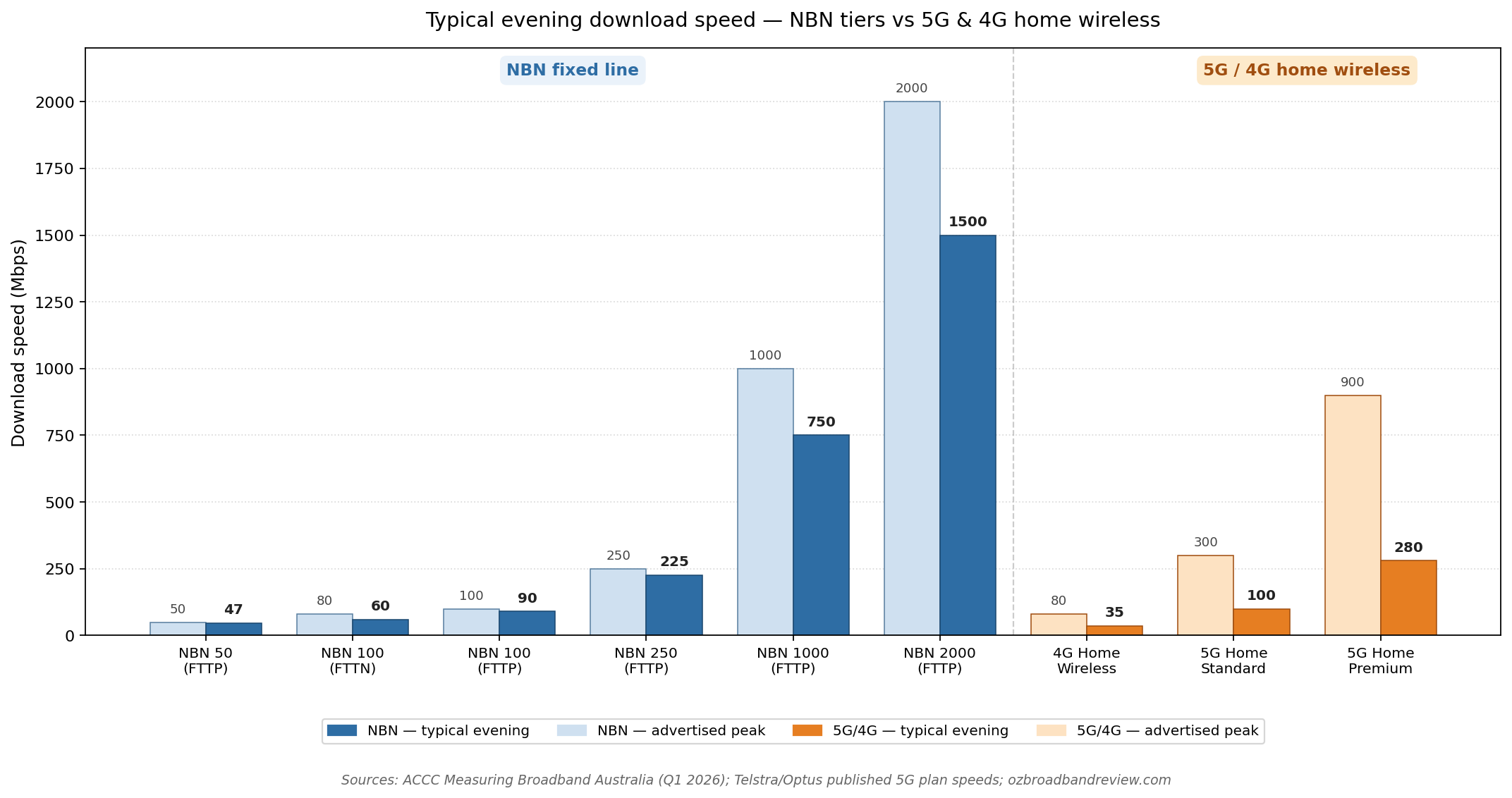
Advertised speeds and real speeds are two different things, and 5G is the technology where the gap is biggest. Marketing material talks about peak speeds. What the network can do at 3am with one user connected to a tower a hundred metres away. That’s not what you get on a Wednesday at 8pm when half the suburb is streaming Netflix.
The chart below shows typical evening speeds (8-11pm) for the common NBN tiers (from NBN 50 right up to NBN 2000) alongside the main 4G and 5G home wireless plans, based on the ACCC’s quarterly Measuring Broadband Australia report and provider self-disclosure. NBN is more predictable. 5G is faster on its best days but more variable. And once you compare against NBN 1000 or NBN 2000 on full fibre, even the fastest 5G home wireless plan is comfortably behind.
Where 5G home wireless wins
- No installation. Pull the modem out of the box, plug it in, wait for the lights to turn green. Most people are online within 15 minutes of unboxing.
- Portability. Moving house? Take the modem with you. As long as the new place has coverage, it just works.
- Cheaper at the entry level. Optus and Telstra 5G plans start at around $59, which beats most equivalent NBN 50 plans from the same providers.
- No copper, no FTTN limits. If you’re stuck on a bad FTTN line getting 25 Mbps when you’re paying for 50, 5G is often a step up , sometimes by a factor of ten.
- Renters and short stays. No landlord paperwork, no installation visit, no commitment beyond a month.
Where NBN still wins
- Consistency. A good NBN connection delivers the same speed at 8pm as it does at 8am. 5G can drop 50% during peak hours on a busy tower.
- Latency for gaming. NBN sits at 5-15 ms. 5G home wireless typically sits at 15-30 ms, sometimes more. If you play competitive online games it’s a meaningful gap. We have a dedicated NBN plans for gaming guide that covers this in detail.
- Predictability of upload. NBN gives you what you pay for on upload. 5G upload can be 10-30 Mbps even on plans advertising “up to 50”.
- No weather effects. Rain and thunderstorms don’t change your NBN speed. They can knock 20-50% off a 5G connection that’s far from a tower.
- Best for households with heavy concurrent use. Four people streaming, gaming and on video calls at once is more reliable on a fixed-line NBN connection.
What our reviewers say about each one
We have been collecting broadband reviews from Australians since 2004, so rather than guess, here is what people who actually live with these connections told us. Since January 2018 we have 571 reviews from people on fixed line NBN and 38 from people on home wireless, either 4G or 5G. Starlink is excluded from the wireless group because it is a different animal.
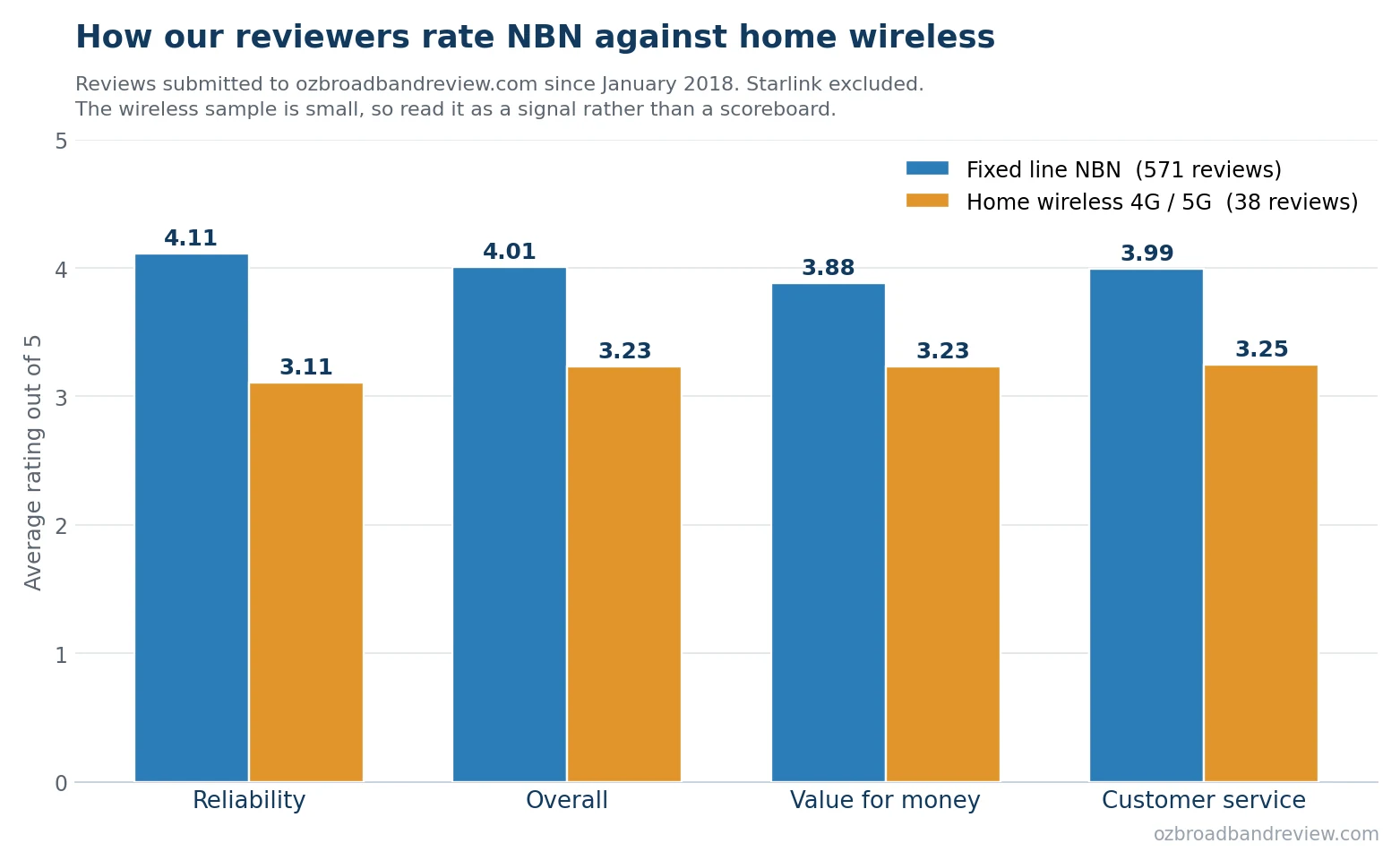
NBN comes out a full point ahead on reliability, 4.11 against 3.11. The honest caveat is the sample: 38 wireless reviews is not a big number, and people who bother to review a home wireless service skew towards those who had a strong opinion about it. Read the gap as a signal, not a scoreboard.
What is more useful is what the wireless reviewers actually wrote, because the same theme shows up over and over. It is not that 5G is slow. It is that it depends on the tower.
“5G broadband so speed and reliability depends on proximity to 5g tower. My connection is so-so, some drop outs and difficulty connecting to 5g.”
TPG home wireless customer, September 2025
“5G broadband reliability issues before switching back to NBN. I was unhappy with the coverage of 5G in this area soon after moving here.”
TPG customer who moved back to NBN, July 2025
“Value for money, reliable, easy to set up. Not very fast during peak usage times.”
TPG home wireless customer, September 2024
That last one sums the technology up neatly. Easy, good value, and slower when everyone else is home. You can see the full spread on our most reliable providers ranking, and the method behind the numbers is set out in how we rank broadband providers.
5G vs NBN for gaming
This is the question we get asked most often, and it is the one where the answer is least ambiguous. For serious online gaming, fixed line NBN wins almost every time.
The reason is not download speed. Most multiplayer games use very little bandwidth once you are in a match, anywhere from 100 KB to a few megabytes a minute. A 25 Mbps connection runs Fortnite, Valorant, Call of Duty, League of Legends and Rocket League without complaint. What games need is three other things: low ping, low jitter and low packet loss.
Ping is the round trip to the game server. Under 20 ms is excellent, 20 to 50 ms is fine, 50 to 100 ms is playable but you feel it. Jitter is how much that ping wobbles from one packet to the next, and it is the one that ruins games. A connection averaging 20 ms but swinging between 10 ms and 60 ms feels far worse than one sitting steadily at 25 ms. Packet loss above about 1% shows up as rubber banding and shots that do not register.
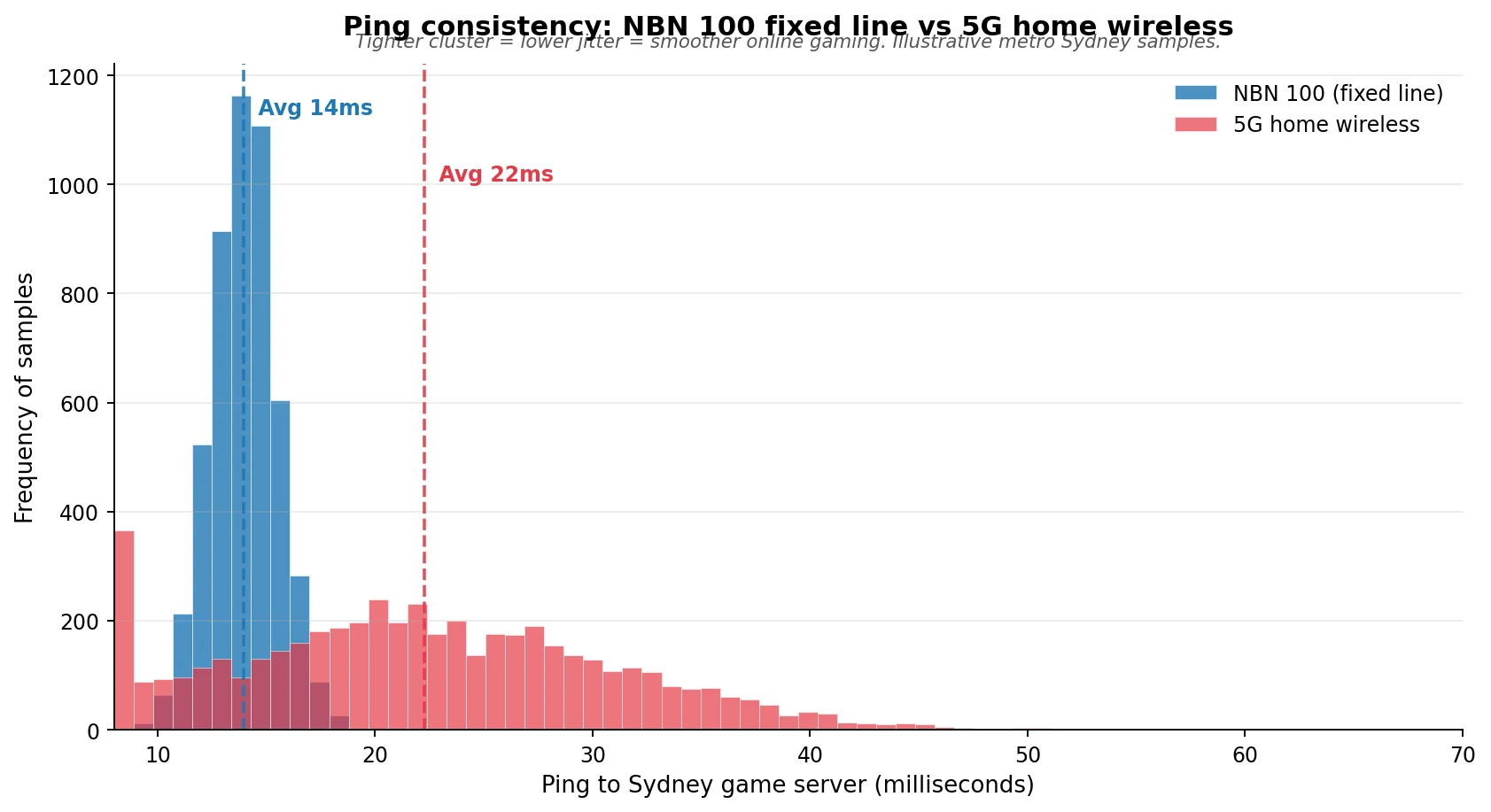
The marketing line about 5G hitting 1 ms refers to a lab condition nobody experiences at home. In practice a 5G connection in Sydney pings a Sydney game server at about 20 to 30 ms on a good day, which is perfectly fine. The catch is the good day qualifier. Tower load changes through the evening, and your ping goes with it.
A story we see repeatedly on Reddit and Whirlpool, paraphrased because the threads keep disappearing: a Telstra 5G user in Melbourne loved the connection for streaming and work, but his ping would swing between 18 ms and 90 ms inside a single match of Apex Legends once his local tower got busy. The HFC connection at the same house sat at 17 ms and barely moved. He kept the 5G modem as a backup and played ranked on the NBN.
| What you play | Better pick | Why |
|---|---|---|
| Competitive FPS, MOBA, ranked anything | NBN, fixed line | Jitter and packet loss matter more than raw speed |
| MMOs, RPGs, long sessions | NBN | You are online for hours. A drop mid raid is rough |
| Console online (PS5, Xbox, Switch) | NBN | Game updates run 50 to 150 GB and chew through a wireless connection |
| Casual co-op and party games | Either | If your 5G signal is strong, both are fine |
| Mobile gaming on a phone | 5G | Built for it, nothing to plug in |
| Cloud gaming (GeForce NOW, xCloud) | NBN | Needs high bandwidth and tight latency at the same time |
| You live somewhere with poor NBN | Test 5G first | If 5G is strong in your suburb it is a genuine option |
Not all NBN is equal here either. FTTP sits around 10 to 15 ms to Sydney, HFC and FTTC 12 to 20 ms, FTTN 15 to 30 ms, NBN Fixed Wireless 20 to 40 ms, and Sky Muster satellite is 600 ms and up, which rules it out for anything real time. If you are a gamer stuck on FTTN, check whether your address is eligible for the free full fibre upgrade. It is the cheapest performance gain you will ever get.
For actual plan picks rather than the comparison, we keep a separate ranked list at best NBN plans for gaming.
How to decide
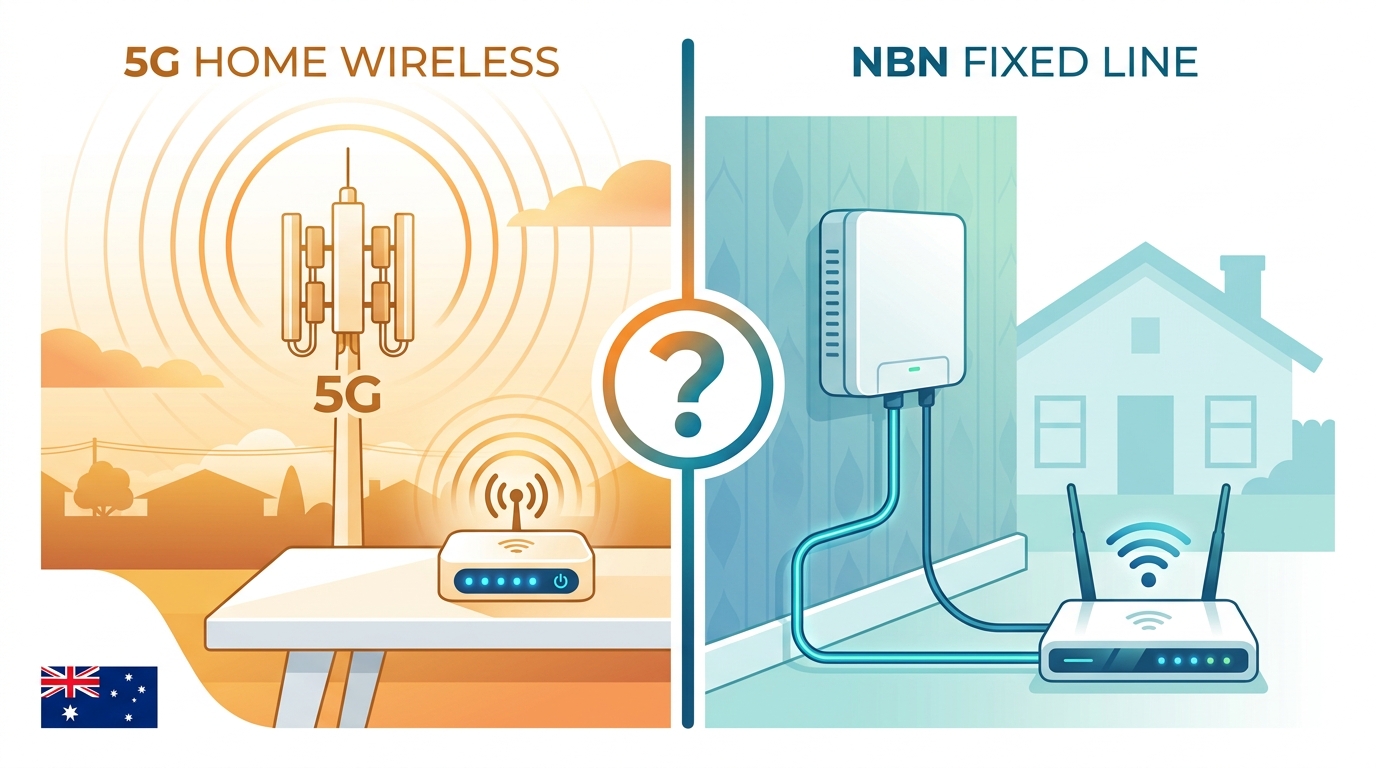
Here’s the decision tree. Five quick questions, and the path you take depends on coverage at your address, what NBN tech you’ve got, whether your current NBN is actually delivering the speed you’re paying for, whether you do anything that needs ultra low latency (gaming, video calls), and whether you’re likely to be at this address long enough that an installation is worth the hassle.

What people who switched are saying
The most common Reddit and Whirlpool story we see goes like this: “I was on FTTN getting 25 Mbps. Switched to Optus 5G and now get 400-900 Mbps. Won’t be going back.” That’s not an exaggeration. One user reported jumping from 28 Mbps NBN FTTN to 931 Mbps on Optus 5G after switching. If you’re on a bad FTTN line, 5G genuinely is life changing.
The other story we see, less often but worth flagging: a Telstra 5G user gets 500-700 Mbps for the first few months, then their tower gets more subscribers and speeds drop to 100 Mbps in evening peak. The 5G plans are uncapped on data but they’re capped on tower capacity. When the tower fills up, everyone slows down. In a few cases users have had ongoing problems and Telstra has actually asked them to switch back to NBN.
For balance, a third story: a user on a good FTTP NBN 100 connection switched to 5G to save $15/month, found the variability annoying for video calls, and switched back. NBN 100 on FTTP is hard to beat for consistency.
Current 5G home wireless plans

|
100GB
100 Mb/s
100 GB data
|
$34.90/mth | Go to site |

|
100GB
150 Mb/s
100 GB data
|
$40/mth | Go to site |
|
|
200GB
250 Mb/s
200 GB data
|
$49.90/mth | Go to site |
|
|
200GB
250 Mb/s
200 GB data
|
$55/mth | Go to site |

|
5G Internet 50
42 Mb/s
Unlimited data
|
$69.90/mth | Go to site |
| Click here to view more wireless 4G and 5G plans | |||
Current NBN plans for comparison
These NBN plans are fast, have plenty of data and all receive excellent reviews from our members. They would be great plans for anyone wanting to work from home.

|
Everyday
25 Mb/s
Unlimited data
|
$78/mth | Go to site |

|
One Plan
500 Mb/s
Unlimited data
|
$80/mth | Go to site |
|
|
Value
25 Mb/s
Unlimited data
|
$80/mth | Go to site |
|
|
Extra Value
50 Mb/s
Unlimited data
|
$89/mth | Go to site |
|
|
Fixed Wireless Plus
80 Mb/s
Unlimited data
|
$92/mth | Go to site |
| Click here to view more great value NBN internet plans for working from home | |||
Frequently asked questions
Is 5G better than NBN?
It depends entirely on what NBN you can get. If your address has FTTP or HFC and the service is working properly, the NBN is more consistent and usually the better choice. If you are on FTTN or FTTB and getting well under the speed you pay for, 5G home wireless is very likely faster. Coverage at your specific address decides it, so check the provider’s address checker before you commit.
Is 5G home wireless cheaper than NBN?
Roughly the same once you compare equivalent plans. 5G plans usually start around $59/month from Optus and Telstra, which is cheaper than equivalent NBN 100 plans from the same providers (about $95-105/month). However, smaller NBN providers like Tangerine and Superloop sell NBN 50 for around $65-70/month on 6-month intro pricing ($89-90 ongoing), so the price gap closes when you compare 5G to those.
Can I take 5G home wireless with me when I move?
Yes. As long as the new address has 5G coverage from your provider, you just unplug the modem and take it with you. No transfer fee, no waiting for installation. This is one of the biggest practical advantages over the NBN, which stays at the address.
Will 5G replace the NBN?
Not in the short term. 5G home wireless has real limits, tower capacity, weather effects and signal variability, that mean it can’t carry the full Australian internet load. It’s a competitor to the NBN for households where its strengths matter, not a replacement for the entire network. For more on the rollout, see our 5G in Australia guide.
Is 5G home wireless good for gaming?
For casual gaming, yes. For competitive online gaming where every millisecond matters, NBN is the safer choice. 5G latency typically sits 10-15 ms higher than NBN, which is enough to feel in fast-paced shooters. If you mainly play single-player or co-op games, 5G is fine.
What’s the catch with 5G home wireless?
Two things mostly. First, the speed varies, tower congestion, signal strength and weather all affect what you actually get. Second, coverage. 5G is widely available in metro Australia and major regional centres, but isn’t everywhere. Always run the provider’s address checker before signing up. If your address only has 4G coverage, the speeds drop a lot, usually 30-80 Mbps rather than several hundred.
Can I use my own router with 5G home wireless?
It depends on the provider. Most 5G plans include a specific modem (Telstra’s Smart Modem, Optus’s 5G WiFi 6 modem) that’s built to talk to the cellular network. Some let you BYO a compatible cellular modem, but the options are limited compared to NBN where almost any router works. If using your own gear is a hard requirement, the NBN is more flexible.
What is a good ping for online gaming?
Under 20 ms is excellent, 20 to 50 ms is fine for almost everything, 50 to 100 ms is playable but you will feel it in fast games, and above 100 ms you are at a real disadvantage in anything competitive. Steady matters more than low. A rock solid 25 ms beats a 15 ms connection that spikes.
Does 5G really have 1 ms latency?
No, not the version you buy for your house. The 1 ms figure comes from the 5G standard under lab conditions measuring only the radio hop. A real 5G home connection pinging a Sydney game server lands around 20 to 30 ms, and more than that when the tower is busy.
Can I use 5G as a backup for my NBN?
Yes, and it is a sensible setup if you work from home. A 5G modem on a cheap plan sitting next to the NBN modem gets you back online during an outage. Some routers will fail over automatically. Just remember the backup is only as good as the tower coverage at your address.
Is NBN Fixed Wireless the same as 5G home internet?
No. NBN Fixed Wireless is part of the NBN, delivered from NBN Co’s own towers to a dish fitted to your roof, and it is mostly a regional product. 5G home internet comes from the mobile networks run by Telstra, Optus, TPG and Vodafone, using an indoor modem you plug in yourself.
The bottom line
If you’re stuck on FTTN or FTTB and your real speeds are well below what you’re paying for, switch. The upgrade from 25 Mbps copper to 300+ Mbps 5G is the single best broadband decision a lot of Australians can make right now.
If you’re on a good FTTP or HFC connection and the speed is solid, stay. Consistency beats peak speed for almost every household task, and a stable NBN 100 connection on fibre is hard to beat.
If you’re a renter or moving often, lean towards 5G. The portability is genuinely valuable and you skip the installation hassle. If you’re a heavy gamer or run a serious work from home setup with daily video calls, lean towards NBN.
For a deeper look at the underlying technologies, our 5G in Australia guide covers speeds, coverage and the best home plans. For NBN specific decisions, the how to compare NBN plans guide and the NBN FAQ are the next reads.