Last updated: 22 August 2026
Pretty much everyone streams video these days. Netflix, Stan, Disney+, YouTube, Kayo, ABC iView. What internet speed do you actually need so things don’t buffer? And how much data does an evening of streaming chew through?
This guide compares the recommended speeds and data usage for 12 major streaming services in Australia, including the newer ones (Paramount+, Kayo Sports, BritBox) that most other comparison pages still miss. There’s a recommendation by household size at the bottom, plus a table for the question we get asked most: can my NBN handle multiple people streaming at the same time?
We’ve also got dedicated deep dives on internet speed for Netflix and internet speed for Stan if you want service specific detail.
How fast does your internet need to be?
The table below shows the recommended internet speeds for streaming video in standard, high and 4K definition across the 12 major services available in Australia.
| Streaming Service | Standard Definition (SD) | High Definition (HD) | Ultra High Definition (4K) |
|---|---|---|---|
| Netflix | 3 Mbps | 5 Mbps | 25 Mbps |
| Stan | 3 Mbps | 7.5 Mbps | 25 Mbps |
| Disney+ | 1.5 Mbps | 5 Mbps | 25 Mbps |
| Amazon Prime Video | 1 Mbps | 5 Mbps | 25 Mbps |
| Apple TV+ | 2.5 Mbps | 8 Mbps | 25 Mbps |
| YouTube | 1.1 Mbps | 5 Mbps | 20 Mbps |
| YouTube TV / Live | 3 Mbps | 7 Mbps | 13 Mbps |
| Binge | 1.5 Mbps | 5 Mbps | (not currently offered) |
| Foxtel Now | 3 Mbps | 7 Mbps | (not currently offered) |
| Paramount+ | 3 Mbps | 7 Mbps | 25 Mbps |
| Kayo Sports | 3 Mbps | 5 Mbps | 15 Mbps (live sport) |
| BritBox | 1.5 Mbps | 5 Mbps | (not currently offered) |
| ABC iView | 1.1 Mbps | 5 Mbps | (not currently offered) |
The pattern: most services need around 25 Mbps for 4K, 5-8 Mbps for HD, and under 3 Mbps for SD. None of the major services advertise 4K above 25 Mbps, even though the raw bitrate of 4K HDR content can spike higher. They’re using modern codecs (HEVC, AV1) to keep the average down.
Two services worth a closer look because the queries we see suggest people are specifically searching for them:
Disney+ 4K speed requirements
Disney+ recommends 25 Mbps for 4K UHD streaming, which includes its 4K HDR and Dolby Vision titles. The Premium plan (currently $20.99/month in Australia) is required to access 4K and HDR. If you’re on the Standard plan ($15.99) you cap out at HD and a 5 Mbps connection is enough. On the cheap ad supported plan you can stream 1080p, and 5 Mbps still does the job.
For the best 4K Disney+ experience (no compression artefacts on dark scenes, smooth playback when multiple devices are streaming), the practical floor is more like NBN 50 with 25 Mbps headroom. NBN 25 will technically work, but if anyone else in the house is doing anything on the internet at the same time you’ll start seeing dropouts.
Kayo Sports — live sport streaming
Kayo is the trickier one. Live sport at HD is around 5 Mbps, which is undemanding, but the SplitView feature (watching up to 4 games at once) multiplies that by however many feeds you’re watching. Four-stream SplitView in HD is around 20 Mbps. Live 4K streams (only available on selected Premier events) need 15 Mbps. The Premium subscription is required for 4K.
Latency matters more for live sport than for on-demand. Anything over 100 ms ping and you’ll see the goal celebration on social media before it lands on Kayo. NBN 50 or NBN 100 on fibre is the sweet spot for serious sport viewers.
Multiple streams at once — what speed do I really need?
This is the question we get asked most. The bandwidth is additive. If one 4K Netflix stream is 25 Mbps, two 4K streams running together is 50 Mbps, three is 75 Mbps. Add in your usual background traffic (one phone scrolling Instagram, the kids’ iPads doing app updates, a smart speaker checking in) and you need headroom above the raw maths.
| Household scenario | Minimum NBN tier | Comfortable NBN tier |
|---|---|---|
| 1 person, occasional HD streaming | NBN 25 | NBN 50 |
| 1 person, mostly 4K streaming | NBN 50 | NBN 50 |
| 2 people, mixed HD + occasional 4K | NBN 50 | NBN 50 |
| 2 people, both regularly 4K | NBN 50 | NBN 100 |
| Family of 4, mixed HD + 4K | NBN 100 | NBN 100 |
| Family of 4, multiple 4K streams + gaming | NBN 100 | NBN 250 |
| Share house with 5+ people streaming concurrently | NBN 100 | NBN 250 or NBN 1000 |
The honest summary: NBN 50 covers most Australian households comfortably. If you’re a family of four where everyone watches their own 4K thing at the same time, NBN 100 starts to make sense. Above that is enthusiast territory unless you have a very specific reason (heavy cloud backup, work from home video calls plus 4K streaming, multiple gamers).
How much data does streaming use?
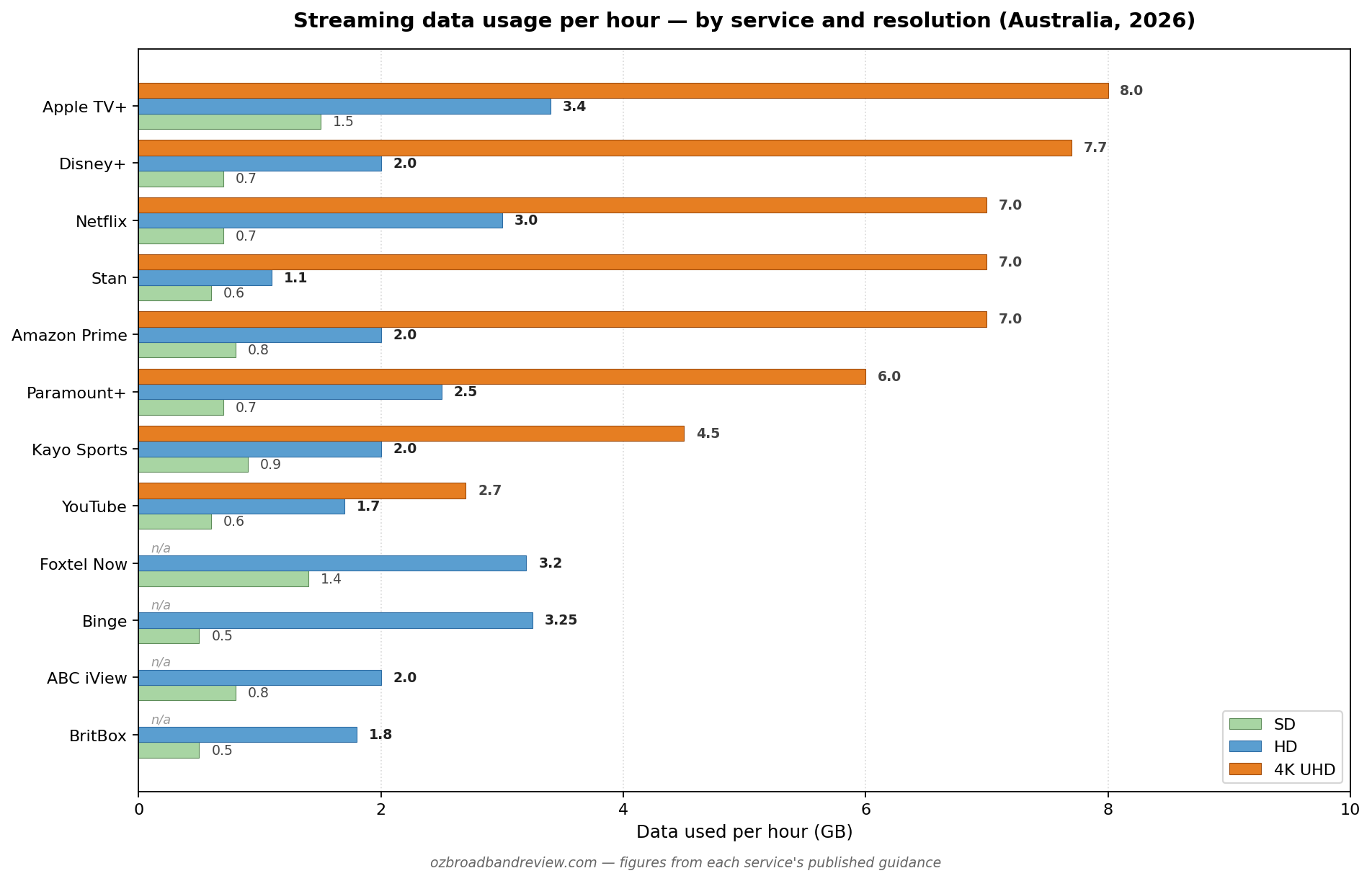
| Service | SD (GB/hr) | HD (GB/hr) | 4K (GB/hr) |
|---|---|---|---|
| Netflix | 0.7 | 3.0 | 7.0 |
| Stan | 0.6 | 1.1 | 7.0 |
| Disney+ | 0.7 | 2.0 | 7.7 |
| Amazon Prime Video | 0.8 | 2.0 | 7.0 |
| Apple TV+ | 1.5 | 3.4 | 8.0 |
| YouTube | 0.6 | 1.7 | 2.7 |
| Binge | 0.5 | 3.25 | — |
| Foxtel Now | 1.4 | 3.2 | — |
| Paramount+ | 0.7 | 2.5 | 6.0 |
| Kayo Sports | 0.9 | 2.0 | 4.5 (live sport) |
| BritBox | 0.5 | 1.8 | — |
| ABC iView | 0.8 | 2.0 | — |
Monthly data needed by household type
| Household | Weekly streaming hours | HD plan needs | 4K plan needs |
|---|---|---|---|
| Light (1-2 movies a week) | ~3 hours | ~40 GB / month | ~85 GB / month |
| Average (one show a night) | ~7-8 hours | ~90 GB / month | ~210 GB / month |
| Heavy (binge-watcher) | ~15 hours | ~180 GB / month | ~420 GB / month |
| Family of 4, multiple streams | ~30+ hours | ~360 GB / month | ~840 GB / month |
Almost every NBN and 5G home wireless plan in Australia is now unlimited as standard, so monthly data is mostly a non-issue. The exception is mobile broadband (4G/5G SIM in a small modem) where capped data is still common. A heavy 4K user can easily blow through a 500 GB monthly cap in a fortnight.
Test your speed before you blame your plan
If streaming is buffering, the first thing to do is actually test your speed, ideally on Ethernet, not Wi-Fi. Plug a laptop directly into your modem with a cable, run the test, and compare against the numbers in the first table above.
For a full guide to reading speed test results and what to do if your numbers are low, see our speed test results guide.
Our recommendation
For most Australian households, the answer is NBN 50 with unlimited data. It handles HD streaming on any service with room to spare, comfortably supports two simultaneous 4K streams, and most providers offer it at $85-$97/month. Step up to NBN 100 if you regularly run more than two 4K streams at once, do serious work from home video calls alongside streaming, or have heavy gamers in the house.
Best NBN plans for streaming
These NBN plans have plenty of speed for HD and 4K streaming, plus unlimited data so you’re not watching the meter.

|
Turtle Speed
25 Mb/s
Unlimited data
|
$64.90/mth | Go to site |

|
Value
25 Mb/s
Unlimited data
|
$72.90/mth | Go to site |

|
Everyday
25 Mb/s
Unlimited data
|
$78/mth | Go to site |

|
Crikey
25 Mb/s
Unlimited data
|
$80/mth | Go to site |

|
One Plan
500 Mb/s
Unlimited data
|
$80/mth | Go to site |
| Click here to view more NBN plans | |||
Frequently asked questions
What’s the minimum internet speed for Netflix in Australia?
Netflix recommends 3 Mbps for SD, 5 Mbps for HD, and 25 Mbps for 4K UHD. In practice, anything below 5 Mbps on a shared household connection will produce visible quality drops on Netflix. For 4K, give yourself 25 Mbps of headroom. If another device on your network needs bandwidth at the same time, Netflix is the first thing to degrade. See our full internet speed for Netflix guide for the deeper breakdown.
Can NBN 50 handle 4K streaming?
Yes for one 4K stream comfortably (4K Netflix is 25 Mbps, NBN 50 typically delivers 47 Mbps in evening peak). For two simultaneous 4K streams you’re at 50 Mbps which is right at the line, usually OK, occasionally tight. For three or more 4K streams, NBN 100 is the safer choice.
How much data does an hour of 4K streaming use?
Roughly 7 GB per hour for most services. Apple TV+ is the highest at around 8 GB/hr because it uses higher bitrates. YouTube 4K is the lowest at around 2.7 GB/hr because of more aggressive compression. A two-hour 4K movie burns through about 14 GB of data.
Does 5G home wireless work for 4K streaming?
Usually yes. 5G home wireless plans in Australia commonly deliver 100-300 Mbps in good coverage areas. More than enough for multiple 4K streams. The catch is variability: 5G speeds drop during evening peak as more people on the same tower fire up Netflix. NBN is more consistent for streaming. See our 5G vs NBN comparison for the full picture.
Why does Netflix buffer if my speed test shows fast speeds?
A few common causes. Wi-Fi between your modem and TV might be the bottleneck (try Ethernet to the TV if possible), your provider may be experiencing peak hour congestion (run a test at 10am to compare), your TV or streaming stick might be the limit (older devices cap at 100 Mbps), or there’s an outage somewhere. See our full speed-test results guide for the diagnosis steps.
What’s the best NBN plan for a family that streams a lot?
NBN 100 with unlimited data. It handles three to four simultaneous 4K streams plus background browsing on other devices. The cheaper options come from Kogan Internet and Moose Mobile at around $86-87/month ongoing, with intros in the $60s. For the best evening speeds (per the ACCC’s quarterly report), Aussie Broadband and Superloop are consistently top of the pack. See the best NBN plans comparison for current offers.
How much data does Kayo Sports use?
Around 2 GB per hour for HD live sport, 4.5 GB/hr for the limited 4K live events Kayo runs, and roughly 0.9 GB/hr in SD. SplitView (watching 2-4 games at once) multiplies that. Four-way SplitView in HD pulls about 8 GB/hr. If you’re a heavy sport viewer on a metered mobile broadband plan, switch to unlimited NBN.
Do streaming services use more data on a bigger TV?
Not directly. Data usage depends on the resolution and bitrate the service sends, which is set by the quality level (SD, HD, 4K) you’ve selected, not by your TV’s screen size. A 4K stream on a 65-inch OLED uses the same data as the same 4K stream on a 27-inch monitor. The exception is auto-quality settings, if your TV reports itself as a 4K device, the service may default to a higher quality than on an HD device.
Do I need to upgrade my plan for 4K?
Probably not. NBN 50 with unlimited data is enough for 4K streaming for most households. The main reason to upgrade is concurrent streams, if everyone in the house wants their own 4K thing at the same time, NBN 100 starts to make sense. Don’t get talked into NBN 250 or 1000 just for streaming, even premium 4K HDR content tops out around 25 Mbps per stream.
Is YouTube TV the same as YouTube for speed?
No. YouTube TV (live streaming) needs slightly higher consistent throughput than on-demand YouTube because it can’t buffer ahead. Plan for 7 Mbps minimum for live HD and 13 Mbps for live 4K, vs 5 Mbps and 20 Mbps for on-demand. ABC iView and Foxtel Now’s live channels have the same characteristic.
Further reading
- Internet speed for Netflix in Australia — deep dive on the most-asked service
- Internet speed for Stan — local streaming service breakdown
- Test your internet speed — free tool + results guide
- NBN, wireless and broadband internet in Australia — the broader hub
- Different types of NBN internet connections
- How to choose a broadband plan
- How to connect to the NBN
- How to compare NBN plans
- Internet speed for working from home