Last updated: 22 August 2026
Broadband terminology can be confusing. Bandwidth, speed, latency, throttling, evening speeds. They all describe different things but they get mixed up constantly in marketing copy. The easiest way to keep them straight is with one consistent analogy. So picture your broadband connection as a highway.
If that mental model clicks, the rest of this article will help everything fall into place. For a different take on the same concept, our water pipe analogy covers the same ground using plumbing instead of traffic.
The terminology first
Before the analogy, here’s what each term actually means:
- Speed — how fast data is travelling between your house and the internet at this moment, measured in Mbps (megabits per second).
- Bandwidth — the maximum capacity of your connection. The speed ceiling, not the speed you’re at right now.
- Quota — how much data (GB) your plan lets you download per month. Most NBN plans in Australia are unlimited in 2026.
- Shaping or throttling — when your provider caps your speed below your plan’s maximum, usually because you’ve exceeded your quota.
- Latency — the time it takes for data to make a round trip. Measured in milliseconds.
- Network congestion — when too many people in your area are using the network at once, slowing everyone down.
The highway analogy
Imagine your broadband connection as a highway that runs between your house and the internet.
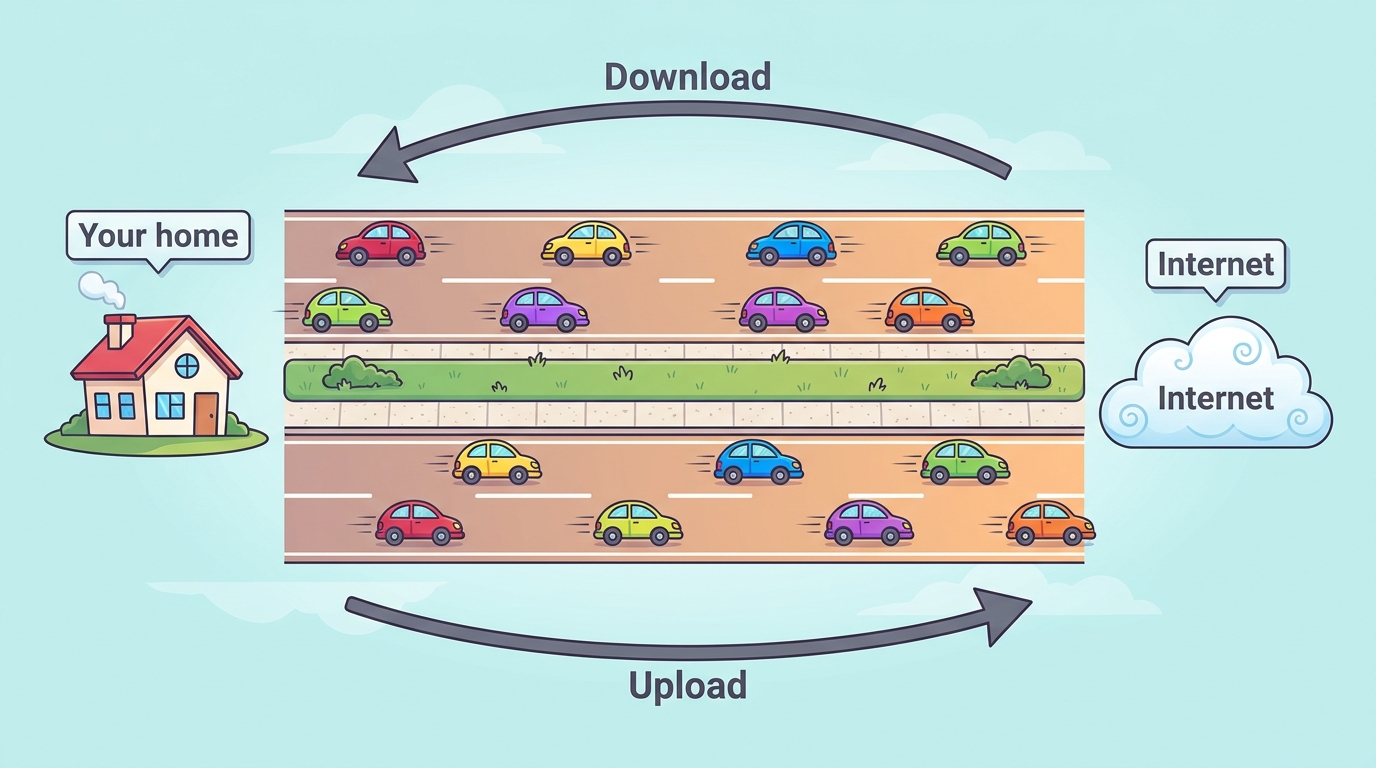
The cars on the highway are pieces of data. Each car is a small chunk of information. A Netflix video frame, part of an email, a Zoom audio packet. The lanes are split in two directions: cars going one way are uploads (data leaving your house), cars going the other way are downloads (data coming to your house).
In that picture:
- Internet speed is how many cars pass a given point per second. The faster they go and the more lanes there are, the higher the speed.
- Bandwidth is the maximum cars per second the highway could possibly carry — every lane full, every car at max speed. Your real speed is usually less because not every lane is full all the time.
- To increase bandwidth you’d add more lanes (more capacity in the cable) or raise the speed limit (better signalling technology).
- Quota is the total number of cars that can use the highway each month. If you blow the quota, your provider might shut the highway, slow it down, or charge you extra.
- Network congestion is a traffic jam. Too many cars trying to use the highway at the same time. Cars still move, just slowly. This is what’s happening when your internet feels sluggish at 8pm.
- Throttling is the highway patrol lowering the speed limit. Cars are still flowing but the maximum speed is reduced — usually because you’ve exceeded your quota or your provider has detected something they don’t like (an old practice, mostly gone in 2026 unless you’re on a mobile broadband plan).
- Latency is how long it takes one car to drive from one end of the highway to the other. Even on an empty highway with a fast speed limit, the trip still takes time. Latency matters most when you need a fast back and forth — gaming, video calls, voice over IP.
That covers most of the broadband terminology you’ll run into.
Why this matters when picking a plan
Once you’ve got the analogy, plan listings make more sense.
- A plan advertising “100 Mbps” is talking about bandwidth — the speed limit. Your actual speed in the evening might be lower.
- A plan advertising “typical evening speed: 90 Mbps” is being honest about the real world flow.
- A plan with “unlimited data” means no quota cap on how many cars use the highway each month.
- A plan with a “contract” means you’ve agreed to keep using this particular highway for X months.
When you’re comparing NBN plans, what you really want to know is the evening speed (real world flow) and the ongoing monthly cost. Our how to compare NBN plans guide walks through this properly, or you can go straight to live NBN plans sorted by evening speed and price. Or, for the broader question of which TYPE of internet to use in the first place, see the NBN vs Broadband vs Wireless hub. If you just want the plain language version of what the NBN actually is, that guide covers it on its own.
Frequently asked questions
What’s the difference between bandwidth and speed?
Bandwidth is the maximum capacity of your connection (the speed limit on the highway). Speed is how fast data is actually moving at a given moment (how fast the cars are actually going). Bandwidth is what’s printed on your plan; speed is what you actually get.
What is broadband throttling?
Throttling is when your provider caps your connection speed below your plan’s maximum. Usually it happens because you’ve exceeded your monthly data quota. Most NBN plans in Australia don’t throttle in 2026 because they’re unlimited.
What is internet latency in plain English?
Latency is how long it takes data to make a round trip from your house to a server and back. It’s measured in milliseconds. Lower is better. For video calls and gaming, anything under 50 ms feels snappy; anything over 150 ms feels laggy.
Why does my internet slow down in the evening?
Network congestion. Lots of people in your area are home and online, all using the same network capacity. Your provider’s “typical evening speed” tells you what to actually expect at peak times. Plans that quote high evening speeds buy more capacity per customer.
What’s a “typical evening speed”?
The average download speed on your plan between 7pm and 11pm. The most important number on a plan listing because it reflects what you’ll actually experience, not the marketing maximum.
For real numbers comparing each type of Australian internet, see our internet speed comparison. For a different mental model of the same concept, the water pipe analogy is a useful companion.