Last updated: 21 August 2026
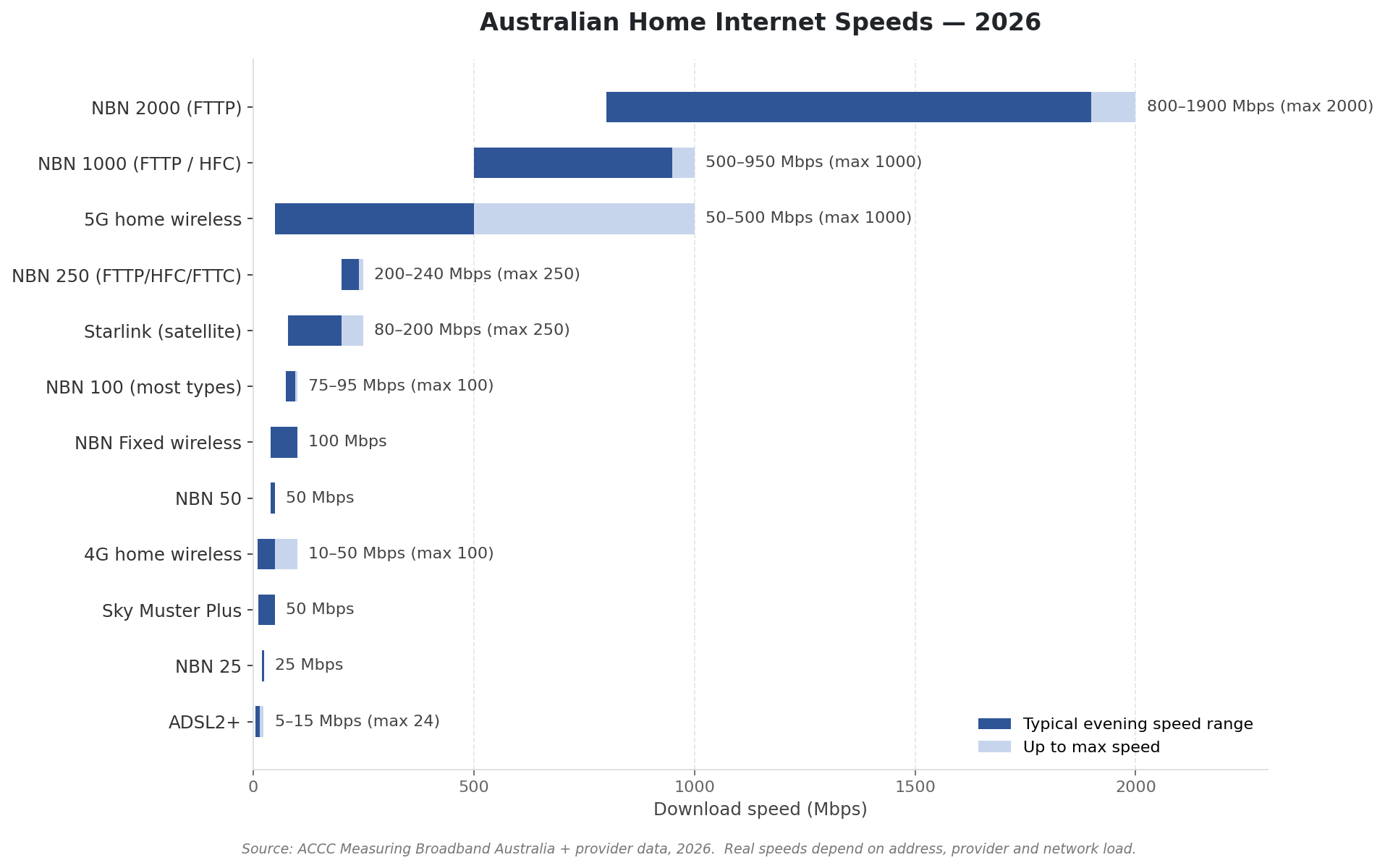
Most Australians don’t know how fast their internet actually is until something goes wrong. Then the question becomes: is it me, my plan, or my technology? This guide shows the typical real world speeds you can expect from each type of home internet in Australia, from the slowest (Sky Muster satellite) to the fastest (FTTP NBN and 5G in good coverage areas).
For broader context on the different connection types, see our NBN vs Broadband vs Wireless hub.
Quick comparison
| Connection type | Typical evening speed | Max speed available | Latency |
|---|---|---|---|
| NBN FTTP | 80–950 Mbps | 2000 Mbps | < 10 ms |
| NBN HFC | 80–900 Mbps | 1000 Mbps | < 15 ms |
| NBN FTTC | 70–230 Mbps | 250 Mbps | < 20 ms |
| NBN FTTN | 30–90 Mbps | 100 Mbps (often less) | 15–30 ms |
| NBN Fixed wireless | 40–100 Mbps | 100 Mbps | 20–40 ms |
| 5G home wireless | 50–500 Mbps | 1000+ Mbps | 10–30 ms |
| Starlink (satellite) | 100–400 Mbps (by tier) | 400+ Mbps | 30–50 ms |
| ADSL2+ | 5–15 Mbps | 24 Mbps | 30–60 ms |
| Sky Muster satellite | 12–50 Mbps | 50 Mbps | 600+ ms |
| 4G home wireless | 10–50 Mbps | 100 Mbps | 30–60 ms |
Typical evening speeds are measured during peak hours (7pm–11pm). Numbers vary by provider, address, and network load.
NBN speeds in detail
The NBN has six different connection types and six speed tiers. The connection at your address determines which speed tiers you can actually use.
NBN speed tiers
| Plan | Max download | Max upload |
|---|---|---|
| NBN 25 | 25 Mbps | 5 Mbps |
| NBN 50 | 50 Mbps | 20 Mbps |
| NBN 100 | 100 Mbps | 20 Mbps |
| NBN 250 | 250 Mbps | 25 Mbps |
| NBN 1000 | 1000 Mbps | 50 Mbps |
| NBN 2000 | 2000 Mbps | 100 Mbps |
What’s the average NBN speed in Australia?
According to the ACCC’s quarterly Measuring Broadband Australia reports, the typical evening speed on an NBN 100 plan in 2026 sits around 90–98 Mbps from the better providers, and 75–88 Mbps from the cheaper providers who buy less network capacity per customer. So if you’re paying for NBN 100 and getting 80+ Mbps in the evening, that’s normal.
Aussie Broadband, Superloop and Swoop consistently top the ACCC speed rankings. Our guide to the fastest NBN plan available tracks the current numbers.
If you’re on a connection type that limits you to a lower tier, like FTTN or fixed wireless, your usable maximum is going to be 50 or 100 Mbps even if you pay for higher.
5G home wireless speeds
5G home broadband can hit 500 Mbps in areas with strong coverage, which beats almost every NBN connection except FTTP and HFC at the 1000 tier. The catch is that speeds vary a lot:
- Tower distance: the further you are from the nearest 5G tower, the slower you go.
- Tower load: speeds drop during peak hours if your tower is busy.
- Weather: heavy rain can degrade signal.
- 5G frequency: mid-band 5G (most common) is fast; mmWave 5G (rare in homes) is faster again.
Typical evening speeds on 5G home plans run 50–300 Mbps for most users in 2026. Telstra, Optus, TPG and Vodafone all offer 5G home internet.
For more, see our 5G internet in Australia guide.
Starlink speeds
Starlink uses thousands of low orbit satellites about 550 km up. Australian residential Starlink users typically see:
- Download: 100, 200 or roughly 400 Mbps depending on plan tier
- Upload: 10–30 Mbps
- Latency: 30–50 ms
These numbers have come down a bit from Starlink’s early days as more subscribers have joined the network. Still excellent for rural Australia where Sky Muster is the only other option.
Our Starlink vs Sky Muster guide covers the comparison in detail.
Sky Muster satellite
Sky Muster uses NBN’s geostationary satellites about 36,000 km above the earth. The huge distance means high latency (600+ ms) which makes video calls and online gaming painful. Download speeds run 12–25 Mbps on the standard service, up to 50 Mbps on Sky Muster Plus.
For most remote Australian properties that can afford the $599 upfront for Starlink hardware, Starlink is now the better option. Sky Muster remains useful for users who can’t justify the upfront cost.
ADSL speeds
ADSL2+ has a theoretical maximum of 24 Mbps but most ADSL connections deliver 5–15 Mbps in practice, depending on how far you are from the exchange. ADSL is being progressively shut down as the NBN rolls out; by 2026 the vast majority of ADSL exchanges are decommissioned.
If you’re still on ADSL, your address is almost certainly NBN ready now. Switching to NBN 25 will at least match your ADSL speed; NBN 50 or 100 will leave it for dead.
4G home wireless
4G home internet is the budget mobile broadband option. It’s slower and less consistent than 5G but cheaper and available in more areas. Typical speeds are 10–50 Mbps. Worth considering as a backup connection or for very low use households.
What’s the average internet speed in Australia?
Pulling together all the technologies above, the rough national average download speed in Australia in 2026 is around 95–110 Mbps, weighted by how many people are on each connection type. That puts Australia roughly 40th–50th globally. Middle of the pack, well behind Singapore, Hong Kong and South Korea but ahead of most of Western Europe’s averages.
For the full global ranking, see our guide to Australia’s internet speed rankings.
How does my speed compare?
Easiest way to check: run a speed test.
- Plug your laptop into your modem with an Ethernet cable (Wi-Fi adds noise).
- Close other apps.
- Go to fast.com or speedtest.net.
- Run the test 2–3 times and average the results.
If your result is way below the speed tier you’re paying for, our internet speed tests explained guide covers what to do next.
Frequently asked questions
What’s the fastest internet you can get in Australia?
NBN 2000 (2000 Mbps) on FTTP is the fastest mainstream residential tier. A small handful of providers offer it for around $200/month. 5G mmWave can hit similar speeds in the few areas where it’s deployed, but residential mmWave is rare.
What’s the average NBN 100 speed in Australia?
Typical evening speeds on NBN 100 in 2026 are 80–95 Mbps from the better providers. ACCC publishes quarterly reports that track this.
Is 5G faster than the NBN?
Sometimes. 5G home broadband can beat NBN 50 or NBN 100 in areas with strong coverage. NBN is more consistent because it’s a fixed line.
How fast is Starlink in Australia?
Starlink residential plans are now speed tiered: 100 Mbps, 200 Mbps, or around 400 Mbps on the Max plan, all with 30–50 ms latency. Good enough for streaming, video calls and gaming.
Why is my internet slower than the speed I’m paying for?
Could be your connection type capping you (e.g. FTTN can’t deliver 100 Mbps if the copper run is long), peak hour congestion at your provider, an old modem, or Wi-Fi limitations. Our guide on what to do when the NBN keeps dropping out covers troubleshooting.
How does Australian internet speed compare globally?
Australia sits around 40th–50th globally for fixed broadband. Not great, not terrible. The NBN rollout has improved averages significantly compared to the pre-NBN days. See our guide to Australia’s internet speed rankings for the full picture.
For the bigger picture, start with our NBN vs Broadband vs Wireless hub. For NBN specific plan comparison, see how to compare NBN plans. To find an actual plan, use our NBN plan finder.