Most Australian households are paying more for their NBN than they need to. Of the 283 real users who ran the OzBroadbandReview savings calculator since 2022, nearly 9 in 10 (88.7%) were shown savings of at least $100 a year by switching, and the typical (median) saving was $246. This post walks through the seven moves that get you to $100, the calculator that does the maths for you, and the two situations where switching costs more than it saves.
If you’ve been on the same NBN plan for more than a year, the odds are very strong that $100 is sitting on the table waiting.
Try the calculator first, then read the rest
The fastest way to find out what you could save is to plug your current bill into the calculator below. It compares what you’re paying right now against every NBN plan in our database and shows you the best alternatives at your speed tier.
The calculator lives at ozbroadbandreview.com/savemoney.php. Put in what you pay now and it checks every plan in our database for something cheaper.
If the calculator shows you saving less than $100 a year, congratulations. You’re already on a competitive plan. The seven moves below are for everyone else.
What the calculator data actually shows
Since the savings calculator went live in 2022, 283 Australians have used it with results that produced positive savings. The distribution is striking:
| Annual saving the calculator showed | Number of users | Share |
|---|---|---|
| $1 to $50 | 10 | 3.5% |
| $51 to $100 | 22 | 7.8% |
| $101 to $200 | 59 | 20.8% |
| $201 to $400 | 154 | 54.4% |
| $401 to $800 | 25 | 8.8% |
| Over $800 | 13 | 4.6% |
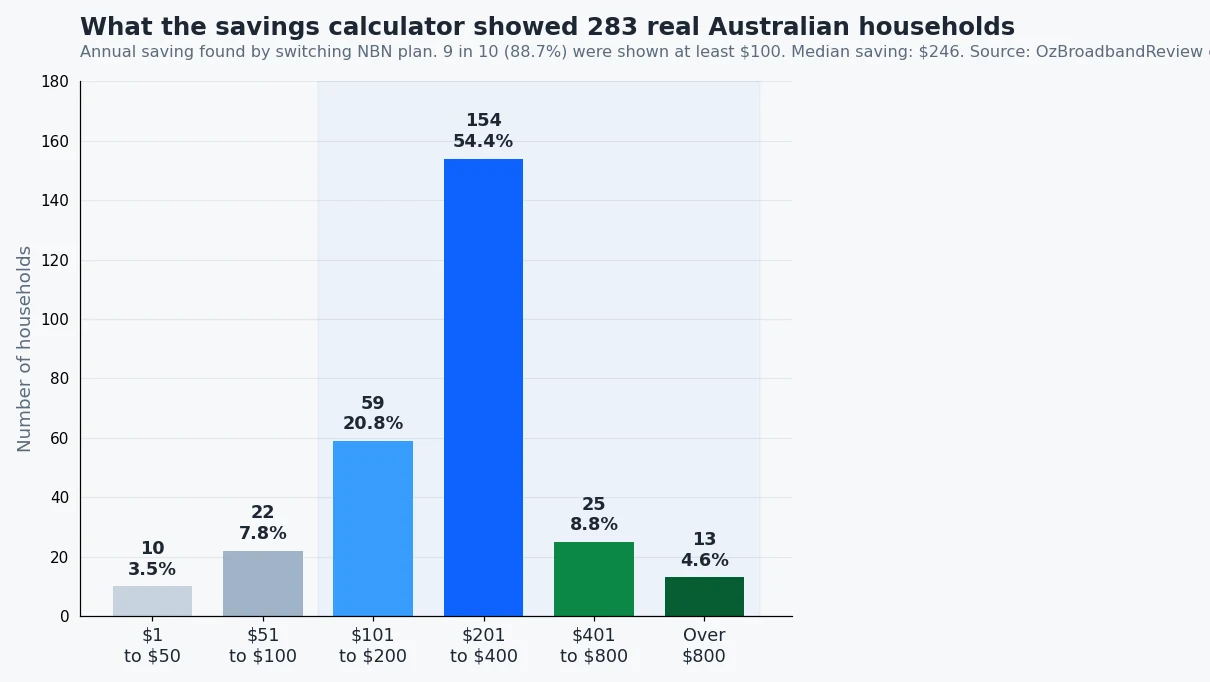
More than half the users who tried the calculator were shown savings of $200 to $400 a year. Almost 9 in 10 (88.7%) beat the $100 floor. About 1 in 7 were shown savings above $400, which usually means they were on a brand name plan with a price that had crept up after the introductory promo ran out.
The median saving is $246 a year, and a handful of outliers (people on very old or business plans) push the raw average past $400. The honest number to plan around is the median, or simpler still, the $100 floor that nearly everyone clears. If you only get to $100, that’s a Friday night dinner for the family with no effort other than a switch you can do online in 20 minutes.
This matches what people say on r/AusFinance, where the most common reason given for switching NBN provider is realising the bill quietly climbed after the first year. The thread that comes up again and again is somebody noticing they’re paying $95 for a plan a new customer can get for $70, then being annoyed they didn’t check sooner.
The seven moves that get you to $100 (and usually well past)
These are the practical changes that make up the difference between what most households pay and what they could pay. Most users will pick one or two and clear $100 a year. Combine three or four and you’re in $400+ territory.
Move 1. Drop one speed tier if you’re not actually using it
A lot of households pay for NBN 100 and run their internet on what an NBN 50 plan would handle without effort. Streaming Netflix in 4K uses 25 Mbps. Two simultaneous 4K streams need 50. If nobody in your house games competitively or works in heavy creative software, NBN 50 is almost certainly fine.
Average price difference: $10 to $15 a month, or $120 to $180 a year. Single biggest move available.
How to check: run a speed test at 8pm on a Wednesday. If you’re consistently getting more than the NBN 50 maximum of 50 Mbps and you don’t notice, you’re paying for headroom you don’t use.
Move 2. Switch off the introductory plan when the promo ends
Most NBN plans are sold with a discount for the first 6 to 12 months, then they jump back to the standard price. Telstra, Optus, Aussie Broadband, Superloop, Tangerine, Dodo, every major provider does this. If you signed up to a plan more than a year ago and you haven’t checked the bill recently, your monthly cost has almost certainly gone up by $10 to $25 a month.
Average price difference: $15 to $25 a month, or $180 to $300 a year.
This is the single most common reason people show up at the calculator with $300+ in savings. The promo expired, they didn’t notice, and they’re now paying the rack rate when a competitor would happily give them a new promo to switch.
Move 3. Cancel bundled extras you don’t use
NBN plans often bundle a home phone line, a streaming service or a Foxtel subscription you signed up for and forgot about. If you genuinely use the streaming service, leave it. If you haven’t picked up the home phone in two years, drop it.
Average saving: $10 to $20 a month depending on what’s bundled.
Look at the line items on the most recent bill. Anything labelled “phone line”, “voice rental”, “value pack” or “bundle credit” is worth questioning.
Move 4. Switch from a big telco to a mid tier provider
Telstra, Optus and TPG charge a premium for the brand and the support overhead. Mid tier Australian providers like Aussie Broadband, Superloop, Tangerine, Exetel, Mate, Dodo and Belong run the same wholesale NBN network and pay the same wholesale price. The difference is in the retail margin.
Typical pricing comparison on an unlimited NBN 50 class plan in 2026: Telstra no longer sells a plain NBN 50 (its entry plan is NBN 25 at $89 a month), Aussie Broadband charges $95, Belong $91 flat, Superloop and Tangerine sit around $89 to $90 ongoing with 6-month intros in the $60s, and Dodo is $87.99 with a $57.99 intro.
Average saving: $15 to $25 a month if you’re currently on a big telco brand. Combined with Move 1 (dropping a tier), most households comfortably clear $300 a year.
Move 5. Use your own modem instead of renting one
Most NBN providers will either give you a “free” modem (paid for in the plan price) or rent you one for $5 to $15 a month. A decent BYO Wi-Fi router and NBN modem costs $150 to $250 once. After about 18 months you’re ahead.
If you already own a Wi-Fi router from your last connection, you very likely don’t need a new one. Check the provider’s BYO list before signing up.
Average saving: $60 to $180 a year depending on the provider and how long you stay.
Move 6. Time your switch to grab the new customer discount
Most providers give new customers $10 to $25 off a month for the first 6 to 12 months. The trick is to switch before your current contract expires (after the new customer discount you signed up for has worn off) rather than after.
Most NBN plans are now month to month with no exit fee, so timing a switch is purely about not leaving the discount window on the table. If you’ve been with one provider for two years and they’re charging you the rack rate, you’ve effectively paid for two new customer discounts at competitors that you never claimed.
Average saving: $60 to $200 a year on year one, depending on the size of the promo.
Move 7. Consider 5G home wireless or fixed wireless if the address suits
If your home is in a metro area with strong 5G coverage and your speed needs are modest, a 5G home wireless plan from Optus, Telstra or TPG can come in $20 to $40 a month under an equivalent NBN plan. It’s not for everyone (latency and peak hour consistency are weaker than fixed NBN), but for solo workers, retirees, or sharehouses on a budget, it’s worth a look.
This is a check, not a default recommendation. Run a coverage check at the provider’s website using your address before getting interested. If the signal is patchy, NBN is the right call.
When switching costs more than it saves
Two situations where the obvious switch is the wrong move.
You’re locked into a contract with an exit fee. Some older plans (and most business plans) have a remaining contract term and an early termination fee. If you’ve got 4 months left on a contract with a $100 exit fee and the new plan saves you $20 a month, the maths is $80 saved vs $100 lost. Wait it out.
You depend on bundled hardware tied to the provider. Telstra’s preconfigured Smart Modem works best on Telstra plans. If you got the modem free and you’d have to buy a new one to switch, factor that in. A $250 modem against $15 a month savings is 17 months to break even, which is still worth it long term but slower than the headline number suggests.
In both cases the calculator will still show a saving figure because it doesn’t know about your exit fees or hardware quirks. Use it as a signal, then check your contract details before you commit.
A real example from the calculator
The most common shape of saving we see in the data is somebody on a name brand NBN 100 plan paying $109 a month with no contract, who runs the calculator and finds an NBN 50 plan at $79 a month from a tier 2 provider. That’s $30 a month difference, $360 a year, with no real change to their daily internet experience.
If they’re prepared to use their own modem (saving another $10 a month) and they actually need NBN 50 not NBN 100 (which is true for most households without heavy users), they’re saving over $400 a year.
The point isn’t that everyone is paying $30 a month too much. It’s that most Australian households haven’t actually checked, and the answer is more often “yes you’re overpaying” than “no you’re already on the best plan”.
Frequently asked questions
How much do most Australians save on their NBN bill by switching?
Based on the 283 real user queries on the OzBroadbandReview savings calculator since 2022 that produced positive savings, the typical (median) saving was $246 a year. Nearly 9 in 10 (88.7%) were shown savings of at least $100 a year, and more than half were shown savings of $200 to $400 a year.
Do I have to call my current provider to switch NBN plans?
No. NBN switching is now handled almost entirely online. You sign up with the new provider, they coordinate the switch with NBN Co, and your old plan is cancelled automatically when the new one activates. Most switches take 1 to 3 business days.
Will I have any downtime when switching NBN providers?
Usually minimal. For most connection types (FTTP, FTTC, HFC, FTTN) the switch is a network update and downtime is measured in minutes. Some legacy connection types may need a technician visit; the new provider will tell you in advance if that applies.
Is there a cancellation fee for leaving my current NBN provider?
Most NBN plans are now sold month to month with no exit fee. If you’re on an older contract or a business plan, check the terms. The calculator above doesn’t factor in exit fees, so if you suspect you might have one, look up your contract before acting.
Do I need to buy a new modem when I switch?
Usually not. Most NBN providers either include a modem with the plan or let you keep using your existing Wi-Fi router and modem. Telstra’s Smart Modem is the main exception; it’s locked to the Telstra network. Generic NBN compatible modems work on every provider.
What’s the cheapest NBN plan available right now?
Look at the calculator results above. Pricing changes weekly so any specific number in a blog post goes out of date fast. The calculator pulls live plan data from the OBBR plan database and shows you the cheapest matching your speed tier.
Should I switch from NBN to 5G home wireless?
Maybe. 5G home wireless is cheaper than NBN at most speed tiers, but the experience is more variable. Latency is higher (worse for gaming and video calls), peak hour speeds can drop more, and coverage depends on your exact address. Run the provider’s coverage check before signing up. For most households with steady NBN it’s not worth switching unless you’re saving more than $20 a month.
How often should I check whether I’m overpaying?
Every 12 months at minimum. The combination of price creep after the introductory promo, new competitors entering the market, and providers refreshing their plan lineup means that the plan you signed up for two years ago is almost certainly not the best plan available today. A 20 minute check once a year is enough to keep you on a current rate.
Does OBBR earn money if I switch through the calculator?
Yes, on some providers. About 6 of the 25 NBN providers in our catalogue are commercial partners, and we earn a referral commission when somebody signs up through one of their plans. The calculator shows results from every provider regardless, and the methodology page explains the affiliate model in detail.
What if the calculator doesn’t show savings for me?
It means you’re on a competitive plan already. If you’re paying market rates for your speed tier, the calculator will return a small saving or no saving and tell you to stay where you are. That’s the honest answer, and it’s also how you know the tool isn’t built to manufacture a switch.
The cheapest unlimited NBN plans right now
If the calculator showed you a saving and you just want the shortlist, these are the cheapest unlimited NBN plans from our partner providers today, updated live from our plan database:

|
Turtle Speed
25 Mb/s
Unlimited data
|
$64.90/mth | Go to site |

|
Value
25 Mb/s
Unlimited data
|
$42.90/mth
for 6 mths,
then $72.90/mth |
Go to site |

|
Basic - nbn 12/1
12 Mb/s
Unlimited data
|
$77/mth | Go to site |

|
Everyday
25 Mb/s
Unlimited data
|
$58/mth
for 6 mths,
then $78/mth |
Go to site |

|
One Plan
500 Mb/s
Unlimited data
|
$80/mth | Go to site |
| Click here to view more NBN plans | |||
For the full method behind every OBBR ranking and recommendation, see How We Rank Australia’s Broadband Providers. For the long view on how Australian broadband pricing has changed over 22 years, see the retrospective drawn from the same review database that powers the calculator above.