Last updated: 22 August 2026
The Australian household that streams Netflix, Disney+, Stan, Kayo and a handful of others doesn’t need the fastest NBN plan to do it well, but it does need the right combination of speed, evening peak performance and unlimited data. This is the practical guide to picking an NBN plan if streaming is what you mostly use the internet for.
The short version: NBN 50 on a provider with good evening peak speeds is the right answer for most Australian households. NBN 100 if you’ve got two simultaneous 4K streams or someone working from home while everyone else watches TV. The Netflix-bundle plans from Telstra and Optus are worth a look only if the maths actually works in your favour. Most of the time, picking a cheaper NBN plan and paying for Netflix separately is the better deal.
The short version — by household
| Household streaming pattern | Pick | Roughly |
|---|---|---|
| 1 person, occasional HD | NBN 25 | $50–60/mth unlimited |
| 1–2 people, regular HD streaming | NBN 50 | $60–75/mth unlimited |
| Family of 4, mixed HD + one 4K viewer | NBN 50 | $65–80/mth unlimited |
| Family with two simultaneous 4K streams + WFH | NBN 100 | $80–95/mth unlimited |
| Sharehouse or power household | NBN 100 or NBN 250 | $85–115/mth unlimited |
The reason NBN 50 covers so many households is that streaming is actually a pretty modest internet workload by 2026 standards. A 4K Netflix stream caps at about 25 Mbps. Three simultaneous HD streams add up to maybe 20 Mbps. Your phone, your smart speaker and your kid’s tablet add another 5 Mbps between them. The plan just needs to be reliable at evening peak, not particularly fast.
How much bandwidth each streaming service needs
The numbers below are per stream bitrates at each quality level for the services Australians actually use. Add them up across simultaneous viewers in your household to get a sense of total demand.
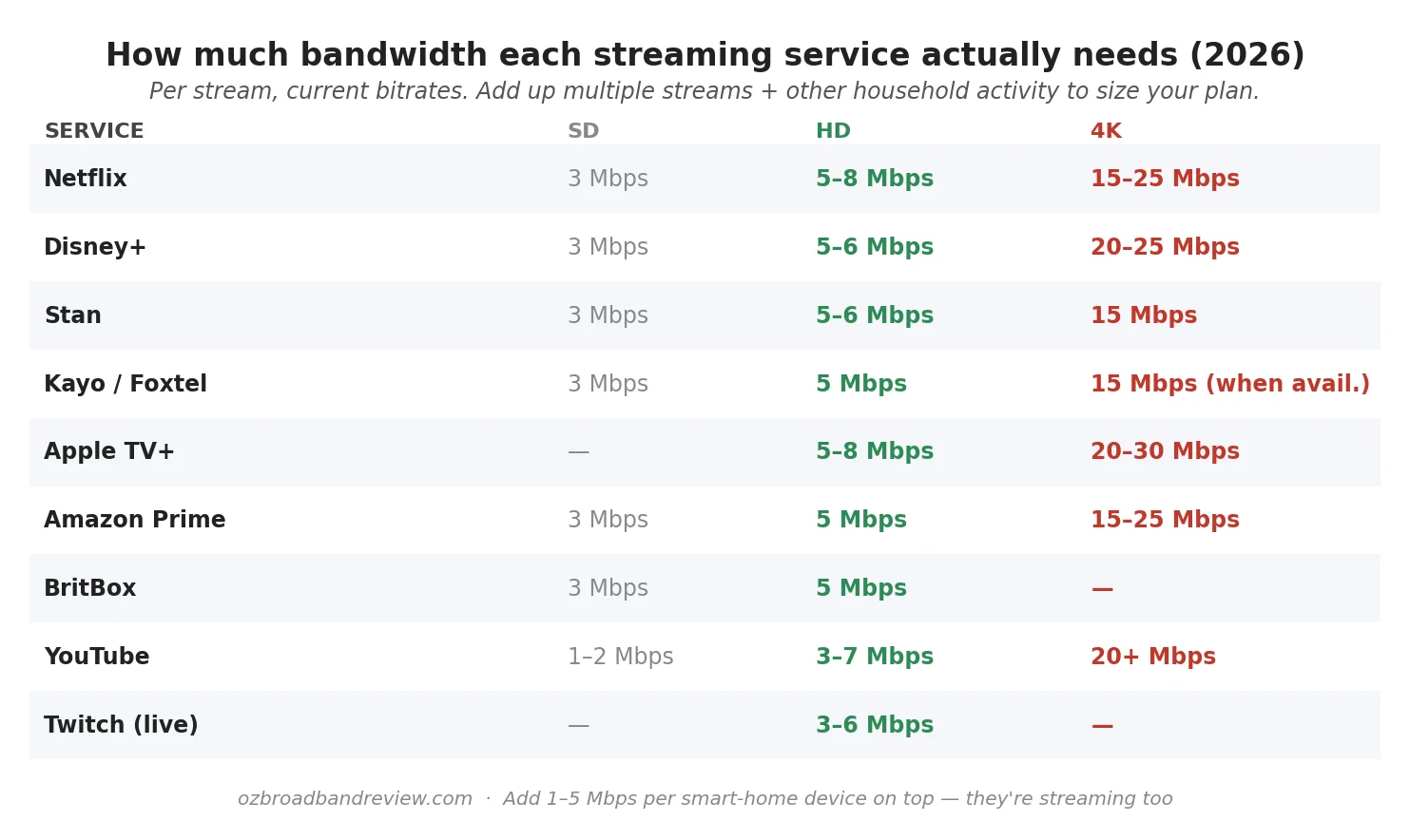
For a more detailed breakdown of speed requirements by service (including buffering troubleshooting), see our internet speed for streaming page. The page above covers the four-number basics; this one focuses on which NBN plan to actually buy.
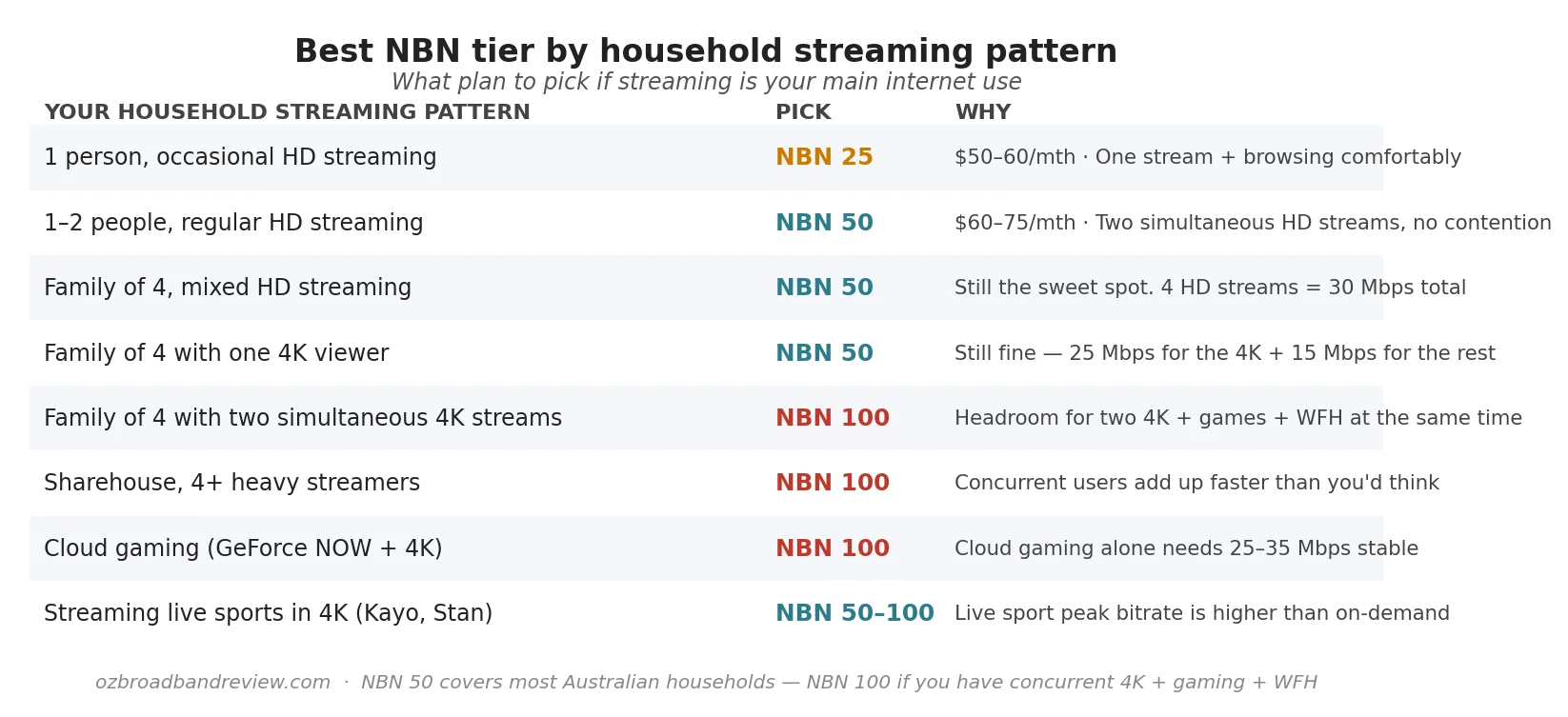
Best NBN plan tier by household streaming pattern
NBN 25 — single user, occasional streaming
NBN 25 (25 Mbps download cap, 5 Mbps upload) handles one HD stream comfortably, with enough headroom for browsing and a video call alongside it. It’s not enough if more than one person streams at the same time, and it’s tight for 4K. But for a solo person or a budget conscious couple watching one TV at a time, it’s enough, and saves $10–15/month over NBN 50.
NBN 50 — the sweet spot
NBN 50 (50 Mbps down, 20 Mbps up) is where most Australian households should land. It comfortably handles two simultaneous 4K streams plus other normal activity. With a good provider (Aussie Broadband, Superloop, Exetel, Tangerine), you’ll get 42–48 Mbps at evening peak. Enough that streams don’t drop quality at 8pm when everyone in the neighbourhood is online.
NBN 100 — concurrent heavy users
NBN 100 (100/20 or 100/40) is the upgrade when you have multiple heavy users at the same time. The example: family of 4, one person on a work video call, another streaming 4K Netflix, a teenager streaming Twitch, a smart speaker downloading an album. NBN 50 can do all four but it’s tight. NBN 100 absorbs the demand with headroom. If anyone in the house works from home daily, pick the 100/40 variant (40 Mbps upload) rather than 100/20.
NBN 250 and NBN 1000 — overkill for streaming
These higher tiers are useful for specific scenarios but not actually needed for streaming. Even four simultaneous 4K Netflix streams + a 4K Disney+ stream + cloud gaming would fit inside NBN 100. If you’re considering NBN 250 or NBN 1000 purely for streaming, the answer is almost always “stay on NBN 100 and save the money”. See fastest NBN plan in Australia for when these higher tiers actually pay off.
NBN plans that include Netflix (and other streaming bundles)
A few of the bigger providers in Australia bundle a streaming subscription into their NBN plans. The deal usually looks like “free Netflix Standard plan included with your NBN”, but the maths is rarely as good as it sounds. Here’s the rundown.
Telstra NBN + entertainment add-on
Telstra has historically offered an add-on bundle that includes Netflix, Foxtel Now (now rebranded as Hubbl/Foxtel Group streaming) or BINGE on top of a standard Telstra Home Broadband plan. The add-on is roughly $20–25/month and replaces what you’d otherwise pay direct to those streaming services. Telstra plans start at around $95/month for NBN 50 with the entertainment bundle.
Optus SubHub
Optus offers SubHub. A billing level integration that lets you add Netflix, Disney+, Apple TV+ and a few others to your Optus Internet bill in a single charge. It doesn’t give you a discount on the streaming subscription itself; the value is purely the convenience of one bill. Optus NBN 100 with a couple of SubHub additions lands around $99–119/month.
The “free Netflix” myth
Where bundles can sometimes pay off:
- You’d genuinely subscribe to that specific streaming service at the standard price anyway
- The bundled NBN price isn’t materially higher than a standalone NBN plan of the same speed from another provider
- You value the convenience of a single bill enough to pay the difference
Where they don’t pay off:
- The bundle locks you into a 24-month contract with exit fees, while a standalone NBN plan from Aussie Broadband, Superloop or similar is month-to-month
- The “free” streaming service is a tier you wouldn’t choose normally (e.g. a basic plan with ads when you’d pay for the standard one yourself)
- The total monthly cost is $15–30 higher than buying the same NBN tier + Netflix separately from a cheaper provider
Run the maths before you sign up. Take the bundled plan’s monthly cost, subtract what you’d pay for the included streaming service direct, and compare to a non-bundle NBN plan of the same tier. If the difference is more than $5/month, you’re paying extra for the convenience.
Evening peak speed is the metric that matters
Two NBN providers advertising the same NBN 50 plan can deliver very different streaming experiences. The reason is the wholesale capacity (CVC) each provider buys from NBN Co for your local area. The better providers buy enough to keep speeds at the advertised 50 Mbps even during 7–11pm peak; the cheaper ones don’t, and you’ll see speeds drop to 30 Mbps or lower at exactly the time you want to watch TV.
Providers that consistently hit close to advertised evening peak speeds on NBN 50 in 2026:
- Aussie Broadband — usually 47–49 Mbps at peak
- Superloop — 45–48 Mbps
- Exetel — 44–47 Mbps
- Mate — 43–47 Mbps
- Belong (Telstra-owned) — 42–46 Mbps
Providers that often drop more at peak:
- Some of the very cheapest providers with sub-$60/mth intro pricing — they sometimes deliver 28–35 Mbps at peak on NBN 50
- Plans where the intro price is significantly cheaper than the standard price after 6 months — that intro pricing often comes from buying less wholesale capacity
The ACCC publishes a quarterly Measuring Broadband Australia (MBA) report covering evening speeds by provider. Check the latest before signing up.
Cheapest streaming-ready plans live
Here are the current cheapest unlimited NBN plans from the affiliate database. For streaming, look at the NBN 50 row. That’s the sweet spot for most households. Pay attention to the post-intro price (the second number) because that’s what you’ll pay after the discount window ends.
Those are the sharpest prices. If you’d rather pick from the standouts at each speed tier, our best NBN plans page ranks them all.
If you want to compare on something other than price, evening speed, customer support country, included extras, use our find a plan tool or the how to compare NBN plans guide.
What to avoid
- Plans with hidden data caps. Most NBN plans are unlimited in 2026, but a few “lite” plans still have monthly limits. Streaming will burn through a 500 GB cap in under a week if anyone’s watching 4K.
- Cheap providers that throttle at peak. If a plan is dramatically cheaper than the competition for the same NBN tier, it’s usually because the provider has under-bought CVC. You’ll see it as buffering at 8pm.
- 24-month contracts with locked-in modems. Most providers in 2026 are month-to-month. If a streaming bundle plan locks you in for 24 months with a modem fee, the exit fees usually wipe out any bundle savings.
- Plans advertised on “up to” speeds without a typical evening figure. The TIO requires all providers to advertise a typical evening speed alongside the maximum. If it’s hidden in the fine print, that’s a signal.
Frequently asked questions
What’s the best NBN plan for streaming Netflix?
NBN 50 from a provider with reliable evening peak speeds. Aussie Broadband, Superloop, Exetel, Mate and Belong all deliver close to the advertised 50 Mbps during 7–11pm peak. NBN 50 handles two simultaneous 4K Netflix streams plus other household activity. NBN 25 is fine for one HD stream at a time; NBN 100 is the upgrade if you’ve got multiple heavy users at once.
Is NBN 25 fast enough for Netflix?
For one person watching Netflix in HD or 4K, yes. NBN 25 caps at 25 Mbps which is enough for one 4K stream (15–25 Mbps) with some headroom. It’s tight if two people stream at the same time, and there’s not much spare bandwidth for browsing or video calls during evening peak. For most single-person households NBN 25 is enough; for couples and up, NBN 50 is the safer choice.
Do I need NBN 100 for streaming?
Only if you have multiple heavy users at the same time. For example two simultaneous 4K streams plus someone gaming online plus a daily video call. For one or two streamers in a household, NBN 50 covers it comfortably. The jump from NBN 50 to NBN 100 is worth it primarily for upload heavy households (WFH with video calls) where the 40 Mbps upload variant matters.
What NBN plans include Netflix in Australia?
Telstra and Optus are the main providers that bundle streaming. Telstra has an entertainment add-on covering Netflix and BINGE; Optus offers SubHub which lets you add Netflix, Disney+, Apple TV+ and others to your Optus Internet bill. Run the maths before signing up. Bundled plans are sometimes more expensive than buying a non-bundle NBN plan and paying for Netflix directly.
Are NBN + Netflix bundles actually a good deal?
Sometimes. They make sense if you’d subscribe to the included streaming service at the standard price anyway, and the bundled NBN price is similar to a standalone plan of the same tier. They don’t make sense if the bundle locks you into a 24-month contract or the total monthly cost is $15–30 higher than buying the same NBN + Netflix separately from a cheaper provider.
Why does my Netflix buffer at 8pm?
Evening peak congestion. Between 7–11pm everyone in your area is using the internet, and if your provider hasn’t bought enough wholesale capacity (CVC) from NBN Co for your suburb, your speed drops below the plan tier’s cap. The fix is to switch to a provider that consistently delivers close to advertised evening speeds. Aussie Broadband, Superloop and Exetel are good performers in 2026.
How much data does streaming use in a month?
A lot. One 4K Netflix stream uses around 7 GB per hour. Two hours of 4K every night for a month is roughly 420 GB. Most Australian households consume 500 GB to 1.5 TB per month once streaming, gaming and smart-home devices add up. Unlimited NBN plans are essentially required for streaming households. Anything with a monthly data cap will be a problem.
Can I stream 4K on NBN Fixed Wireless or 5G home wireless?
Yes, with caveats. NBN Fixed Wireless delivers 50–100 Mbps in most areas now, enough for 4K streaming. 5G home wireless from Telstra, Optus and TPG also handles 4K well. Peaks are higher but consistency at evening peak varies by tower. If you’re choosing between fixed-line NBN and a wireless alternative for streaming, fixed line is more consistent at peak time. See 5G home wireless vs NBN for the full comparison.
What upload speed do I need for streaming?
For watching streaming services, upload speed barely matters. You’re downloading the video, not uploading. The exception is if you stream out from your home (Twitch, YouTube Live, OBS to social media). For broadcasting at 1080p you want at least 6 Mbps upload; for 4K live streaming, 25 Mbps+. NBN 50 (20 Mbps up) is enough for most home streaming-out scenarios.
What’s the cheapest NBN plan that’s reliable for streaming?
Look at the live table further up the page. The cheapest unlimited NBN 50 plans typically sit between $58 and $70/month on intro pricing, $81 to $90 ongoing. Dodo, Tangerine and Superloop regularly run 6-month intro offers. Check the post-intro price too. Aussie Broadband and Superloop sit slightly higher but offer the most consistent evening speeds, which matters more for streaming than the bottom line price.