OzBroadbandReview ranks Australian broadband providers using real user reviews submitted to this site since 2004. Every star rating, every “would you recommend it to a friend?” tally, and every leaderboard you’ll see on the site comes from the same database of 1,146 first-person reviews from Aussies who told us what their internet was actually like. This page explains exactly what we measure, how we calculate it, and where we draw the line on which providers get ranked.
If you’re going to trust a ranking, you need to know what’s behind it. So here it is.
What we ask every reviewer
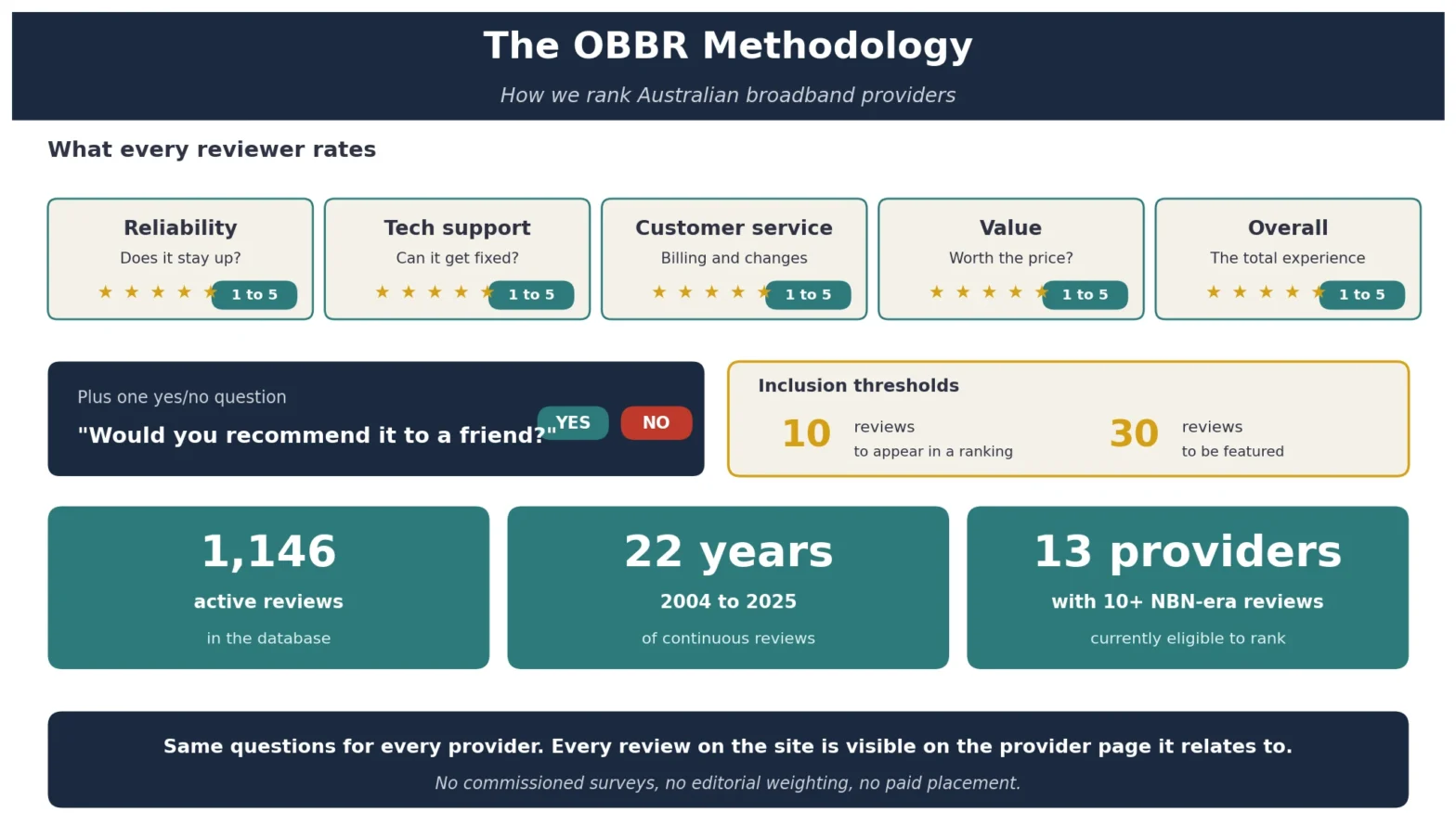
When somebody writes a review on OzBroadbandReview, they rate their provider on five things, each on a 1-to-5 scale. We’ve used the same five categories since the very first review in 2004, which is what makes the longitudinal data possible.
The five sub-ratings are:
- Reliability. Does the connection stay up? How often does it drop out, and when it does, how long is it gone for?
- Technical support. When something breaks, can you get it fixed? Are the support staff helpful, do they know what they’re doing, and how long are you stuck on hold?
- Customer service. Everything that isn’t a technical issue. Billing, plan changes, moving house, cancellations.
- Value for money. Is the plan worth what you’re paying? This isn’t just about the headline price, it’s about what you get for it.
- Overall. A single number that captures the reviewer’s experience with the provider.
Reviewers also answer one yes/no question that drives the most useful single ranking we publish: “Would you recommend this provider to a friend?” That answer feeds the “percent recommended” score on every provider page and is the backbone of our “most loved” rankings.
On top of the ratings, every review collects the plan name, the monthly price the reviewer was paying, the connection type (NBN, ADSL, cable, satellite, wireless, and so on), the state and postcode, and free-text fields for pros, cons and a longer comment. About 35% of reviews have a verified email address attached and about 28% have a verified phone number.
How many reviews does a provider need before we rank them?
Two thresholds.
A provider needs at least 10 reviews before they appear in any leaderboard we publish. Below 10, the average can swing too much on a single five-star or one-star review and the score isn’t telling you anything about the provider, it’s telling you about the reviewer who happened to show up.
A provider needs at least 30 reviews to be featured in any “best of” tile, banner, or recommendation. Thirty is where the noise starts to settle and the average actually starts to mean something.
Right now there are 13 providers with at least 10 NBN-era reviews on the site, which is the eligible field for any current NBN ranking. Eleven providers have 30 or more reviews in total. The full numbers are visible on each provider’s page on the main site, and we show the review count next to the rating so you can see for yourself whether the sample size justifies the headline number.
Why we limit comparisons to the NBN era
If you average a provider’s reviews across all 22 years of the database, you’re comparing apples to oranges. Australian broadband in 2008 was nothing like Australian broadband in 2024, and a reviewer rating their ADSL connection in the Howard era had a completely different set of expectations to somebody on FTTP today.
So when we publish a current ranking, the comparison set is reviews from November 2018 onwards, which is when the NBN review volume reached a useful size. There are 490 NBN-era reviews in the database, with 574 reviews in total since 2018 that have the full sub-rating set. That’s the pool current leaderboards are drawn from.
The older reviews still exist on the site, they’re still on the provider pages, and they’re still useful for historical context. We just don’t put them next to current scores in a comparison table.
Two years that don’t follow the pattern
If you ever see a chart on OzBroadbandReview with the review counts by year, you’ll notice two oddities.
2020 has only three reviews. That was the COVID year and the site had a stretch of low traffic combined with a back-end issue. There simply isn’t enough data from 2020 to draw any conclusion about what that year was like for broadband customers.
2021 had 241 reviews, roughly six times the typical annual volume since. That spike came from a relaunch push and isn’t a sign that satisfaction or usage suddenly exploded. When we calculate trends we either smooth across rolling windows or annotate the chart so the spike doesn’t read as a real-world signal.
Every time-series chart on the site flags both anomalies on the figure itself.
What we don’t measure
Three things we deliberately don’t put numbers on, and the reasons why.
We don’t measure download speed directly through the review database. Reviewers sometimes mention their speed in the comment field but we don’t ask for a structured number, because what people remember is often the plan tier (“I’m on the 50 plan”) rather than what they’re actually getting. For real speed data we point to the ACCC’s Measuring Broadband Australia report, which uses Sam Knows whiteboxes in real Australian homes and is the only data source that doesn’t rely on memory.
We don’t measure outage frequency as a separate metric. Reliability captures it from the reviewer’s perspective, which is the bit you actually care about as a customer. The wholesale outage data from NBN Co and the providers themselves is published elsewhere if you want the raw count.
We don’t measure install time quantitatively for ranking purposes. Reviews can mention it in the activation field and the comments, but install times depend so heavily on connection type and address-specific quirks that a provider-level average isn’t fair.
If a number sits in our leaderboard, it came from real reviewer ratings, not from any of these adjacent measurements.
The affiliate question
A handful of the providers we rank are commercial partners of OzBroadbandReview, which means we earn a referral commission when somebody clicks through and signs up. We acknowledge this openly and you can see the disclosure on every relevant page.
What’s worth being clear about: reviewers have no idea which providers we earn commission from when they’re writing. The review form asks the same questions of every reviewer for every provider, the database column structure is identical across all 25 active providers in our catalogue, and the ranking calculation runs the same way regardless of commercial relationship.
Picking partners is a separate decision from collecting reviews. We partner with providers we already trust based on the reviews they’ve earned. That means partners tend to be operators with strong existing user feedback, which is the order we want it in: good providers first, then commercial relationship second. Some of the best-rated providers on the site aren’t partners and they appear in our leaderboards on the same basis as everyone else.
The label “affiliate” appears next to a provider’s name wherever we list them, so you can see at a glance which is which. Then you can make your own call.
How rankings are updated
The provider pages refresh whenever a new review comes in, so the headline rating on the main site is always live. The blog rankings we publish (most reliable, best support, best value, most recommended) are recalculated quarterly, in February, May, August and November. We pick those months to line up with the ACCC quarterly speed report so the publication cycle on the site stays in sync with the most-cited external benchmark.
Every blog ranking carries a date stamp on the article. If you’re reading one of our “best of” posts and the date is more than three months old, the underlying data has probably moved.
Where the data lives and how to contribute
The full review database powers four things:
The main provider pages at /company/[provider], each one showing the live rating, the breakdown across the five sub-ratings, and a rolling feed of recent reviews.
The savings calculator at savemoney.php, which uses the plan-price field from real reviews to show you what people on your speed tier are actually paying.
The blog rankings, recalculated quarterly from the same SQL.
The annual retrospective work like our 22 Years of Australian Broadband post, which is the long-form view of what’s changed across the full history of the database.
If you’ve got an Aussie broadband connection and you’ve never written a review, you can add one at any provider page. The reviews that actually move the rankings are the detailed ones with verified emails. The leaderboards get better every time somebody contributes.
How OBBR compares to other Australian comparison sites
Most of the major Australian broadband comparison sites publish “best provider” lists based on either editorial picks or a one-off survey of a few thousand customers commissioned each year.
OzBroadbandReview is different in that the entire ranking is built on free-form user reviews submitted continuously to a public database since 2004. There’s no commissioned survey, no editorial weighting, no one-shot snapshot. Every review on the site is visible on the provider page it relates to, so the data behind any ranking we publish is auditable in the same place it was collected.
That’s the trade-off. The sample sizes per provider are smaller than a 3,000-person survey, which is why we apply the 10-review and 30-review thresholds. What we lose in raw volume we make up in longitudinal continuity and in the fact that nothing in the database is paid placement or solicited feedback.
Frequently asked questions
How many reviews are in the OBBR database?
There are 1,146 active reviews in the database as of May 2026, covering the period from August 2004 to August 2025. About 490 of those are from the NBN era (November 2018 onwards) and 574 reviews from 2018 to 2025 have the full sub-rating and recommend-friend data set populated.
Why is the minimum threshold 10 reviews and not 5?
Because below 10 reviews the average rating can swing by half a star or more on a single new review, which makes the score unreliable as a basis for comparison. Ten is the point where the sample starts to settle. Thirty is where it stabilises enough that we’ll feature a provider in a banner or recommendation.
How is “percent recommended” calculated?
Each reviewer answers yes or no to “would you recommend this provider to a friend?” The percent recommended figure on each provider page is simply the share of reviews answered yes, out of all reviews that answered the question. Reviews from before 2019 don’t have an answer recorded for this question, so the calculation is based on 2019-onwards data.
Do you weight recent reviews more heavily than old reviews?
For the headline provider rating on the main site, no. Every active review counts equally. For current blog rankings we restrict the comparison set to the NBN era (November 2018 onwards) so the data being averaged comes from a single technology generation. We don’t apply a decaying weight on top of that, because once you start tweaking weights the methodology stops being something a reader can verify for themselves.
Are reviews verified?
About 35% of reviews have a verified email address attached and about 28% have a verified phone number. We don’t filter the ratings shown on the site to verified-only, because that would throw out useful data from earlier reviewers who used now-defunct email addresses. The verification flag is collected and stored, and if you want to drill into a single provider’s verified-only rating, the data is there to do it.
Do you remove or edit reviews?
We remove reviews that breach our review guidelines (spam, defamation, content that names individuals rather than the company, obvious fake submissions). Genuine negative reviews stay up. The active flag in the database is what controls visibility, and 1,146 reviews are currently active out of a slightly larger total submitted. Every removal decision is on the basis of guidelines, never on what the rating is or who the provider is.
How does OBBR earn money if the reviews are independent?
Through referral commissions from a subset of providers when somebody clicks through to a plan and signs up. Six of the 25 active providers in our catalogue are commercial partners. The “affiliate” tag is shown wherever those providers appear. Reviewers don’t know about the commercial relationship when they’re rating a provider, so it has no effect on what gets submitted.
Why is OptusNet listed instead of Optus?
The provider names in the database match the brand names we collected reviews against when those reviews were submitted. OptusNet was the consumer broadband brand for Optus for most of the database’s history. We keep the original brand name so the longitudinal review record is internally consistent. The same logic applies to brand renames like iiNet (now owned by TPG).
Can I download the raw review data?
Not as a one-click export, but the data is visible on every provider page as an aggregated view, and we publish quarterly slices of it in the blog rankings. Researchers and journalists wanting a structured cut can contact us via the contact page.
How often are the rankings updated?
The live provider pages update whenever a new review comes in. The blog rankings (most reliable, best support, best value, most recommended) are recalculated quarterly, in February, May, August and November. Annual retrospectives like the 22 Years of Australian Broadband wrap-up are published once a year.
What happens if a provider exits the market?
Their reviews stay in the database with the original company record marked inactive. They don’t appear in current rankings (which require at least 10 NBN-era reviews and an active company status), but the historical record is preserved so we can include them in longitudinal pieces like the 22-year retrospective.
If you want to see the methodology in practice, two pieces of OBBR content lean on it heavily: the 22 Years of Australian Broadband retrospective, which uses the full historical database, and Starlink vs Sky Muster, which is the kind of head-to-head comparison the review data is built to support.
Spot something in the methodology that doesn’t add up, or want a piece of the data cut a different way? Drop us a note via the contact page.
The rankings built on this methodology
We have started publishing leaderboards that use the scoring described above: