Last updated: 22 August 2026
It’s no secret that Australia is a massive country, so making sure that everyone has access to fast internet is always going to be a massive challenge.
Satellite internet plays an important role in ensuring that the majority of Australians have access to fast internet regardless of where they live. In country towns and rural areas internet options are limited. NBN fibre to the node or curb infrastructure may not be available and the distance to the nearest exchange may be too far for ADSL which leaves satellite internet as the only option remaining for broadband internet access.
There are currently two main players in the Satellite internet space in Australia:
- Sky Muster (NBN)
- Starlink (SpaceX – Elon Musk)
This article compares Sky Muster and Starlink satellite internet providers and provides the key pros and cons of each service.
What is NBN Sky Muster Satellite internet?
As mentioned in our article on different types of NBN connections, Sky Muster is the satellite internet provided by NBN Co which is the Australian government owned national broadband network provider.
There are currently two Sky Muster satellites that provide internet to remote parts of Australia. To access Sky Muster, a satellite dish must be installed on your house so you can receive the signal from the satellite. Satellite connections are much slower than the other NBN connections but the technology is improving all the time. NBN Sky muster internet is currently available in speeds up to 25Mbps.
A network of 10 ground stations, each featuring two 13.5 metre satellite dishes which broadcast the internet signal to the orbiting Sky Muster satellites. The ground stations have been built in specific locations across Australia to maximize both the availability and capacity of the system.
What is Starlink Satellite Internet?
Starlink is a satellite internet provider owned and operated by Elon Musk’s company SpaceX. It is available in over 100 countries globally and covers all of Australia in 2026. You can check Starlink satellite coverage.
Starlink’s main advantage over conventional satellite internet providers is that its satellites orbit the earth at much lower altitudes which means that it is able to deliver faster internet with low latency.
Starlink’s key market is rural and remote areas due to most of the world’s rural population having little to no access to the ‘normal’ fibre optics based broadband internet. It is not as cost competitive in cities as there are usually numerous wired and wireless internet options available in urban areas. We have already written an overview of Starlink internetbut this article goes on a much deeper dive.
How does Starlink and Sky muster work?
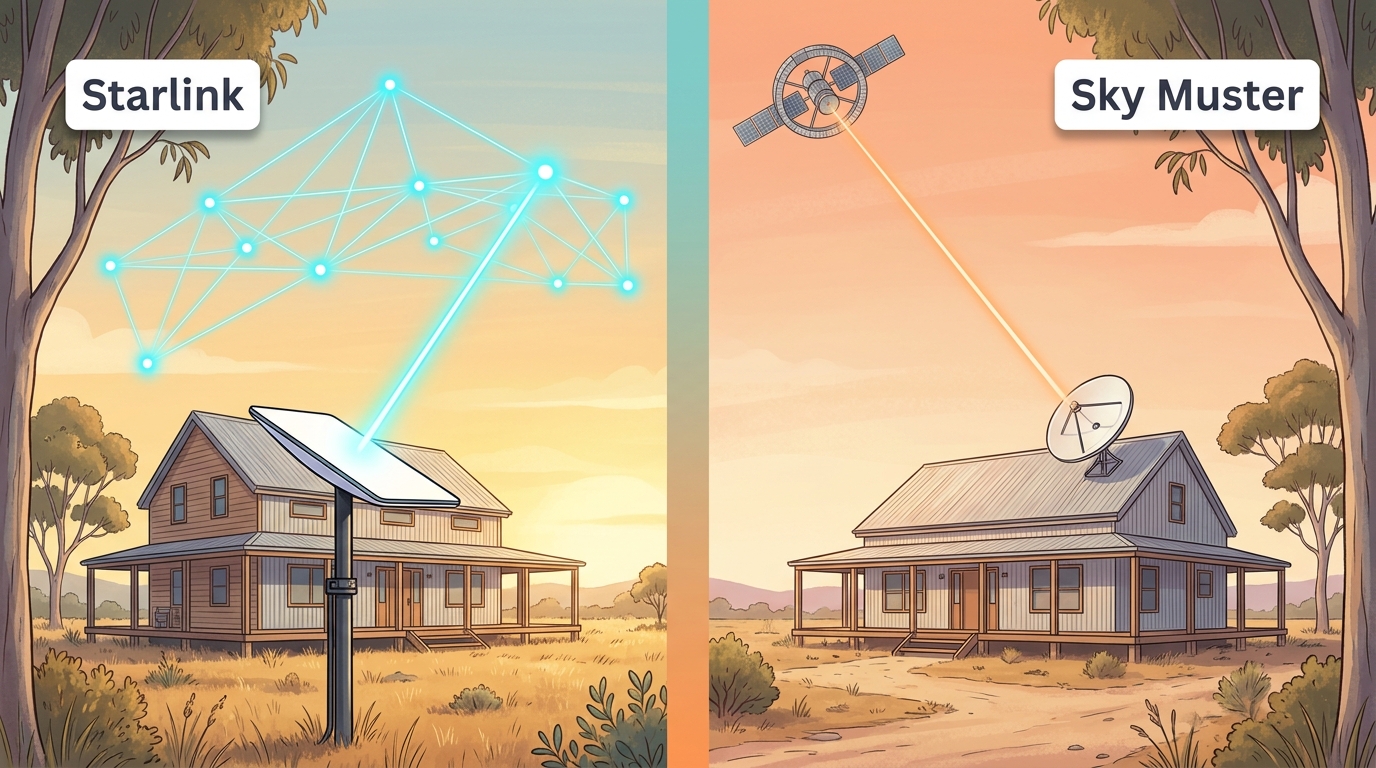
Sky Muster and Starlink are very different types of satellites but they operate in similar ways.
Sky Muster and Starlink satellites are both in orbit above the earth and communicate with ground mounted satellite dishes called ground stations. The ground station has a high speed internet connection and sends the signal up to the satellite which then re-transmits it to your house via the satellite dish or receiver on your home.
The diagram below is a simplified view of how satellite internet services work.

How does Starlink compare to NBN Sky Muster?
Design
What do Sky Muster and Starlink satellites actually look like?
As you can see from the images below, Sky Muster satellites look like the conventional communications satellites that you see on TV from time to time. Starlink satellites look a bit like a yacht from the future. Both satellites are powered by solar panels as you can see in the pictures.


NBN Sky Muster satellites are one of the largest communications satellites
Size and Weight
NBN Sky Muster satellites are one of the largest communications satellites in the world. On the other hand, Starlink Satellites are tiny in comparison. The table below summarises the size and weight of the both the satellite types.
| Satellite | Size | Weight |
|---|---|---|
| NBN Sky Muster | 26 metres long, 12 metres wide, and 9 metres tall. | 6,400 kg |
| Starlink | Roughly the size of a dining table ie. 2 metres long and 1 metre wide. | 260 kg |
Number of Satellites
There are currently over 7,000 Starlink satellites in orbit and SpaceX has been granted permission for around 12,000 satellites under the first-generation constellation, with applications filed for tens of thousands more. There are roughly 700 Starlink satellites above Australia at any one time.
The image below shows all the Starlink Satellites above Australia. Pretty amazing! You can track the Starlink Satellites in real time at this interactive website.

At the other end of the spectrum, Sky Muster has only 2 satellites above Australia in high orbit which can cover the whole country.
| Company | Satellites over Australia | Satellites Worldwide |
|---|---|---|
| Starlink | ~700 | 7,000+ and growing |
| Sky Muster | 2 | 2 (only available in Australia) |
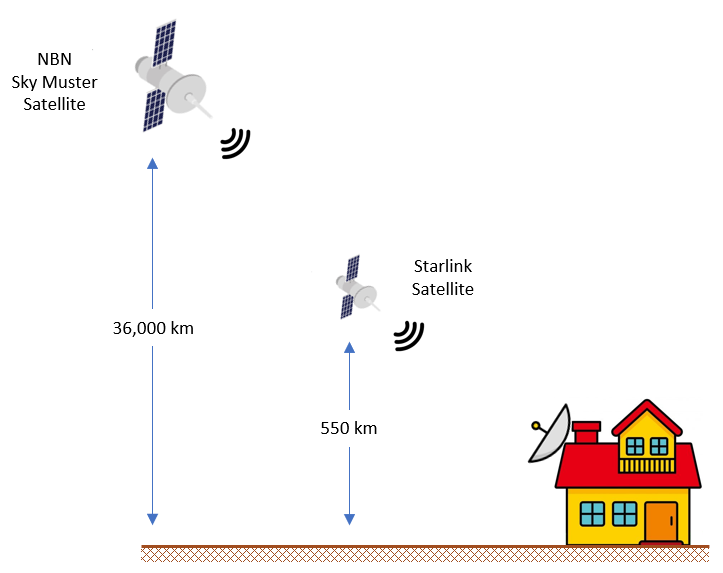
Orbit Altitude
Sky Muster satellites have a very high orbit which means that each satellite is able to cover a huge area. Sky Muster only needs 2 satellites to cover the whole of Australia.
On the other hand, Starlink satellites orbit the earth at a much lower altitude which means that there needs to be hundreds of satellites to cover the whole of Australia.
NBN Sky Muster vs Sky Muster Plus – What’s the difference?
NBN Sky Muster comes in two flavours: Sky Muster and Sky Muster Plus. The main
With standard Sky Muster all downloads will count towards the monthly quota whereas with Sky Muster Plus only video streaming and VPN traffic between midnight and 4pm counts towards the monthly data quota. Sky Muster Plus is also faster than standard Sky Muster.
Examples of video streaming that count towards your monthly data allowance between 4pm and 12am midnight, include: Netflix, ABC iView, Stan, FOXTEL, You Tube, Tik Tok, Play On and embedded video on newspaper and magazine websites.
Examples of Virtual Private Network traffic that count towards your monthly data allowance between 4pm and 12am midnight include: accessing the internet through products like Nord VPN, Norton Secure VPN, Pure VPN and/ or VPNs proprietary to workplaces and companies.
NBN ran a trial of an upgraded Sky Muster Plus service in 2023 and rolled out the improvements through 2024–2025. The current Sky Muster Plus Premium tier offers burst speeds of up to 100Mbps download and 20Mbps upload in eligible areas, with much higher unmetered allowances than the old standard Sky Muster.
Speed
Standard Sky Muster plans are offered at NBN 25 (25Mbps) and Sky Muster Plus plans are advertised with a minimum download speed of 25Mbps with burst speeds of up to 50Mbps and an upload speed of 5Mbps. The newer Sky Muster Plus Premium service can deliver up to 100Mbps in eligible areas.
On the other hand Starlink offers download speeds of 80Mbps to 200Mbps and upload speeds of around 10–30Mbps. Speeds have come down a bit from Starlink’s early days as more subscribers have joined the network. Despite this, Starlink remains far faster than Sky Muster.
Data allowance
Sky Muster plan data allowances range from 150GB to 500GB. Sky Muster Plus has unlimited data except for streaming video and VPN during peak periods (4pm–midnight). It can appear a bit confusing to be honest. Sky Muster Plus Premium offers higher unmetered allowances again.
Starlink, on the other had, only has one plan for residential customers and it includes unlimited data use.
Latency
As discussed in our NBN vs Broadband vs Wireless guide, latency is the time it takes to send data and receive a response and is measured in milliseconds (ms). In the case of a satellite internet system, the data has to travel a lot further than a typical fibre to the node or curb system.
Poor latency (the higher the number the worse the latency) is a common issue associated with satellite internet.
Because NBN satellites orbit the earth at such a great height, it takes time for the signal to be sent and received between dish and satellites, which can result in bad latency. Sky Muster satellite latency is around 600ms.
Starlink is able to achieve much lower latency because its satellites are a lot closer to Earth. Typical values for latency for Starlink are between 20ms and 40ms.
Cost
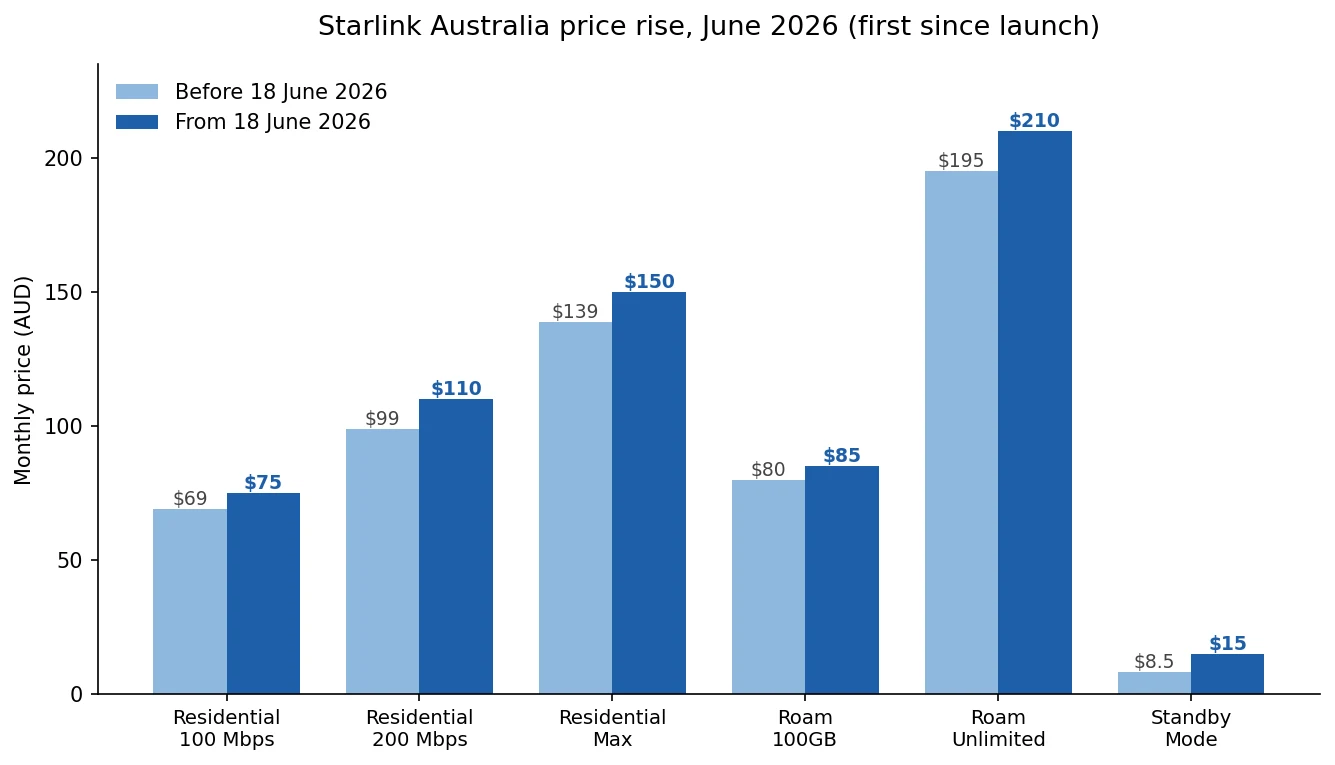
Starlink put its Australian prices up in June 2026, the first rise since the service launched here. There are now three residential tiers: 100 Mbps for $75 per month, 200 Mbps for $110 per month, and Residential Max (uncapped, typically 170 to 320 Mbps) for $150 per month. New customers also pay $15 a month to rent the hardware, so the real monthly figures are $90, $125 and $165.
The other big change is that the upfront hardware bill is gone. The standard kit used to cost $599; it’s now a free rental with nothing to pay up front. The catch is you have to send it back within 30 days if you cancel, or Starlink charges you $549. If you’d rather own the kit outright you can buy one from JB Hi-Fi, Officeworks or Harvey Norman for around $549.
NBN Sky Muster on the other hand is much cheaper and comes in many different shapes and sizes.
Sky Muster plans start at around $35 per month for 50 to 100GB of data. Sky Muster Plus plans are a bit more expensive and start at around $70 per month. Sky Muster Plus Premium tiers with uncapped data generally land between $70 and $135 per month depending on the provider and speed tier. And unlike Starlink, the Sky Muster dish and installation are handled by nbn for free, with nothing to return if you ever cancel.
Summary
| Company | Download Speed | Upload Speed | Data | Latency | Cost |
|---|---|---|---|---|---|
| Sky Muster | 25 Mbps | 5 Mbps | 150GB to 500GB | ~600ms | $35 to $70/month |
| Sky Muster Plus / Plus Premium | 25 to 100 Mbps | 5 Mbps | Uncapped (Premium) | ~600ms | $70 to $135/month |
| Starlink Residential | 100 to 320+ Mbps | 15 to 35 Mbps | Unlimited | 25 to 40ms | $90 to $165/month (incl. hardware rental) |
| Starlink Roam (travel) | 50 to 150 Mbps | 10 to 20 Mbps | 100GB or Unlimited | 25 to 40ms | $85 or $210/month + Mini kit from $399 |
Starlink vs Sky Muster – Which one should I choose?
Starlink and Sky Muster really cater to two totally different markets and whether you choose Starlink or Sky Muster really depends on your situation.
If you play games, work from home regularly or stream heaps of online video content then Starlink is probably better for you.
If you are a small consumer of the internet and are prepared to put up with some buffering and lag in order to save some money then you will be able to find a Sky Muster plan to suit your needs.
If you are currently a Sky Muster customer and are frustrated with the speed or lag then it might be worth giving Starlink a go.
Is Starlink better than Sky Muster?
The short answer is yes. Starlink is faster, has unlimited data and no and has lower latency so it is technically better than Sky Muster but it can also be much more expensive than Sky Muster depending on how you use it.
Is Starlink viable in the long term?
In 2024 SpaceX announced that Starlink had reached cash-flow positive territory, which suggests the long-term business is viable. Maintaining the satellite constellation is expensive, but the subscriber base has grown rapidly and there are now over 7,000 satellites in orbit with regular launches replacing older ones.
As wireless mobile networks continue to improve and become cheaper in price they are a real threat to companies like Space X. A mobile phone tower is much cheaper to install and maintain than a satellite.
What do you think? Let us know.
What’s the best satellite internet in Australia?
For most rural Australian households in 2026, Starlink Standard is the best satellite internet option. The combination of speed tiers from 100 up to roughly 400 Mbps, 30–50ms latency, and unlimited data beats anything else on the satellite market by a long way. The trade-off is the $599 upfront cost.
If you want something cheaper, Sky Muster Plus from a provider like SkyMesh, Activ8me or iPrimus is the next best option. Slower and laggier than Starlink, but with no upfront hardware cost and monthly plans from $70.
Starlink Mini is the budget Starlink option, $399 hardware and $80/month. The smaller kit is also portable, which makes it the right pick for caravans and travel as well as small fixed homes.
Here is how the current satellite plans stack up on price and speed. One thing worth checking before you commit: if your address can get a fixed line NBN connection, that will almost always be cheaper, and our best NBN plans page covers those.
Are there any alternatives to Starlink in Australia?
For satellite only options, Sky Muster (and Sky Muster Plus / Plus Premium) is the main alternative. The one to watch is Amazon Leo, which used to be called Project Kuiper. nbn has partnered with Amazon to run a low earth orbit service for regional Australia, with trials expected to start in late 2026. If it shows up on schedule it will be the first real competition Starlink has had in this country. OneWeb is around too but only for business customers.
Telstra also sells a Satellite Home Internet plan that actually runs on Starlink’s network. It’s $125 per month with download speeds capped at 50 Mbps. You are paying for Telstra billing and support rather than dealing with SpaceX directly. Most people are better off going direct, but if you want everything on the one Telstra bill it exists.
We\’ve pulled all of these options apart properly, with current prices and who each one suits, in our full guide to Starlink alternatives in Australia.
If you’re considering satellite because you can’t get fixed-line NBN, also check whether 5G home wireless works at your address. In some semi-rural areas Telstra or Optus 5G can deliver 50–300 Mbps for $59–$85/month with no upfront hardware cost. Worth a coverage check before committing to satellite.
For a deeper look at Starlink specifically, see our guide to Starlink in Australia.
SkyMesh vs Starlink: aren’t they the same thing?
Heaps of people search for SkyMesh vs Starlink, so let’s clear this up because the names are confusingly similar. SkyMesh isn’t a satellite. It’s an Australian internet provider that has been connecting regional Australia for about 20 years, and it’s best known for selling Sky Muster plans. Sky Muster is the actual nbn satellite; SkyMesh is one of the companies you buy it through.
So a SkyMesh vs Starlink comparison is really a Sky Muster plan from SkyMesh up against Starlink bought directly from SpaceX, and everything in this article about speed, latency and cost applies. SkyMesh does sell Starlink as well, but only to business customers. If you want to see how the two stack up on real customer reviews, we compare them side by side at SkyMesh vs Starlink.
Frequently asked questions
Is Starlink available everywhere in Australia?
Yes. As of 2026 Starlink covers all of Australia including the Northern Territory, WA, and far north Queensland. You can check service availability for your specific address at starlink.com.
How much does Starlink cost in Australia?
Starlink residential plans are $75 (100 Mbps), $110 (200 Mbps) or $150 (Residential Max) per month, plus $15 a month hardware rental for new customers. There’s no upfront hardware cost on residential plans any more. Roam plans for travellers are $85 per month for 100GB or $210 per month unlimited. Prices went up in June 2026, the first rise since Starlink launched in Australia.
Can Sky Muster Plus Premium really do 100 Mbps?
In eligible areas, yes. Sky Muster Plus Premium can burst up to 100 Mbps. Real world speeds during evening peak are usually lower (40–80 Mbps). Latency is still high (~600ms) since the satellites are still geostationary.
Is Sky Muster Plus unlimited?
It’s effectively unlimited for most uses. The exception: video streaming (Netflix, YouTube, ABC iView, etc.) and VPN traffic between 4pm and midnight count towards a metered allowance. Outside those hours streaming and VPN are unmetered.
Is Starlink Mini good enough as a primary home connection?
For 1–2 people or a small home, yes. Speeds are typically 50–150 Mbps versus the 100 to 400 Mbps tiers on Residential, and the smaller dish uses less power (around 30W vs 75W). For larger families or heavy streaming, the Standard kit is the better fit.
Can I use Starlink in a caravan or while travelling?
Yes. Starlink Roam is the plan designed for that: $85 per month for 100GB of data or $210 per month for unlimited. Works anywhere in Australia, no fixed address requirement. The Starlink Mini kit (from $399) works well for travel because it’s small and runs off 12V power.
Some real world data
A friend of mine lives on a semi rural property about an hour out of Newcastle. He doesn’t have access to cable based internet so is forced to use Satellite internet.
He was with NBN Sky Muster and was getting download speeds of 5-15Mbps and a latency of 800 to 1200ms.
He recently changed to Starlink and is now getting download speeds of 50 to 150Mbps with a latency of 30 to 60ms.
The improvement is quite remarkable and he was on quite a high data plan with Sky Muster so is paying about the same per month for both of the services.
His experience matches the official numbers. In its December 2025 report, the ACCC measured Starlink at an average of 197 Mbps during busy hours with latency around 27ms, while Sky Muster latency came in over 660ms. That was one of the last reports the ACCC ever published; it wound up its Measuring Broadband Australia program in June 2026, so from here, real world numbers like the ones our reviewers report are pretty much all anyone has to go on.