Last updated: 18 May 2026
VPNs have moved from a niche tech-enthusiast product to something you see advertised on YouTube every other day. After the Optus and Medibank data breaches in 2022-2023, plus the ongoing rollout of Australia’s metadata retention laws, “should I use a VPN for my NBN connection?” is a question more Australians are asking. The short answer: it depends on what you’re trying to protect against. This article walks through what a VPN actually does, what it doesn’t, and whether the speed trade-off is worth it.
What a VPN is in plain English
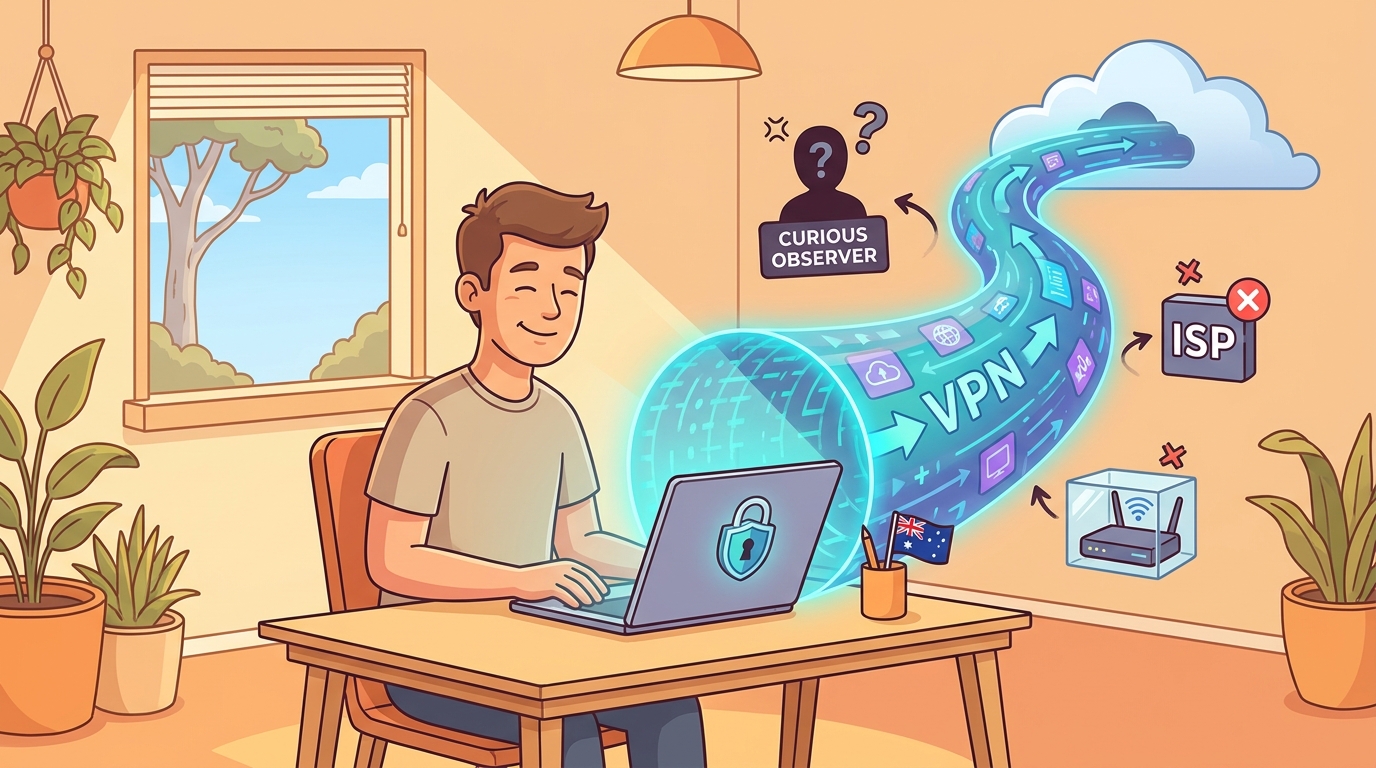
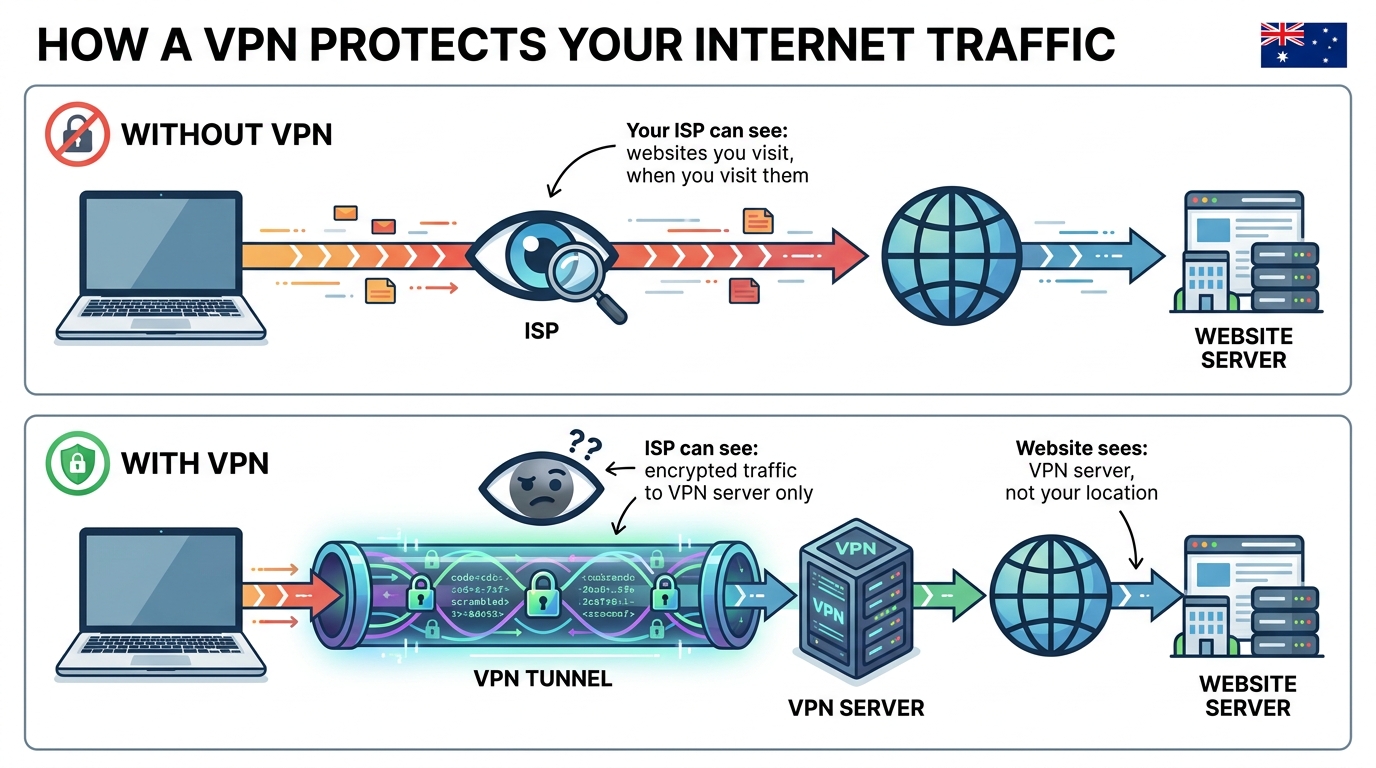
A Virtual Private Network (VPN) routes your internet traffic through an encrypted tunnel to a server run by the VPN provider. The VPN server then sends your traffic on to the actual destination (a website, an app server, a video stream) on your behalf, and brings the response back through the encrypted tunnel.
Two practical effects:
- Your ISP can’t see what websites you’re visiting. They only see an encrypted connection between your house and the VPN server.
- Websites and apps see the VPN server’s location, not yours. Connect to a VPN server in Tokyo, and Netflix thinks you’re in Tokyo.
What a VPN does — and what it doesn’t
The VPN industry has been over marketed to the point where many people think a VPN is a magic privacy bullet. It isn’t. Here’s what they actually do versus the things they’re often falsely advertised to do.
| What a VPN DOES | What a VPN DOES NOT do |
|---|---|
| Hides which websites you visit from your ISP | Make you anonymous to the websites themselves (they still see your account, cookies, browser fingerprint) |
| Encrypts traffic on hotel / cafe / airport Wi-Fi so others on the network can’t snoop | Protect you from malware, phishing or scam sites |
| Lets you access geo-restricted content (Netflix US, BBC iPlayer, etc. — though streamers block VPNs aggressively now) | Hide your activity from a VPN provider that logs traffic |
| Hides your real IP address from websites and apps | Speed up your internet (it almost always slows it down) |
| Adds a layer of protection on public Wi-Fi networks | Make you immune to government data requests if the VPN keeps records |
| Can sometimes get around employer / school network restrictions | Make HTTPS sites “more secure” — they were already encrypted end-to-end |
Australia-specific context: data retention and breaches
Australian ISPs are required by law to retain certain metadata about your internet activity for two years under the Telecommunications (Interception and Access) Act. This includes things like which IP addresses you connect to, when, and for how long, but not the content of what you actually did. Using a VPN shifts that recording from your ISP to the VPN provider (and good VPN providers keep no logs, by policy).
After the Optus (2022) and Medibank (2022) data breaches affecting millions of Australians, plus the more recent attacks on Australian companies, there’s been renewed interest in personal privacy tools. A VPN doesn’t help if your data was already leaked from a company’s database, but it does add a layer of protection going forward, particularly on public Wi-Fi and against ISP level tracking.
The speed trade-off
Routing your traffic through a VPN server adds latency and reduces bandwidth. How much depends on three things:
- Distance to the VPN server. A Sydney user connected to a Sydney VPN server might lose 5-15% of their speed. The same user connected to a London server might lose 50-70% — the data has to physically travel to the UK and back.
- VPN protocol. WireGuard is the modern fast option (built into most consumer VPNs in 2026). OpenVPN is slower. Avoid PPTP entirely — it’s old and insecure.
- VPN provider quality. The premium providers (Mullvad, ProtonVPN, NordVPN, ExpressVPN) have more capacity per server and so suffer less congestion. The free or ultra-cheap providers are often overloaded.
Which VPN should I get?
If you want a paid VPN that just works on an Australian NBN connection, our pick is NordVPN. AU servers in Sydney and Melbourne, fast WireGuard speeds (typically 200 to 300 Mbps on a gigabit NBN line), and a kill switch on every plan. Roughly $4 to $7 per month on the longer plans.
Practical example: on a typical NBN 100 connection in Australia, a Sydney-server VPN with WireGuard typically delivers 85-95 Mbps. A US-server VPN with WireGuard often drops to 30-60 Mbps. If you need full plan speed for 4K streaming or competitive gaming, run those on the bare connection and use the VPN only when you need privacy or geo-bypass.
Do you need one? Honest answer
For most Australian home users on the NBN, you probably don’t need a VPN running 24/7. HTTPS already encrypts the actual content of your traffic with every reputable website. Your home Wi-Fi network (with WPA2 or WPA3 encryption) protects you from neighbours snooping. Your ISP can see metadata but typically isn’t doing anything malicious with it.
Where a VPN clearly earns its place:
- You frequently use hotel, cafe or airport Wi-Fi. These networks are genuinely sketchy; a VPN is a real security upgrade.
- You want to access geo-restricted content. Streaming libraries from other countries, BBC iPlayer, etc.
- You torrent or do other things you’d prefer your ISP didn’t log.
- You travel often, especially overseas. Some countries block services like Google or social media; a VPN gets around it.
- You value privacy as a principle regardless of immediate practical need. Reasonable position.
Where a VPN is probably overkill: a typical home user who mostly streams Netflix, scrolls Instagram, and does online banking. HTTPS plus a good Wi-Fi password is enough for almost everything.
What to look for in a VPN provider
- No-logs policy that’s been independently audited. “We don’t keep logs” is meaningless unless a third party has verified it. Mullvad and ProtonVPN are known for strong audit records.
- Jurisdiction. Where the VPN company is legally based matters. Companies based in “14 Eyes” countries (including Australia) can be legally required to start logging. Swiss, Panamanian and Icelandic providers are typically considered safer jurisdictions.
- Modern protocols. WireGuard support is now standard and significantly faster than OpenVPN.
- Server in Australia. Critical for keeping speeds reasonable for everyday browsing.
- Reasonable price. Premium VPNs run $5-$10/month on annual or 2-year plans. Anything significantly cheaper is usually selling your data or skimping on infrastructure.
Avoid “free” VPNs. Most monetise by logging and selling your browsing data, which defeats the entire purpose.
Frequently asked questions
Does a VPN need Wi-Fi to work?
No. A VPN works over any internet connection, including Wi-Fi, Ethernet, 4G/5G mobile data, and 5G home wireless. The VPN just adds an encrypted layer on top of whatever connection you already have. It needs an internet connection to function, but the connection itself can be wired or wireless.
Will a VPN slow down my NBN connection?
Yes, usually by 5-15% if you connect to a VPN server in Australia, or 30-70% if you connect to a server overseas. Modern WireGuard based VPNs have minimised this overhead but it’s never zero. If you only need the VPN for specific tasks (overseas streaming, public Wi-Fi), most apps let you turn it on and off easily.
Can my ISP see what I do with a VPN on?
Your ISP can see that you’re connected to a VPN server (specifically, that you have an encrypted connection to a known VPN service’s IP address). They can’t see what websites or services you’re visiting beyond that, or what data you’re sending. In short: they know you’re using a VPN, but nothing about what you do through it.
Are VPNs legal in Australia?
Yes. Using a VPN is completely legal in Australia. What you do through the VPN still has to be legal. A VPN doesn’t change the legality of actions like copyright piracy or hacking. But the VPN itself, and using one to protect your privacy, access geo-restricted content, or use public Wi-Fi safely, is all permitted under Australian law.
Will a VPN protect me from hackers?
Partly. A VPN protects you from passive snooping on the same network, like someone capturing data on hotel Wi-Fi. It does not protect you from malicious websites, phishing emails, malware downloads, or attacks aimed at your accounts directly. For those, you need other things, strong passwords, two-factor authentication, antivirus, sensible browsing habits.
Can I use a VPN to watch Netflix from other countries?
Sometimes. Streaming services aggressively detect and block VPN servers, Netflix, Disney+ and Stan all maintain databases of known VPN IP addresses. Premium VPN providers play cat-and-mouse with the streamers and usually have some servers that still work for streaming. Cheap or free VPNs are almost always blocked. If geo-bypass is your main reason for using a VPN, check current reviews of specific providers’ streaming success rates, they change month to month.
Do I need a VPN with HTTPS?
Not strictly. HTTPS already encrypts the content of your traffic between you and the website. A VPN adds the additional layer of hiding which websites you’re visiting from your ISP and obscuring your location from the websites. So HTTPS protects the content; a VPN protects the metadata.
Can I use a VPN with 5G home wireless?
Yes. VPNs work on any internet connection including 5G home wireless from Telstra, Optus and TPG/Vodafone. The speed reduction tends to be slightly higher than on fibre NBN because 5G already has variable latency. For an honest comparison of 5G home wireless vs NBN see our 5G vs NBN guide.
What\u0026#39;s a no-logs VPN?
A VPN provider that promises not to keep records of your activity. Which IPs you connected to, what sites you visited, when. Critically, “no logs” is only meaningful if it’s been independently audited (the provider hasn’t just said so). Mullvad and ProtonVPN have the strongest audit records as of 2026.
Should I run a VPN on my router?
Running a VPN on your router covers every device in your house automatically. Trade-offs: the router itself becomes the bottleneck for VPN speeds (cheap routers struggle to keep up), and you lose the flexibility of turning the VPN off for specific devices (your smart TV won’t stream Australian Netflix if your router VPN is set to the US). Most people get more flexibility from running VPN apps on individual devices.
Related guides
- Test your internet speed — useful for measuring the VPN’s speed impact
- How to compare NBN plans — if you need extra headroom for the VPN’s overhead
- 5G home wireless vs NBN
- The difference between broadband and Wi-Fi
- NBN FAQ