The ACCC Measuring Broadband Australia report is a quarterly government check on whether NBN providers actually deliver the speeds they sell. It uses real testing hardware plugged into about 1,148 volunteer homes around the country, runs hundreds of thousands of automated speed tests, and publishes how close each provider and each connection type gets to its advertised speed. It is the closest thing Australia has to an independent umpire on broadband performance, and almost nobody outside the industry knows it exists.
We cite this report constantly across OzBroadbandReview, so this is the post that explains what it is, who runs it, and what the latest edition found. The current edition is Report 32, released on 2 April 2026, covering tests run through December 2025.
What is Measuring Broadband Australia?
Measuring Broadband Australia (MBA) is a program the ACCC has run since 2018. The competition regulator pays an independent testing company, SamKnows (now part of Cisco), to measure fixed broadband performance in real homes rather than relying on what providers claim in their ads.
It works like this. Volunteer households host a small testing device called a Whitebox that plugs into their modem. The Whitebox runs automated tests around the clock against servers hosted in Australia, measuring download and upload speed, latency, packet loss, outages, how fast popular web pages load, and whether video streams play cleanly. It does not record your browsing or personal data. The December 2025 panel ran more than 251,000 download tests on NBN fixed-line connections alone.
The headline number everyone quotes is download speed as a percentage of plan speed during the busy hours, which the ACCC defines as 7pm to 11pm on weekdays. That is the window when everyone is home streaming and the network is under the most strain, so it is the fairest test of whether you get what you pay for when it matters.
What the latest report found
Across all NBN fixed-line connections, providers delivered 98.5% of plan speed during the busy evening hours in the December 2025 data. In plain terms, if you paid for an NBN 100 plan you were typically getting about 98 Mbps in the evening. That is a strong result, though it slipped slightly from 100.0% in the previous report, and the ACCC’s own commissioner described it as Australians “typically receiving the speeds they have paid for.”
The more useful detail is the gap between providers. Here is how each retailer scored on busy-hour download speed in Report 32.
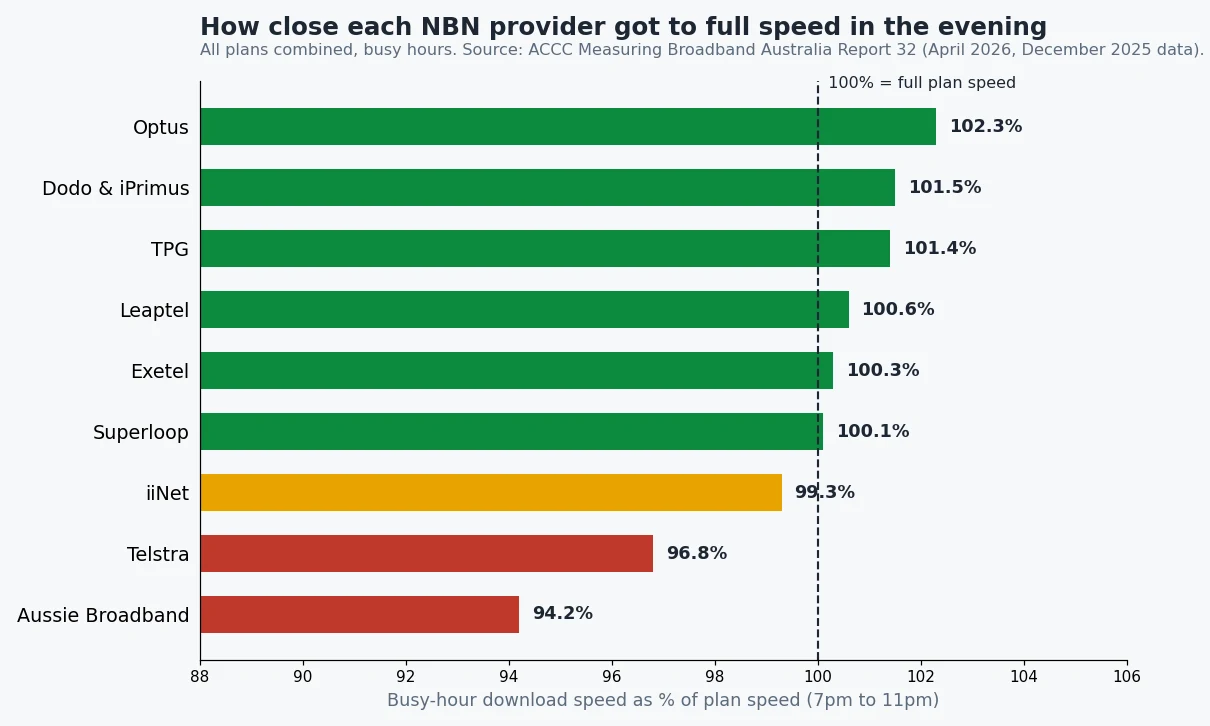
A few things stand out. Optus, Dodo, TPG and Exetel actually delivered slightly above 100% of plan speed, which happens because the NBN often provisions a small buffer above the headline number. Most providers sat within a whisker of 100%. The one result worth a closer look is Aussie Broadband at 94.2%, the lowest of the named retailers this quarter. That looks surprising given its strong reputation, and the explanation is mostly in the mix of connection types its test panel happened to have, not a sudden drop in quality. One quarter of data on a panel of around 130 homes can move a provider’s number a few points either way, so the ranking matters less than the fact that every major retailer landed in the 94 to 102% band.
The real story is your connection type, not your provider
The biggest differences in the report are not between providers at all. They are between the physical technologies the NBN uses to reach your home. The same plan on the same provider performs very differently depending on whether you have fibre to the home or the old copper from the node.
| Connection type | Busy-hour download (% of plan) | Verdict |
|---|---|---|
| FTTC (fibre to the curb) | 105.2% | Best performer |
| FTTP (fibre to the premises) | 100.1% | Full speed |
| HFC (cable) | 98.3% | Close to full |
| FTTN (fibre to the node) | 93.6% | The laggard |
FTTN, the technology that still runs the last stretch to your home over copper from a street cabinet, is the clear weak link. It came in nearly 12 percentage points below the fibre options on the NBN 50 tier, and its upload performance is worse again at around 81% of plan. If you are on FTTN and your evening speeds frustrate you, the report is quietly telling you the problem is the copper, not your retailer. Switching providers on the same FTTN line rarely helps. Checking whether your address is eligible for a free fibre upgrade usually does.
This is the single most useful thing the report can do for a household: it separates the part of your speed that a provider controls from the part that is fixed by the wire in your street.
Underperforming services: 6.4%, and the cause is shifting
The ACCC flags a service as underperforming if it reaches 75% of its plan speed in fewer than 5% of tests. In Report 32, 6.4% of all tested services were underperforming, up from 4.4% in the previous report.
FTTN is the worst offender at 11.8% underperforming, and the NBN classifies almost all of those as “impaired,” meaning the maximum speed the line can physically reach is below the plan the customer bought. That is the ACCC’s polite way of saying some people are paying for NBN 100 on a line that will never deliver it.
The newer twist is interesting. Underperformance is now appearing on fibre and cable connections too, not because the network is failing but because of old gear inside the home. After NBN Co lifted many plans to higher speeds in September 2025, 6.3% of services on the new 500 Mbps plan were underperforming, often because of an aging router or a 100 Mbps Ethernet cable that physically cannot carry the speed. The bottleneck moved from the street into the living room.
This matches what you see on Whirlpool, where the running advice whenever someone upgrades to a 500 or 1000 Mbps plan and complains about not seeing the full speed is to check the router and the cable before blaming the provider. The report now backs that advice with hard numbers.
The high-speed plans changed the picture
The most significant change in this edition is the arrival of much faster plans. In September 2025 NBN Co lifted wholesale speeds on many fibre and cable connections, and the old 100/20 plan effectively became a 500/50 plan. That 500/50 plan is now the most popular plan in the entire test panel, and services on it averaged 493.7 Mbps in the busy hours, almost the full headline speed.
At the very top, the 1000 Mbps plan delivered download speeds in the 880 to 891 Mbps range through the day. That is not a shortfall: gigabit plans hit a practical ceiling around 940 Mbps because of normal networking overhead, so the high-800s is roughly what full speed looks like in the real world. There is now a 2000 Mbps tier as well, but the testing hardware cannot measure speeds that high yet, so the report leaves it out. Worth knowing if you are tempted by the fastest plan on the shelf: nobody is independently verifying it yet.
One catch the report makes plain: FTTN and FTTC connections cannot buy the 500/50 plan at all. Their ceiling is still 100 Mbps. If you want the new fast tiers, you need fibre or cable to the home, which loops back to the connection-type point above.
How to use this report when choosing a plan
For most people the practical takeaways are simple. The provider you pick makes only a small difference to raw speed, because they all sit close to 100% of plan, so choose on price, support and contract terms rather than chasing a fractional speed advantage. Your connection type matters far more than your provider, so find out whether you are on FTTP, FTTC, HFC or FTTN before you judge your speed. And if you are on FTTN and it frustrates you, check your fibre upgrade eligibility rather than switching retailers.
If you have decided your current plan is more than you are getting value from, these are the cheapest unlimited NBN plans from our partner providers right now:

|
Turtle Speed
25 Mb/s
Unlimited data
|
$64.90/mth | Go to site |

|
Value
25 Mb/s
Unlimited data
|
$42.90/mth
for 6 mths,
then $72.90/mth |
Go to site |

|
Basic - nbn 12/1
12 Mb/s
Unlimited data
|
$77/mth | Go to site |

|
Everyday
25 Mb/s
Unlimited data
|
$58/mth
for 6 mths,
then $78/mth |
Go to site |

|
One Plan
500 Mb/s
Unlimited data
|
$80/mth | Go to site |
| Click here to view more NBN plans | |||
For the wider context, our guide to the most reliable NBN providers ranks retailers on real customer reviews, and the piece on what Australians complain about most shows where the report’s numbers and lived experience line up.
Frequently asked questions
What is the ACCC Measuring Broadband Australia report?
It is a quarterly report from the ACCC that measures how fast NBN providers actually deliver, using testing hardware installed in around 1,148 real Australian homes. It has run since 2018 and is delivered with the independent testing company SamKnows. It measures download and upload speed, latency, outages and streaming quality, and reports each provider’s speed as a percentage of the plan speed customers paid for.
How fast is the NBN really, according to the ACCC?
In the latest report (Report 32, April 2026, covering December 2025), NBN fixed-line connections delivered 98.5% of their plan speed during the busy evening hours of 7pm to 11pm. So on an NBN 100 plan you were typically getting around 98 Mbps in the evening. Performance varies by connection type, with fibre delivering close to 100% and FTTN copper connections the slowest at 93.6%.
Which NBN provider is fastest in the ACCC report?
In Report 32 the providers closest to or above 100% of plan speed in the busy hours were Optus, Dodo and iPrimus, TPG, Leaptel, Exetel and Superloop. The differences between providers are small because they all run on the same NBN network and provision similar speeds. Your connection type makes a far bigger difference to your actual speed than which retailer you choose.
Why is my NBN slower than the plan I pay for?
The most common reason is your connection type. FTTN connections, which use copper from a street cabinet, averaged 93.6% of plan speed and 11.8% were classed as underperforming, often because the line physically cannot reach the plan speed. Other causes include old in-home equipment like an aging router or a 100 Mbps Ethernet cable, which the ACCC found bottlenecks the newer 500 Mbps plans. Switching providers rarely fixes a connection-type problem.
How often is the report published?
Quarterly. The ACCC releases a new Measuring Broadband Australia report roughly every three months and updates its online data dashboard at the same time. The current edition is Report 32, released on 2 April 2026. We update this page each quarter when a new edition lands.
Does the report measure the new 1000 Mbps and 2000 Mbps plans?
It measures the 1000 Mbps plan, which delivered download speeds of 880 to 891 Mbps through the day, close to the practical ceiling of about 940 Mbps once normal networking overhead is accounted for. The 2000 Mbps plan now exists but the testing hardware cannot measure speeds that high yet, so it is not covered. That means the fastest plan on the market has no independent speed verification at this stage.
Is the ACCC report independent?
Yes. It is run by the ACCC, the national competition regulator, using an independent testing company and hardware in real homes rather than data supplied by the providers. Providers cannot game it the way they can game a marketing claim, which is why it is the most trusted source of NBN speed data in Australia. Government funding for the program currently runs to June 2026.
References
- ACCC, Measuring Broadband Australia, Report 32 (2 April 2026, December 2025 data)
- ACCC media release: NBN delivers steady performance but some consumers missing out on full plan speeds (2 April 2026)
- ACCC, Measuring Broadband Australia program overview
- ACCC, broadband performance data explained (methodology)