Last updated: 22 August 2026
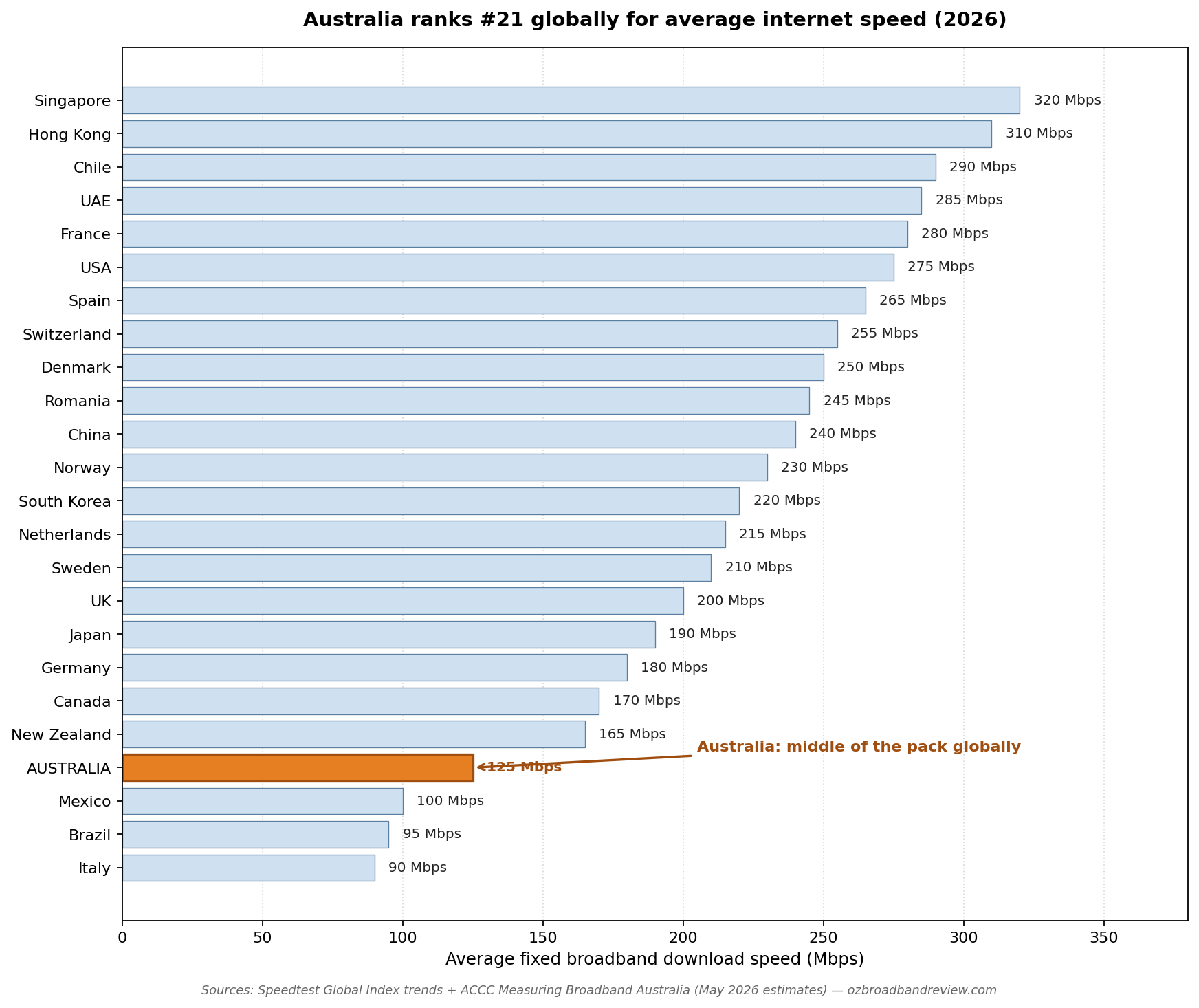
Where does Australia actually stand in the global internet speed rankings? The short version: middle of the pack. Per the latest Speedtest Global Index, Australia ranks around 21st worldwide for average fixed broadband speed at roughly 125 Mbps, well behind the world-leading 320 Mbps in Singapore and Hong Kong, but ahead of much of Europe and South America. Here’s the detail, why we sit where we do, and where we’re heading.
Australia’s ranking in 2026
The headline numbers as of May 2026:
- Global rank: ~21st for average fixed broadband download speed
- Average fixed download speed: ~125 Mbps
- Average fixed upload speed: ~28 Mbps
- Median latency: ~12 ms (locally)
- Median mobile download speed: ~95 Mbps
- NBN coverage: 93%+ of Australian premises
Compare that to the world’s top performers: Singapore and Hong Kong both routinely deliver averages above 300 Mbps, and the US has climbed to around 275 Mbps thanks to widespread fibre rollouts. New Zealand (165 Mbps) and Japan (190 Mbps) sit ahead of Australia. We’re slightly ahead of Mexico, Brazil and Italy.
Why is Australia mid-pack?
A few practical reasons we’re not in the top 10 despite having an NBN:
- The NBN’s “Multi-Technology Mix” legacy. Original 2009 plan was full fibre to most homes. After 2013 the rollout switched to a mix of FTTN copper, FTTC, HFC cable and Sky Muster satellite, which is cheaper to build but capped at lower speeds than full fibre. About 35% of homes still have copper-based FTTN connections capped around 50-90 Mbps.
- Geography. Australia is enormous and sparsely populated outside the major cities. Per-capita fibre rollout is much more expensive than in Singapore or Korea.
- Provider congestion. Even on capable connections, evening-peak congestion at retailers drags average speeds down. The ACCC’s quarterly report shows providers like Aussie Broadband and Superloop hit 95%+ of advertised speed; cheaper providers can dip to 75-85%.
- Late start on gigabit. NBN 1000 only became widely available in 2020-22. Most households haven’t upgraded yet.
What’s changing: the next few years
The trajectory is genuinely upward. Three things are pulling Australia’s average up:
- Free FTTP upgrade program. By mid-2026 around 2 million homes have been upgraded from FTTN copper to full fibre. Each upgrade typically takes the household from 50-90 Mbps to 250+ Mbps overnight.
- NBN 1000 and NBN 2000 adoption. Gigabit plans now start from around $110/month (Vocal’s nbn 1000), making the top tier accessible to enthusiast households. NBN 2000 (2 Gbps) launched in 2024 for FTTP premises and now starts from around $165/month.
- 5G home wireless. Telstra, Optus, TPG and Vodafone’s 5G plans routinely deliver 100-400 Mbps. Half a million Australian households are on 5G home wireless instead of NBN, which lifts the country’s average.
Realistic forecast: Australia should climb to around 17-18th globally by 2028 as more FTTN copper gets retired and gigabit plans become standard.
How does this compare to Australia’s past?
| Year | Australian average fixed download | Approx. global rank |
|---|---|---|
| 2016 | ~13 Mbps (ADSL era) | ~60th |
| 2020 | ~50 Mbps | ~50th |
| 2022 | ~70 Mbps | ~40th |
| 2024 | ~90 Mbps | ~30th |
| 2026 | ~125 Mbps | ~21st |
Where can you check your own speed?
The “average” headline number is interesting but what matters is your actual line. Run a speed test on Ethernet (wired connection, not Wi-Fi) to see where you sit:
If you’re below the national average (125 Mbps) on a connection that should deliver more, either your plan needs a bump or your provider has peak hour congestion problems. See how to compare NBN plans for the buyer’s framework.
Frequently asked questions
What is Australia’s average internet speed?
As of May 2026, Australia’s average fixed broadband download speed is roughly 125 Mbps, with around 28 Mbps upload. Median latency on local routes sits around 12 ms. The numbers have improved steadily as the NBN’s FTTP upgrade program retires copper FTTN connections. We’ve broken down the numbers behind this in more detail separately.
Where does Australia rank globally for internet speed?
Around 21st globally for average fixed broadband speed in 2026. We sit behind Singapore (#1 at ~320 Mbps), Hong Kong (#2 at ~310 Mbps), France, USA, Switzerland and New Zealand, but ahead of Mexico, Brazil, Italy and most of South America. The ranking moves by a few positions each year as countries upgrade infrastructure.
Why is Australian internet slower than in some other countries?
Three main reasons: (1) the NBN’s “Multi-Technology Mix” decision in 2013 meant a lot of homes got copper based FTTN instead of full fibre, capping speeds around 50-90 Mbps; (2) Australia is geographically enormous and sparsely populated, making nationwide fibre much more expensive than in Singapore or Korea; (3) gigabit plans are still relatively new and most households haven’t upgraded yet.
Is Australia’s internet getting faster?
Yes, steadily. Average download has gone from ~13 Mbps in 2016 to ~125 Mbps in 2026. Almost a 10x improvement. The free FTTP upgrade program (running since 2020) has upgraded around 2 million households from copper to fibre. The recent NBN 2000 tier launch and growth of 5G home wireless are also pushing the average up.
Which country has the fastest internet?
Singapore consistently ranks #1 globally for average fixed broadband speed at around 320 Mbps. Hong Kong is a very close #2 at around 310 Mbps. Both achieve this with widespread fibre-to-the-premises rollouts on dense urban populations. Much easier than in geographically large countries like Australia or the US.
What’s a good internet speed for Australian homes in 2026?
For most households of 2-4 people, NBN 50 (typical evening speed 47 Mbps) is the sweet spot. For families of 4+, heavy 4K streaming households or multiple people working from home, step up to NBN 100. NBN 250/500/1000 are increasingly mainstream for enthusiast or large households. See our what speed do you really need guide for the full breakdown.
How does Australia compare to New Zealand for internet speed?
New Zealand sits a few places ahead of Australia (~17th vs ~21st globally, ~165 Mbps avg vs Australia’s ~125 Mbps). NZ’s smaller geographic area + more concentrated fibre rollout via Chorus has paid off. The gap has narrowed in recent years as Australia’s FTTP upgrade program has reached more households.
What is the fastest internet you can get in Australia?
NBN 2000 (2 gigabits per second download) is the fastest residential plan available, only on FTTP connections, from around $165 to $225/month. For most practical purposes NBN 1000 (1 Gbps) is the realistic top tier, with providers including Vocal offering it from around $110/month. See our fastest NBN plans guide for the detail.