Last updated: 16 May 2026
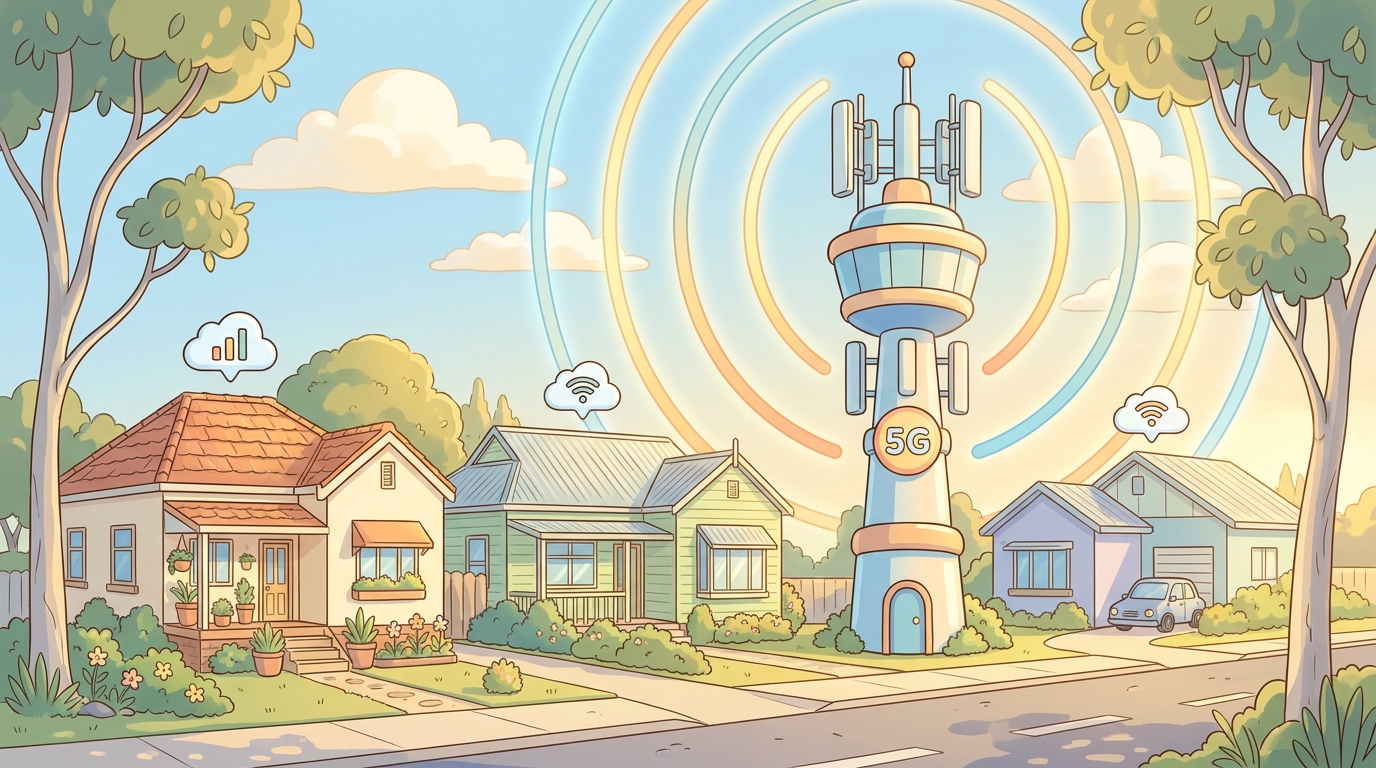
5G home internet is a real alternative to the NBN in most of metro Australia in 2026. You can get 50–500 Mbps download speeds for $59–$85/month with no installation and no NBN technician visit. The catch is coverage and consistency. Speeds depend on how strong your 5G signal is at your address and how busy the local tower is. This article covers what 5G is, how fast it actually runs in Australia, who offers it, and how to know if it’s the right choice for your home.
For the broader question of which type of internet suits you, see our NBN vs Broadband vs Wireless hub.
What is 5G?
5G is the fifth generation of mobile network technology. It runs on a wider range of radio frequencies than 4G, which lets it carry more data and serve more devices at once. Australian networks have been rolling out 5G since 2019, and by 2026 the major providers have 5G coverage across all capital cities and most regional centres.
The two main uses of 5G in Australia are:
- 5G on your phone — same as 4G mobile internet, just faster
- 5G home internet — a dedicated 5G modem that sits in your house and gives you Wi-Fi like the NBN does
This article focuses on 5G home internet, since that’s the option that competes with the NBN.
5G coverage in Australia in 2026
By 2026, the three main mobile networks have substantial 5G coverage:
- Telstra — around 90% of the Australian population. Best regional coverage of the three.
- Optus — around 85% population coverage. Strong in metro areas.
- Vodafone — around 85% population coverage. Concentrated in the major cities.
TPG uses Vodafone’s network for its 5G home plans, so coverage is similar.
Coverage varies street by street. The best way to check your specific address is on each provider’s coverage map (telstra.com.au, optus.com.au, vodafone.com.au).
5G in Sydney, Melbourne, Brisbane and other capitals
All three networks have strong 5G coverage in:
- Sydney — comprehensive metro coverage, most suburbs
- Melbourne — comprehensive metro coverage
- Brisbane — strong inner and middle suburbs, growing outer
- Perth — comprehensive metro coverage
- Adelaide — comprehensive metro coverage
- Hobart — central areas, expanding
- Canberra — comprehensive
For specific area coverage, our Where 5G is available in Australia guide tracks the current rollout.
How fast is 5G in Australia?
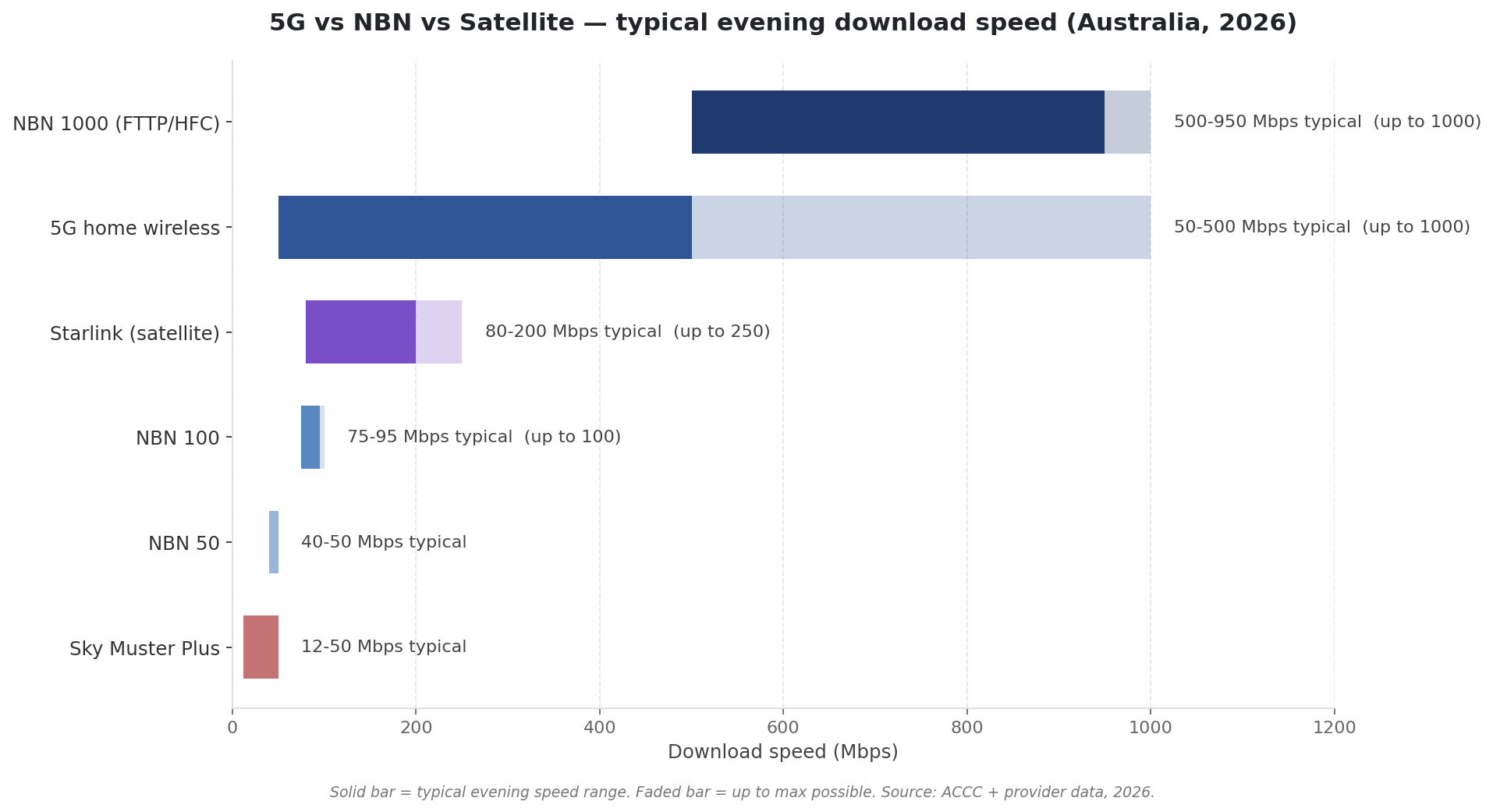
Real world 5G home internet speeds in Australia in 2026:
- Typical evening speed: 50–300 Mbps
- Peak speed in strong coverage: 500+ Mbps
- Theoretical max (mmWave 5G): 1000+ Mbps, but mmWave is rare in residential settings
For reference, the typical NBN 100 plan delivers 80–95 Mbps in the evening. So 5G can comfortably beat NBN 100, but the variability is much wider.
Best 5G home internet plans in 2026
The four main 5G home internet providers in Australia:
| Provider | Plan | Typical speed | Monthly price |
|---|---|---|---|
| Telstra | Home Internet 5G | Up to 250 Mbps | ~$85/mo |
| Optus | 5G Home Internet | Up to 300 Mbps | ~$75/mo |
| TPG | 5G Home Broadband | Up to 100 Mbps | ~$60/mo |
| Vodafone | 5G Home Internet | Up to 250 Mbps | ~$80/mo |
Most providers offer a 14 or 30 day trial. Use it. Coverage varies so much by exact address that the only reliable way to know if 5G will work for you is to plug a modem in and test.
Browse all current plans on our wireless plan comparison page.
Here are the latest 5G home wireless plans from our partner providers:

|
100GB
100 Mb/s
Unlimited data
|
$34.9/mth | Go to site |

|
100GB
150 Mb/s
100 GB data
|
$40/mth | Go to site |
|
|
200GB
250 Mb/s
Unlimited data
|
$49.9/mth | Go to site |
|
|
200GB
250 Mb/s
200 GB data
|
$55/mth | Go to site |
|
|
400GB
250 Mb/s
Unlimited data
|
$64.9/mth | Go to site |
| Click here to view more wireless 4G and 5G plans | |||
5G vs 4G
The key differences:
- 5G is 5–20x faster than typical 4G in real world conditions
- 5G has lower latency — usually 10–30 ms compared to 30–50 ms for 4G
- 5G can handle far more devices in the same area (relevant in apartment buildings)
- 5G base stations transmit a shorter distance than 4G, so the 5G network needs more towers for the same coverage area
- 5G uses higher frequencies that don’t penetrate walls as well as 4G
For most people choosing between 5G and 4G home internet in 2026, 5G is the clear winner if it’s available at your address.
5G vs NBN — which is better?
Depends on your situation:
- NBN is better for: consistent speeds, multi user households, long term fixed line setups, anywhere with poor 5G coverage
- 5G is better for: renters, short term setups, places where NBN is FTTN with poor copper, anywhere with strong 5G coverage
5G can be faster than NBN 50 or NBN 100 in good coverage, but the speed varies a lot. NBN is more predictable.
For a deeper comparison see our NBN vs Broadband vs Wireless hub. If you’re actively weighing up dropping NBN for 5G, our Ditch the NBN and switch to 5G post covers the decision in detail.
5G frequency bands in Australia
Australian 5G operates on three main frequency ranges:
- Low band (700–850 MHz) — long range, modest speed. Good for regional coverage.
- Mid band (3.5 GHz) — the main 5G band. Good balance of speed and range. This is what most home users connect to.
- mmWave (26 GHz) — extremely fast (multi-Gbps) but very short range. Rare in residential use; mostly deployed at stadiums and event venues.
Our guide to 4G frequency bands used by Telstra, Optus and Vodafone covers the technical detail of which provider uses which spectrum.
Is 5G safe?
Yes. ARPANSA (the Australian Radiation Protection and Nuclear Safety Agency), the World Health Organization, and Australian, US and European regulators have all reviewed the evidence and found no credible health risks from 5G at the power levels used in mobile networks. 5G operates well below the exposure limits that have been established for radio frequency emissions.
The conspiracy theories that flared up around 5G during 2019–2020 don’t hold up under any serious review of the science.
Working from home on 5G
5G home internet can absolutely handle a typical work from home setup. Video calls, file syncs, screen sharing. Two things to check:
- Test during peak hours. Evening congestion is the main risk with 5G. Make sure your speed holds up between 7pm and 11pm before committing.
- Have a backup. Mobile broadband on a different network as backup is a smart investment for anyone whose income depends on being online.
For more, see our Is 5G wireless broadband suitable for working from home guide.
Frequently asked questions
How fast is 5G home internet in Australia?
Typical evening speeds run 50–300 Mbps, with peaks of 500+ Mbps in areas with strong coverage. Slower than NBN 1000 in absolute terms but easily beats NBN 50 or NBN 100 in many homes.
Is 5G faster than the NBN?
In areas with strong 5G coverage, yes, 5G can beat NBN 50 and NBN 100. NBN is more consistent because it doesn’t depend on signal strength or tower load.
How much does 5G home internet cost in Australia?
Most plans run $59–$85/month for unlimited data in 2026. Telstra is at the top of that range, TPG at the bottom.
Who offers 5G home internet in Australia?
Telstra, Optus, Vodafone and TPG. TPG uses the Vodafone network. Some smaller MVNOs may also offer 5G home plans by 2026.
Is 5G available at my address?
Check each provider’s coverage map (telstra.com.au, optus.com.au, vodafone.com.au). Coverage varies street by street.
Can I use 5G home internet for working from home?
Yes, in most cases. Make sure to test during peak hours before committing, and consider a backup connection if your work depends on being online.
Does 5G replace the NBN?
No, they coexist. 5G is a viable alternative for many homes, especially renters and short term setups. The NBN is still the better choice for consistent fixed line performance and households with heavy data use.
For the bigger picture, see our NBN vs Broadband vs Wireless hub. To compare 5G plans against NBN plans directly, use our wireless plan finder or NBN plan finder.