Every speed test in Australia gives you a number. Ours used to as well. You’d get 94 Mbps, nod, and close the tab, because 94 Mbps on its own doesn’t answer the question you actually had, which is usually some version of “is this normal, or am I being ripped off?”
A number can’t answer that. A ranking can.
So we’ve rebuilt the whole thing. The Great Australian Speed Test still measures your download, upload, ping, jitter and bufferbloat in about 25 seconds. The difference is what happens after the numbers land. It works out who your provider actually is, asks you two quick questions, and then tells you where you sit against other Australians on the same connection type and the same plan.
That last part matters more than it sounds.
Why comparing your speed to “Australia” is useless
If you’re on FTTN at the end of a long copper run in a 1970s suburb, and I’m on FTTP in a new estate, we are not using the same product. Ranking us against each other tells neither of us anything. You’d come last, I’d come first, and we’d both learn nothing.
The comparison worth having is against people with the same setup as you. Same access technology, same plan tier. If you’re on FTTN NBN 100 and everyone else on FTTN NBN 100 is getting 87 while you’re getting 41, that’s a real finding. It means the gap isn’t physics, it’s something fixable at your end or your provider’s.
That’s what the new test does. Two taps and you get your position.
Two questions, and why we ask them after the test
The old version asked for your postcode, then let you run the test, then buried a question about your plan somewhere in the results. About a quarter of people answered it.
Now we only ask one thing before the test: your postcode. Then you get your numbers straight away, no gate, no signup. The two questions come afterwards, and we’re upfront about the trade: we can’t rank you until you tell us what speed your plan is sold as and how your connection reaches the house.
If you don’t know, “not sure” is a real answer. We’ll still rank you, just against a broader group, and we say which group we used. Nobody gets a dead end.
We work out your provider, and we get it right
Here’s something we got wrong for months, and it’s worth explaining because most speed tests still get it wrong.
We identify your provider from your connection’s network identity rather than asking you. The trap is that several well known brands run on someone else’s network. Belong runs on Telstra’s. Exetel runs on Superloop’s. If you check one field and stop, every Belong customer gets filed as a Telstra customer and every Exetel customer as a Superloop customer.
That’s exactly what we were doing.
We tested the old matcher against every result we’d ever stored, 301 of them. It correctly identified 203, about 67%. Of the 98 it missed, 50 were people on VPNs, in datacentres or overseas, which it should skip. The other 48 were real Australian providers it simply didn’t know: Vocus, Infinite Networks, Launtel, AAPT, Occom, Wireline, Flip TV and others.
It also had three bugs we hadn’t spotted. Belong customers were recorded as Telstra. Exetel customers as Superloop. And anyone whose network reported itself as “OPTUSINTERNET” with no space matched nothing at all.
The rebuilt version checks the ISP name, the organisation, the network operator and the autonomous system number together, and lets the most specific brand win regardless of which field it turned up in. It now identifies all 301, correctly attributes Belong and Exetel, and knows about roughly seventy Australian providers including ones we don’t review or earn a cent from.
Being able to name your provider and having a commercial relationship with them are separate things. Mixing those two up would quietly bias the whole dataset.
What we don’t count
Some results can’t be part of a fair comparison, so they’re stored but kept off every ranking:
- VPN and proxy connections, because you’re measuring the VPN
- Datacentre and hosting connections, because they’re not homes
- OBBR Pulse monitoring runs, because one household testing every 30 minutes for a day would swamp everything
- Any result where the plan tier you told us is impossible for the speed measured
In the last 90 days that’s 131 results excluded from 274. The methodology page has the full list and the reasoning.
The honest limitation, stated plainly: everyone in our data chose to run a speed test. That’s a self selected sample and it isn’t representative of Australia. People tend to test when something feels wrong, which drags results down, and people with fast connections enjoy testing, which pushes them up. We publish the sample size next to every figure so you can judge how much weight to give it.
The rankings
There’s now a rankings page showing how Australian broadband is actually performing, broken down by state, access technology, plan tier, provider and postcode.
The state numbers are the ones with the most data behind them right now:
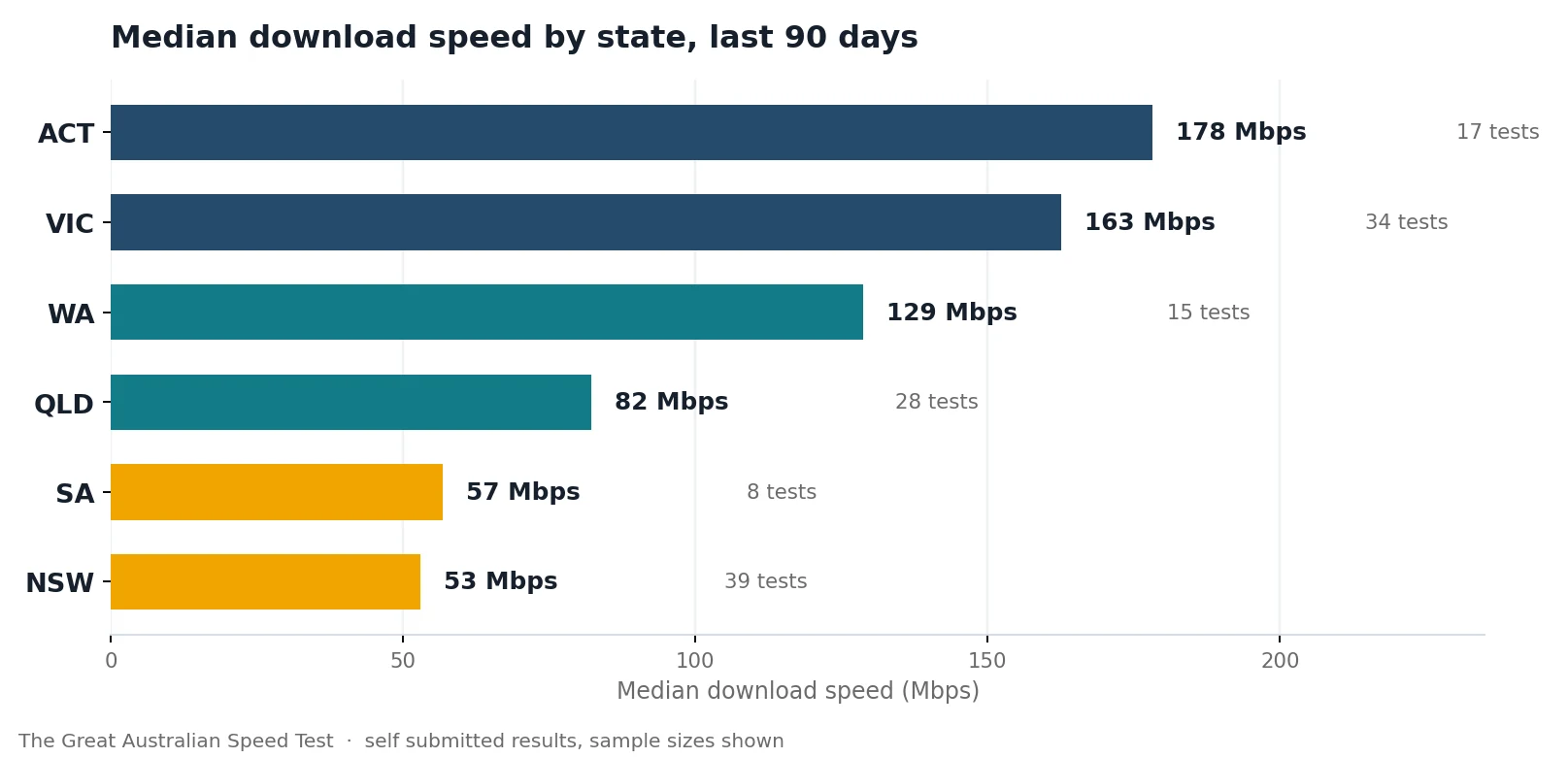
The ACT sitting on top is not really a surprise once you know that Canberra has an unusually high share of FTTP. Same story with Victoria. New South Wales at the bottom on 52.9 Mbps is a bigger sample, 39 tests, and probably reflects how much FTTN is still in the ground across Sydney.
Read those numbers with the sample sizes in mind. Seventeen tests in the ACT is enough to be interesting and not enough to be definitive. The Northern Territory and Tasmania have one test each, so they aren’t shown at all. A group has to clear a minimum before we’ll publish it, because below that it isn’t a comparison, it’s an anecdote.
The same rule applies to the provider rankings, with a higher bar. We won’t name a provider until at least 25 of its customers have tested and told us their plan tier. At the time of writing, none have cleared that, and the page says so rather than showing you a table built on four results.
That’ll feel slow. It’s deliberate. We earn commission from some of the providers who’ll eventually appear there, and publishing a thin, unfair number about a company is the fastest way to make the whole thing worthless.
Provider rankings are about delivery, not speed
When the provider rankings do go live, they won’t rank by raw speed. They’ll rank by how much of the advertised tier customers actually measured.
That’s a deliberate choice. Ranking by raw speed just tells you which providers sell the most gigabit plans. Ranking by delivery tells you something useful: a $69 NBN 50 plan delivering 48 out of 50 is doing better by its customers than a $109 plan delivering 380 out of 1000. The modest plan wins, which feels right, and it’s the ranking most people can actually act on.
Share your result, or challenge someone
Every result now gets a permanent link and a card built for sharing. That’s not decoration. “94 Mbps” means nothing to your mate. “Bottom 25% on FTTN 100” they get instantly.
There’s also a challenge link that carries your score, so whoever you send it to sees the number to beat before they test. To be honest, this is the part I’m most curious about. It either travels or it doesn’t, and we’ll know in a month.
What’s next
The rankings get better as more people test. That’s not a marketing line, it’s arithmetic: a postcode needs eight results before it appears, a provider needs 25, a monthly champion needs 20 in a single month. Right now most of those are empty and the page tells you exactly how many more it needs rather than pretending.
If you want to see where your street sits, the fastest way is to run it and send it to a neighbour.
Run the speed test · See the rankings · How we measure
Frequently asked questions
Why does the speed test ask for my postcode?
So the comparison means something. Your postcode lets us rank you against people near you and work out the typical evening speed for your NBN tier and area. It is the only thing we ask before the test.
How do you know which provider I am on?
From your connection’s network identity, checked across the ISP name, the organisation, the network operator and the autonomous system number together. Checking them together matters because brands like Belong and Exetel run on other companies’ networks.
Why is my result compared to my plan tier rather than to everyone?
Because comparing an FTTN NBN 50 line to an FTTP gigabit line tells neither person anything. Ranking you against people on the same technology and the same plan is the comparison that can actually tell you whether something is wrong.
What results do you exclude from the rankings?
VPN and proxy connections, datacentre and hosting connections, OBBR Pulse monitoring runs, and any result where the plan tier you told us is impossible for the speed measured. In the last 90 days that is 131 of 274 results.
Is the data representative of Australia?
No, and we say so. Everyone in the data chose to run a speed test, which is a self selected sample. People tend to test when something feels wrong, and people with fast connections enjoy testing. We publish the sample size next to every figure.