Last updated: 22 August 2026
The NBN offers eight standard speed tiers in 2026: NBN 25, 50, 100, 250, 500, 750, 1000 and 2000. NBN 50 is the sweet spot for most Australian households, with ongoing prices from $70/month. NBN 25 is the entry level option from $50/month. NBN 100 (from $84/month) is the right pick for larger households with multiple streamers or gamers. NBN 250 and above are only available on FTTP and newer HFC connections, and most homes don’t need them.
This guide covers every tier with current 2026 prices, what each one suits, and which provider is the best pick at each speed. For the broader question of how to compare plans, see our how to compare and choose an NBN plan guide.
NBN speed tiers at a glance
NBN plans come in eight standard speeds. The table below shows each tier, what it is best for, and what it costs. The price column is read from our plan database every time this page loads, so it is the live market rather than a figure from whenever we last edited the article.
Not every tier is available at every address. Your NBN connection type determines what you can actually use. FTTN, FTTC and FTTB are capped at NBN 100 even if the plan exists. Fixed wireless now goes higher, with the new Fixed Wireless tiers reaching 250 and 400 Mbps.
Pricing by tier in 2026
Those bars are read straight from our plan database every time this page loads, so they are current rather than a snapshot from whenever we last updated the article.
The thing worth noticing is how much the bars overlap. The spread inside a single tier is often wider than the step up to the next one, which means the provider you choose usually moves your bill more than the speed tier does. Paying at the top of a tier should buy you better evening speeds and Australian based support. It does not always, which is why the reviews matter as much as the price.
If you are shopping on price, these are the cheapest unlimited plans from providers we partner with, sorted live:
Real evening speeds by tier
The advertised speed on a plan is the maximum. What you actually get during peak hours (7–11pm) is usually a bit lower because everyone in your area is online at the same time. The ACCC publishes quarterly evening speed reports that track real world performance for each provider.
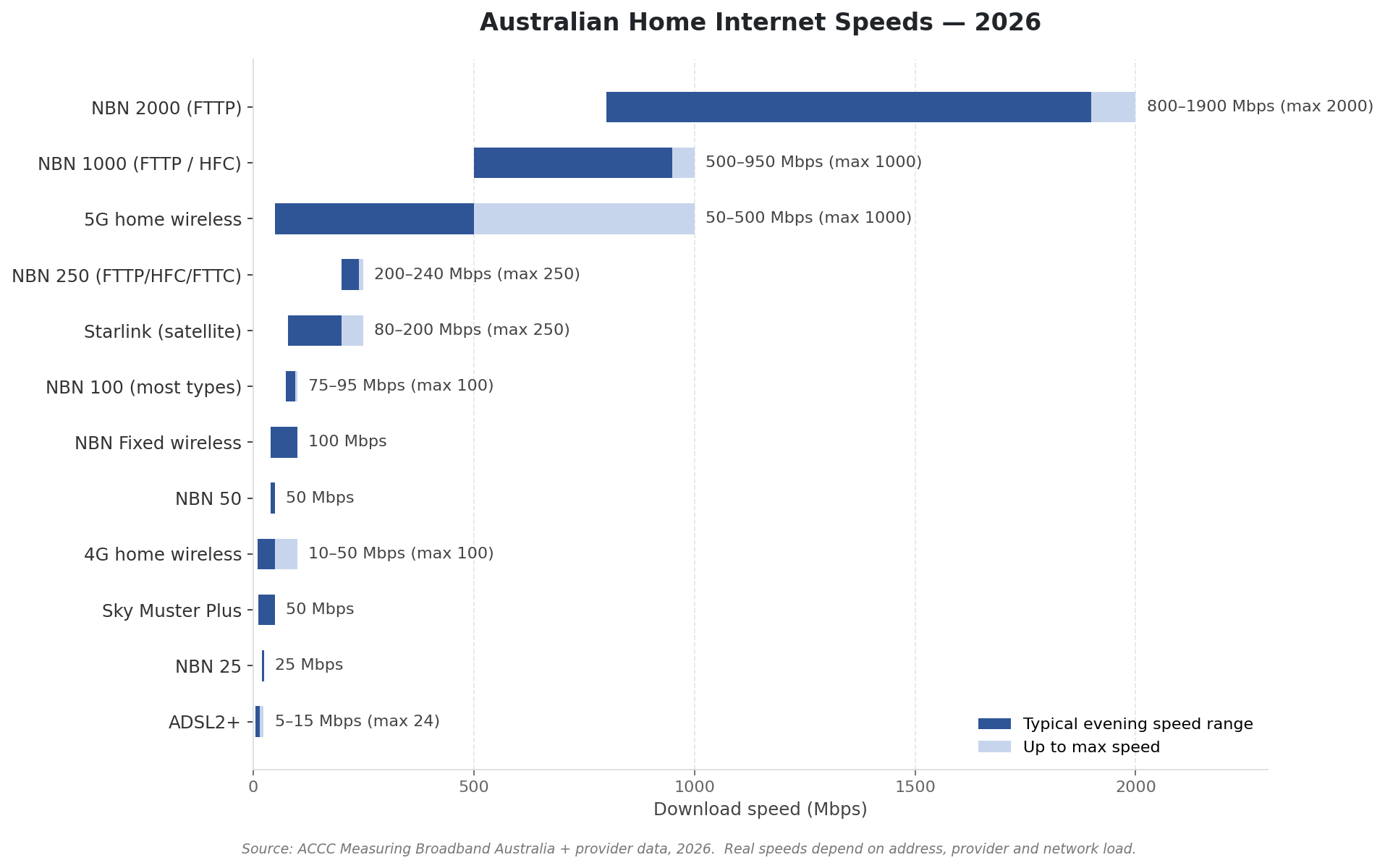
For full detail across all connection types and providers, see our Australian internet speed comparison.
NBN 25 — for whom?
The entry-level tier. 25 Mbps download is enough for one person who doesn’t game and only streams in HD. Couples can usually get by on it too if they don’t both video-call at once. Not enough for families or 4K streaming.
Cheapest options: Tangerine, Activ8me, Superloop.
NBN 50 — for whom?
The most popular tier in Australia. Right choice for most households of 2–4 people. Handles two simultaneous HD video calls plus the usual browsing and streaming. Works comfortably for working from home.
Best picks: Superloop, Tangerine, Aussie Broadband.
NBN 100 — for whom?
For larger households (4+ people), regular 4K streaming on multiple TVs at once, gaming households, or sharehouses. Around half of Australian households who care about speed end up here. NBN 100 is also a smart upgrade from NBN 50 if you spend a lot of time uploading large files.
Best picks: Aussie Broadband, Superloop.
NBN 250 — for whom?
Only available on FTTP and HFC connections. Heavy users who push a lot of data. Video editors uploading project files, content creators, multi-user 4K streaming households. Most homes don’t need this much.
Best picks: Aussie Broadband, Superloop.
NBN 500 — for whom?
The tier created by the 2025 NBN speed upgrades, when the wholesale NBN 100 products were bumped to 500/50 on capable lines. Where your address supports it (FTTP and newer HFC), NBN 500 is often the best dollar per megabit on the whole network. Exetel’s One Plan at $80/month flat is the standout deal here.
Best picks: Exetel, Tangerine, Aussie Broadband.
NBN 750 — for whom?
The upgrade path from the old NBN 250 tier, again only on FTTP and newer HFC. Heavy downloaders and bigger households who want real headroom without paying gigabit money.
Best picks: Superloop, SpinTel.
NBN 1000 — for whom?
Power users on FTTP or HFC who want gigabit speeds. Worth it for large multi-user households doing simultaneous 4K streaming + large file uploads + gaming, or for small home offices with cloud heavy workflows. Overkill for almost everyone else.
Best picks: Aussie Broadband, Superloop.
NBN 2000 — for whom?
The newest tier. Available on FTTP connections and, with some providers, newer HFC. 2 Gbps download and 100 Mbps upload. For most people this is well beyond useful, but it’s there for power users and businesses.
Best picks: Superloop, Mate, Aussie Broadband.
Which NBN tier should I get?
Quick decision guide based on household size and use:
- 1 person, browsing + Netflix: NBN 25
- 1 person on video calls daily: NBN 50
- Couple or small family (2–3 people): NBN 50
- Family of 4+ with 4K streaming and gaming: NBN 100
- Sharehouse (4+ adults): NBN 100
- Heavy uploaders (video editors, content creators): NBN 250 or 1000
- Cloud-heavy work-from-home setup: NBN 100 or 250
For a deeper buyer’s guide that walks through the entire selection process, see our how to compare NBN plans guide. To explore plans interactively, use our full plan comparison tool. You can filter by speed tier, price, data and provider.
Looking for the cheapest or fastest?
Two specific cuts of the data worth knowing:
- Cheapest NBN plans — our 10 cheapest unlimited NBN plans guide ranks the absolute lowest-priced options across all tiers.
- Fastest NBN plans — our fastest NBN plan available guide tracks the providers with the highest typical evening speeds, based on ACCC data.
Our editor’s picks
The plans below are pulled live from our database. We’ve filtered for plans from providers we recommend with unlimited data. A good starting point if you don’t want to drill through the full comparison tool.
For a full filterable view of every NBN plan available in Australia, browse our comparison tool or the best NBN plans page.
Frequently asked questions
What’s the most popular NBN plan in Australia?
NBN 50 is the most subscribed tier nationally, followed by NBN 100. Together they cover the majority of fixed-line NBN customers.
What does NBN 100 actually cost?
$84 to $114 a month as at August 2026, across the 22 fixed line NBN 100 plans in our database. Carbon Comms, Kogan and Moose Mobile sit at the low end, Mate and Aussie Broadband at the top. The price chart earlier in this article reads live from our database, so it always shows the current range.
Is NBN 1000 worth the extra cost?
For most homes, no. NBN 1000 makes sense if you’ve got multiple 4K streams running simultaneously, you upload very large files routinely, or you’re running a small home business. For typical household use, NBN 50 or 100 is plenty.
Can I get NBN 1000 at my address?
Only if you’re on FTTP or HFC. FTTN, FTTC, FTTB, fixed wireless and Sky Muster customers are limited to NBN 100 or below. Check via the NBN Co address checker.
What’s the difference between NBN 25 and NBN 50?
Double the download speed (25 vs 50 Mbps) and four times the upload (5 vs 20 Mbps). Upload is the more practical difference if you do video calls regularly. NBN 25’s 5 Mbps upload is borderline for HD video conferencing.
Can I change my NBN plan?
Yes, easily. Most NBN plans are month-to-month, so you can change tiers or providers any time. If you have a contract, check whether there’s a termination fee. Speed changes within the same provider usually happen overnight.
What’s the average NBN speed Australians get?
Weighted by tier subscriptions, the national average sits around 75–95 Mbps download in 2026. Most users are on NBN 50 or 100, and the better providers deliver close to the advertised maximum during evening peak. See our Australian internet speed comparison for full detail.
For broader context: our NBN vs Broadband vs Wireless hub covers whether NBN is even the right choice for you (vs 5G home wireless or Starlink). To pick a plan now, use the NBN plan finder or comparison tool.